

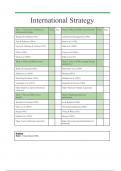
International Strategy
Week 1: Theoretical Foundation of Read Page Week 4: When do MNEs invest abroad? Read Page
international strategy
Rugman & Verbeke (1992) Lieberman & Montgomery (1988)
Foss & Pedersen (2004) Kerin et al. (1992)
Cantwell, Dunning & Lundan (2010) Gaba et al. (2002)
Porter (1986) Frynas et al. (2006)
Ghemawat (2008) Case: CircusTrix
Week 2: Where do MNEs invest? Week 5: How do MNEs manage foreign
subsidiaries?
Benito & Gripsrud (1992) Birkinshaw et al. (1998)
Mariotti et al. (2010) Harzing (2001)
Demirbag & Glaiser (2010) Minbaeva et al. (2003)
Laamanen et al. (2012) Mudambi & Navarra (2004)
Case: Qualtrics; rapid international Case: Walmarts Flipkart Acquisition
expansion
Week 3: How do MNEs invest Week 6: Multinationality and
abroad? performance
Brouthers & Hennart (2007) Lu & Beamish (2004)
Meyer et al. (2009) Vermeulen & Barkema (2002)
Kogut (1991) Chang & Rhee (2011)
Ghubbi et al. (2010) Hennart (2007)
Case: Costco wholesale coporation Case: Resuming internationalization at
Starbucks
Grading
Exam - essay based, 60%
, Week 1 - Theoretical Foundation of IS
1.1 Lecture
What do we know about MNEs?
- From 1980s: Industry based view (Porter)
- Industry level, competitiveness
- From 1990s: Resource based view (Barney)
- VRIO model, capabilities of firm to recombine resources, tangible/intangible resources
- From 2000s: Institution based view (North, Scott, Peng)
- Regulative, normative and cognitive structures that provide stability and change
circumstance
→ Evolution from market-focus to MNE-focus
Revisiting the OLI Framework
OLI does not say how to go abroad, what are the implications - only says, why? how? where?
1.2 Tutorial
Peter Kersten - Guest lecturer
- 4 main questions
- Why is there internationalization?
- Employee value proposition, what value does company offer
- Support structures and cost
- Management perception and view
- Where do they go?
- When / timing: yes important to consider workforce when going timing abroad
- Labor cost change bc. of inflation
- People have Training / knowledge - uppsala
- local situation e.g. local lockdowns, political hostility
- Institutions might change e.g. Joint venture - employees will be affected
- Upcoming changes in laws
- Company culture if they do not have international mindset
- How to people factor influence it and how is it done? What are the pitfalls?
,1.3 Knowledge clips
1) Globalisation: Room for MNE strategy
- Example: Toyota is japanese, manufacturing is done in XY, Engine is made in XY, Headlights in
XY or 69% of Kuwaitis are foreigners
- Process where countries become closer in a number of areas
- Internationalisation: Extension of economic activities across border - globalisation more as it has
functional integration it is a process
- Debate 1: Hyperglobalists vs sceptics
- See same products all over the world, homogeneous tastes, standardisation
- Globalisation is a myth - world is more globalised in the past than it is now
- Debate 2: End of globalisation? Brexit, US going away (Nationalist stance)
- Debate 3: Is globalisation good for the world? Sustainability etc.
- Regionalization vs. globalization
2) MNE acitivities across the globe
- Global value chain: Cars is being made in multiple countries, therefore it is a global value chain
as it contributes to multiple economies (e.g. labour work)
- Why are global value chains complex? MNEs activities are distributed geographically and
organizationally (outsourcing vs subsidiaries) / Cultural differences → High coordination costs
- How do MNEs make strategic decisions about global value chain activities?
3 decision drivers (OLI) need to be interconnected
- FSA - e.g. IKEA furniture, can also be developed in subsidiaries and transferred into
MNE network (Location and non-location bound)
- CSA - e.g. Saudi Arabian oil industry, gain new FSAs
- Internationalization advantages - E.g. Amazon & Wholefoods, went from online
shopping into food
- Non location bound FSA: Unilever - brand name, high internationalised and global
- Location bound FSA: Unilever products - adapting product to local market
3) Formulating international strategies
- Need to determine how to organize international activities
- How to leverage differences in countries
, - Multidomestic industries: Cannot transfer company from Country A to B - example: Insurance
companies (Alliance)
- Global industries: crossing national borders, strategies fit different markets served by firm e.g.
electronic consumer equipment (Apple)
- Porter Value chain
- Want to lower costs and have superior coordination compared to competitors
- Firm competing internationally must decide how to spread activities in value chain
among countries
- Configuration (concentrated vs dispersed)
- Geography of activties
- Lightest version: Exporting as you dont move geographically
- Coordination (market vs internalization)
- Governance of activities
- Ghemawat : Differences countries have to create value
- AAA framework
- Adaptation: local responsiveness, adjust to differences
- Aggregation: scale and scome economies, overcome differences
- Arbitrage: exploiting differences
4) International strategy types
MNEs in a globalised world - Bartlett & Ghoshal
Global integration
- Global integration allows for global value chain, global
factory
- Economies of scale - need for efficiency
- Standardization of products - lowers costs, large scale to
manufacture at low cost
- Competition at a global scale
Local responsiveness
- Different preferences based on consumer tastes e.g. sweeter cokes in south america than Europe
- Differences in infrastructure, business practices etc.
- Adjust products to meet local demand → MNEs follow different global strategies based on in
responsive to local pressures
Week 1: Theoretical Foundation of Read Page Week 4: When do MNEs invest abroad? Read Page
international strategy
Rugman & Verbeke (1992) Lieberman & Montgomery (1988)
Foss & Pedersen (2004) Kerin et al. (1992)
Cantwell, Dunning & Lundan (2010) Gaba et al. (2002)
Porter (1986) Frynas et al. (2006)
Ghemawat (2008) Case: CircusTrix
Week 2: Where do MNEs invest? Week 5: How do MNEs manage foreign
subsidiaries?
Benito & Gripsrud (1992) Birkinshaw et al. (1998)
Mariotti et al. (2010) Harzing (2001)
Demirbag & Glaiser (2010) Minbaeva et al. (2003)
Laamanen et al. (2012) Mudambi & Navarra (2004)
Case: Qualtrics; rapid international Case: Walmarts Flipkart Acquisition
expansion
Week 3: How do MNEs invest Week 6: Multinationality and
abroad? performance
Brouthers & Hennart (2007) Lu & Beamish (2004)
Meyer et al. (2009) Vermeulen & Barkema (2002)
Kogut (1991) Chang & Rhee (2011)
Ghubbi et al. (2010) Hennart (2007)
Case: Costco wholesale coporation Case: Resuming internationalization at
Starbucks
Grading
Exam - essay based, 60%
, Week 1 - Theoretical Foundation of IS
1.1 Lecture
What do we know about MNEs?
- From 1980s: Industry based view (Porter)
- Industry level, competitiveness
- From 1990s: Resource based view (Barney)
- VRIO model, capabilities of firm to recombine resources, tangible/intangible resources
- From 2000s: Institution based view (North, Scott, Peng)
- Regulative, normative and cognitive structures that provide stability and change
circumstance
→ Evolution from market-focus to MNE-focus
Revisiting the OLI Framework
OLI does not say how to go abroad, what are the implications - only says, why? how? where?
1.2 Tutorial
Peter Kersten - Guest lecturer
- 4 main questions
- Why is there internationalization?
- Employee value proposition, what value does company offer
- Support structures and cost
- Management perception and view
- Where do they go?
- When / timing: yes important to consider workforce when going timing abroad
- Labor cost change bc. of inflation
- People have Training / knowledge - uppsala
- local situation e.g. local lockdowns, political hostility
- Institutions might change e.g. Joint venture - employees will be affected
- Upcoming changes in laws
- Company culture if they do not have international mindset
- How to people factor influence it and how is it done? What are the pitfalls?
,1.3 Knowledge clips
1) Globalisation: Room for MNE strategy
- Example: Toyota is japanese, manufacturing is done in XY, Engine is made in XY, Headlights in
XY or 69% of Kuwaitis are foreigners
- Process where countries become closer in a number of areas
- Internationalisation: Extension of economic activities across border - globalisation more as it has
functional integration it is a process
- Debate 1: Hyperglobalists vs sceptics
- See same products all over the world, homogeneous tastes, standardisation
- Globalisation is a myth - world is more globalised in the past than it is now
- Debate 2: End of globalisation? Brexit, US going away (Nationalist stance)
- Debate 3: Is globalisation good for the world? Sustainability etc.
- Regionalization vs. globalization
2) MNE acitivities across the globe
- Global value chain: Cars is being made in multiple countries, therefore it is a global value chain
as it contributes to multiple economies (e.g. labour work)
- Why are global value chains complex? MNEs activities are distributed geographically and
organizationally (outsourcing vs subsidiaries) / Cultural differences → High coordination costs
- How do MNEs make strategic decisions about global value chain activities?
3 decision drivers (OLI) need to be interconnected
- FSA - e.g. IKEA furniture, can also be developed in subsidiaries and transferred into
MNE network (Location and non-location bound)
- CSA - e.g. Saudi Arabian oil industry, gain new FSAs
- Internationalization advantages - E.g. Amazon & Wholefoods, went from online
shopping into food
- Non location bound FSA: Unilever - brand name, high internationalised and global
- Location bound FSA: Unilever products - adapting product to local market
3) Formulating international strategies
- Need to determine how to organize international activities
- How to leverage differences in countries
, - Multidomestic industries: Cannot transfer company from Country A to B - example: Insurance
companies (Alliance)
- Global industries: crossing national borders, strategies fit different markets served by firm e.g.
electronic consumer equipment (Apple)
- Porter Value chain
- Want to lower costs and have superior coordination compared to competitors
- Firm competing internationally must decide how to spread activities in value chain
among countries
- Configuration (concentrated vs dispersed)
- Geography of activties
- Lightest version: Exporting as you dont move geographically
- Coordination (market vs internalization)
- Governance of activities
- Ghemawat : Differences countries have to create value
- AAA framework
- Adaptation: local responsiveness, adjust to differences
- Aggregation: scale and scome economies, overcome differences
- Arbitrage: exploiting differences
4) International strategy types
MNEs in a globalised world - Bartlett & Ghoshal
Global integration
- Global integration allows for global value chain, global
factory
- Economies of scale - need for efficiency
- Standardization of products - lowers costs, large scale to
manufacture at low cost
- Competition at a global scale
Local responsiveness
- Different preferences based on consumer tastes e.g. sweeter cokes in south america than Europe
- Differences in infrastructure, business practices etc.
- Adjust products to meet local demand → MNEs follow different global strategies based on in
responsive to local pressures



