Link Reaction
Stages of Link Reaction
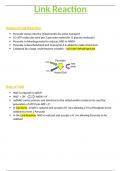
Pyruvate moves into the mitochondria by active transport
0.5 ATP molecules used per 2 pyruvate molecules (1 glucose molecule)
Pyruvate is dehydrogenated to reduces NAD to NADH
Pyruvate is decarboxylated and Coenzyme A is added to make Acetyl CoA
Catalysed by a large, multi-enzyme complex – pyruvate dehydrogenase
CoA
Pyruvate
NAD
NADH
CO₂
Acetyl CoA
Role of NAD
NAD is reduced to NADH
NAD⁺ + 2H⁻ NADH + H⁻
redNAD carries protons and electrons to the mitochondria cristae to be used for
generation of ATP from ADP + P
in Glycolysis, 2 NAD is reduced and accepts 2H⁻ ions allowing 2 Trios Phosphate to be
oxidised to form 2 Pyruvate
In the Link Reaction, NAD is reduced and accepts a H⁻ ion allowing Pyruvate to be
oxidised
Stages of Link Reaction
Pyruvate moves into the mitochondria by active transport
0.5 ATP molecules used per 2 pyruvate molecules (1 glucose molecule)
Pyruvate is dehydrogenated to reduces NAD to NADH
Pyruvate is decarboxylated and Coenzyme A is added to make Acetyl CoA
Catalysed by a large, multi-enzyme complex – pyruvate dehydrogenase
CoA
Pyruvate
NAD
NADH
CO₂
Acetyl CoA
Role of NAD
NAD is reduced to NADH
NAD⁺ + 2H⁻ NADH + H⁻
redNAD carries protons and electrons to the mitochondria cristae to be used for
generation of ATP from ADP + P
in Glycolysis, 2 NAD is reduced and accepts 2H⁻ ions allowing 2 Trios Phosphate to be
oxidised to form 2 Pyruvate
In the Link Reaction, NAD is reduced and accepts a H⁻ ion allowing Pyruvate to be
oxidised