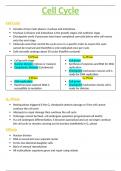
Cell Cycle
Cell Cycle
Consists of two main phases: m-phase and interphase
M-phase is division and interphase is the growth stages and synthesis stage
Checkpoints verify if processes have been completed correctly before ethe cell moves
onto the next stage
Molecule evets that control the cycle occur in a specific order to ensure the cycle
cannot be reversed and that DNA is only replicated once per cycle
Cells normally undergo about 50 cycles (Hayflick constant)
M-Phase G₁-Phase
Cell growth stops Cell grows
Nuclear division (mitosis or meiosis) Synthesis of enzymes and RNA for DNA
Cytoplasmic Division (Cytokinesis) replication
Checkpoint mechanism ensures cell is
ready for DNA replication
S-Phase G₂-Phase
DNA replication Cell grows
Rapid because exposed DNA is Checkpoint mechanism checks cell is
susceptible to mutation ready for division
G₀-Phase
Resting phase triggered if the G₁ checkpoint detects damage or if the cell cannot
continue the cell cycle
Attempts to repair damage then continue the cell cycle
If damage cannot be fixed, cell undergoes apoptosis (programmed cell death)
If a cell undergoes differentiation, it becomes specialised and can no longer continue
the cell cycle so remains carrying out its function indefinitely in G₀-phase
Mitosis
Nuclear division
DNA is moved into two separate nuclei
Forms two identical daughter cells
Basis of asexual reproduction
All multicellular organisms grow and repair using mitosis
Cell Cycle
Consists of two main phases: m-phase and interphase
M-phase is division and interphase is the growth stages and synthesis stage
Checkpoints verify if processes have been completed correctly before ethe cell moves
onto the next stage
Molecule evets that control the cycle occur in a specific order to ensure the cycle
cannot be reversed and that DNA is only replicated once per cycle
Cells normally undergo about 50 cycles (Hayflick constant)
M-Phase G₁-Phase
Cell growth stops Cell grows
Nuclear division (mitosis or meiosis) Synthesis of enzymes and RNA for DNA
Cytoplasmic Division (Cytokinesis) replication
Checkpoint mechanism ensures cell is
ready for DNA replication
S-Phase G₂-Phase
DNA replication Cell grows
Rapid because exposed DNA is Checkpoint mechanism checks cell is
susceptible to mutation ready for division
G₀-Phase
Resting phase triggered if the G₁ checkpoint detects damage or if the cell cannot
continue the cell cycle
Attempts to repair damage then continue the cell cycle
If damage cannot be fixed, cell undergoes apoptosis (programmed cell death)
If a cell undergoes differentiation, it becomes specialised and can no longer continue
the cell cycle so remains carrying out its function indefinitely in G₀-phase
Mitosis
Nuclear division
DNA is moved into two separate nuclei
Forms two identical daughter cells
Basis of asexual reproduction
All multicellular organisms grow and repair using mitosis