Psychodynamic
Approaches AO1
- Sigmund Freud
- Id – primitive, pleasure principle
- Ego – reality principle, defensive
mechanisms
Origins
- Superego – morality principle
- Wilhelm Wundt’s lab first psychology lab - 5 Psychosexual Stages - conflict at each
in Leipzig stage leads to fixation
- Introspection – study human mind - Oedipus/Electra complex
systematically
- Standardized Procedures
- Structuralism – divided human mind into Humanistic
categories
- Focuses on the whole
- People are active agents who are self-
determining
Behaviourist
- Maslow’s hierarchy of needs;
- Two-process model physiological, safety/security,
- Classical conditioning – Pavlov’s dogs love/belongingness, self-esteem, self-
- Operant conditioning – Skinner’s rats actualisation
Social Learning Theory Comparison of Approaches
- Learned through observation and - Determinist: Behaviourist/SLT
imitation (environmental), Biological (biological),
- Vicarious reinforcement (Bandura’s Bobo Psychodynamic (psychic)
doll) - Free Will: Cognitive, Humanistic
- Mediational Processes – attention, - Reductionist: Behaviourist/SLT
retention, motivation, motor (environmental), Biological (biological),
reproduction Psychodynamic, Cognitive (machine)
- Identification with role models - Holistic: Humanistic
- Nature: Cognitive, Biological,
Psychodynamic, Humanistic
- Nurture: Behaviourist, SLT
Cognitive
- Nomothetic: Behaviourist, SLT, Cognitive,
- Study internal mental processes through Biological
inference - Idiographic: Psychodynamic, Humanistic
- Schema – mental shortcut/blueprint
- Theoretical and computer models – mind
is like a computer – applied to AI
- Emergence of cognitive neuroscience
Biological
- Dependent on chemicals
- Genetic basis (twin studies)
- Genotype/Phenotype = Nature/Nurture
- Evolutionary basis
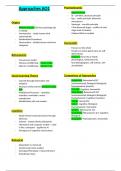
Approaches AO1
- Sigmund Freud
- Id – primitive, pleasure principle
- Ego – reality principle, defensive
mechanisms
Origins
- Superego – morality principle
- Wilhelm Wundt’s lab first psychology lab - 5 Psychosexual Stages - conflict at each
in Leipzig stage leads to fixation
- Introspection – study human mind - Oedipus/Electra complex
systematically
- Standardized Procedures
- Structuralism – divided human mind into Humanistic
categories
- Focuses on the whole
- People are active agents who are self-
determining
Behaviourist
- Maslow’s hierarchy of needs;
- Two-process model physiological, safety/security,
- Classical conditioning – Pavlov’s dogs love/belongingness, self-esteem, self-
- Operant conditioning – Skinner’s rats actualisation
Social Learning Theory Comparison of Approaches
- Learned through observation and - Determinist: Behaviourist/SLT
imitation (environmental), Biological (biological),
- Vicarious reinforcement (Bandura’s Bobo Psychodynamic (psychic)
doll) - Free Will: Cognitive, Humanistic
- Mediational Processes – attention, - Reductionist: Behaviourist/SLT
retention, motivation, motor (environmental), Biological (biological),
reproduction Psychodynamic, Cognitive (machine)
- Identification with role models - Holistic: Humanistic
- Nature: Cognitive, Biological,
Psychodynamic, Humanistic
- Nurture: Behaviourist, SLT
Cognitive
- Nomothetic: Behaviourist, SLT, Cognitive,
- Study internal mental processes through Biological
inference - Idiographic: Psychodynamic, Humanistic
- Schema – mental shortcut/blueprint
- Theoretical and computer models – mind
is like a computer – applied to AI
- Emergence of cognitive neuroscience
Biological
- Dependent on chemicals
- Genetic basis (twin studies)
- Genotype/Phenotype = Nature/Nurture
- Evolutionary basis