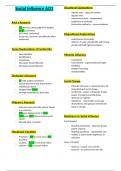
Situational Explanations
Social Influence AO1
- Agentic state – agent of another
- Agentic shift
- Autonomous state – independent
- Legitimacy of authority
Asch’s Research
- Destructive authority – causes problems
- 123 American men judged line lengths
- 36.8% conformity
- 25% never conformed Dispositional Explanations
- Group size, dissenter and difficulty affect
conformity - Authoritarian Personality
- Adorno’s F-scale -Aps identify with strong
people and hold rigid stereotypes
Types/Explanations of Conformity
- Internalisation Minority Influence
- Identification
- Compliance - Consistency
- Normative Social Influence - Commitment - augmentation principle
- Normative Social Influence - Flexibility
- Deeper Processing
- Snowball Effect
Zimbardo’s Research
- 21 male student volunteers Social Change
- Guards became brutal and prisoner’s
rebellion put down - Minority influence is a powerful force for
- Stopped after 6 days innovation and social change
- Strongly conformed to their roles - Conformity - power of dissenter breaks
power of majority and NSI draws
attention to majority
- Obedience – role models encourage
Milgram’s Research disobedience and gradual commitment
- American men gave fake electric shocks leads to change
in a university
- 65% gave highest shock of 450V
- 100% gave 300V (where learner went Resistance to Social Influence
silent)
- Showed signs of anxiety Social Support
- Resisting conformity – dissenter breaks
power of group
Situational Variables - Resisting obedience – disobedient role
models or peers breaks legitimacy of
- Proximity – 40% in same room, 30% authority
touching
- Location – 47.5% in run down office Locus of Control
- Uniform – 20% in casual clothes - Internal – control over own life
- External – no control over own life
Social Influence AO1
- Agentic state – agent of another
- Agentic shift
- Autonomous state – independent
- Legitimacy of authority
Asch’s Research
- Destructive authority – causes problems
- 123 American men judged line lengths
- 36.8% conformity
- 25% never conformed Dispositional Explanations
- Group size, dissenter and difficulty affect
conformity - Authoritarian Personality
- Adorno’s F-scale -Aps identify with strong
people and hold rigid stereotypes
Types/Explanations of Conformity
- Internalisation Minority Influence
- Identification
- Compliance - Consistency
- Normative Social Influence - Commitment - augmentation principle
- Normative Social Influence - Flexibility
- Deeper Processing
- Snowball Effect
Zimbardo’s Research
- 21 male student volunteers Social Change
- Guards became brutal and prisoner’s
rebellion put down - Minority influence is a powerful force for
- Stopped after 6 days innovation and social change
- Strongly conformed to their roles - Conformity - power of dissenter breaks
power of majority and NSI draws
attention to majority
- Obedience – role models encourage
Milgram’s Research disobedience and gradual commitment
- American men gave fake electric shocks leads to change
in a university
- 65% gave highest shock of 450V
- 100% gave 300V (where learner went Resistance to Social Influence
silent)
- Showed signs of anxiety Social Support
- Resisting conformity – dissenter breaks
power of group
Situational Variables - Resisting obedience – disobedient role
models or peers breaks legitimacy of
- Proximity – 40% in same room, 30% authority
touching
- Location – 47.5% in run down office Locus of Control
- Uniform – 20% in casual clothes - Internal – control over own life
- External – no control over own life