Standard Electrode Potential
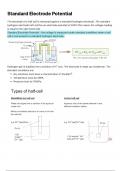
The electrode of a half cell is measured against a standard hydrogen electrode. The standard
hydrogen electrode half cell has an electrode potential of 0.00V this means the voltage reading
is equal to the right hand side.
Standard Electrode Potential - the voltage is measured under standard conditions when a half
cell is connected to a standard hydrogen electrode.
Hydrogen gas is bubbled into a solution of H+ ions. The electrode is made up of platinum. The
standard conditions are:
Any solutions must have a concentration of 1mol/dm3.
Temperature must be 298K.
Pressure must be 100kPa.
The electrode of a half cell is measured against a standard hydrogen electrode. The standard
hydrogen electrode half cell has an electrode potential of 0.00V this means the voltage reading
is equal to the right hand side.
Standard Electrode Potential - the voltage is measured under standard conditions when a half
cell is connected to a standard hydrogen electrode.
Hydrogen gas is bubbled into a solution of H+ ions. The electrode is made up of platinum. The
standard conditions are:
Any solutions must have a concentration of 1mol/dm3.
Temperature must be 298K.
Pressure must be 100kPa.