
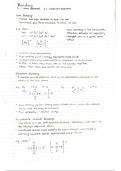
Bond1ng
3.1 1ONIC 8ONDING, 3.2 COVALENTt BONDIN
lonc Bond1ng!
- Metals lose outer electrons. to form +ve ions
Non metals gan these electrons to form -ve ions
eg. Na Cl lonic bonding is the elecdrostatic
Na ls 2st 2p 3s' atration between all oppositely
Cl ls 2s 2,6 3s3 3p Uharged 1ons in a g1ant 10nIc
Lattice
- Sohd at room temperature
High melt1ng pont -energy requred to break bonds
* Conduct electricity when molten or dissolved - ons ca move
Brtle - a blow ey move 1ons of lulke charaes togefher,
which then repeland shater the structure
Covalent Bond1ng
Ashaed paur of electrons, held by the electrostat1c atracton to the
nudei of the two atoms
e.g. H2 HH H- H
HC *H H -C-H
- Low melt1ng ponts - strong bonds between atoms, weale ntermoleular
forces that are easy to ove cOme
Poor cond uctors neutral charge
Co-ord1nate (D ative) Bond1ngt
- One atom provides both electrons to share donating a lone pair to
the electron defIcient atom
(oordinate bonds have exactly the same strength and length as
oroinary covalent bonds between the same atoms
+
I-Z-I
H
H* H -N’ H
H N ’
, 3.3. METALLIC BOND|NG
in a metal element,outer electron shells merae to fornm a sea ot delocal1sed
electrons around alatiice of tve metal ons.
Má
e e
e
giant metallie structure
Good conductor ot electricitu and heat delocalised electrons move
Strength depends ondi charge (stronge chaye, stronger attracion)
and sie (smaller atom,stronger bond)
Melleable and ductle
Hign met1ng and bo1ling points hord to separate otoms due to
strong atroction.
3.1 1ONIC 8ONDING, 3.2 COVALENTt BONDIN
lonc Bond1ng!
- Metals lose outer electrons. to form +ve ions
Non metals gan these electrons to form -ve ions
eg. Na Cl lonic bonding is the elecdrostatic
Na ls 2st 2p 3s' atration between all oppositely
Cl ls 2s 2,6 3s3 3p Uharged 1ons in a g1ant 10nIc
Lattice
- Sohd at room temperature
High melt1ng pont -energy requred to break bonds
* Conduct electricity when molten or dissolved - ons ca move
Brtle - a blow ey move 1ons of lulke charaes togefher,
which then repeland shater the structure
Covalent Bond1ng
Ashaed paur of electrons, held by the electrostat1c atracton to the
nudei of the two atoms
e.g. H2 HH H- H
HC *H H -C-H
- Low melt1ng ponts - strong bonds between atoms, weale ntermoleular
forces that are easy to ove cOme
Poor cond uctors neutral charge
Co-ord1nate (D ative) Bond1ngt
- One atom provides both electrons to share donating a lone pair to
the electron defIcient atom
(oordinate bonds have exactly the same strength and length as
oroinary covalent bonds between the same atoms
+
I-Z-I
H
H* H -N’ H
H N ’
, 3.3. METALLIC BOND|NG
in a metal element,outer electron shells merae to fornm a sea ot delocal1sed
electrons around alatiice of tve metal ons.
Má
e e
e
giant metallie structure
Good conductor ot electricitu and heat delocalised electrons move
Strength depends ondi charge (stronge chaye, stronger attracion)
and sie (smaller atom,stronger bond)
Melleable and ductle
Hign met1ng and bo1ling points hord to separate otoms due to
strong atroction.


