Water
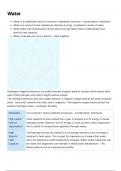
Water is a metabolite which is involved in metabolic reactions - condensation, hydrolysis.
Water is a solvent (some substances dissolve in it) eg. cytoplasm is made of water.
Water helps with temperature control due to its high latent heat of vaporisation and
specific heat capacity.
Water molecules are very cohesive - stick together.
Hydrogens negative electrons are pulled towards oxygens positive nucleus which leaves each
side of the hydrogen atom with a slight positive charge.
The unshared electrons give the oxygen electron a negative charge making the water molecule
polar - (one end is positive the other end is negative). The negative oxygen atoms attract the
positive hydrogen atoms - hydrogen bonding.
Metabolite It is involved in many metabolic processes - condensation, hydrolysis.
High Latent (Heat required to heat a liquid into a gas) It requires a lot of energy to break
Heat of hydrogen bonds therefore a lot of energy is used up when water evaporates -
Vaporisation this is useful for temperature regulation through sweat.
High The hydrogen bonds can absorb a lot of energy therefore a lot of energy is
Specific required to heat water. This is good for organisms as it means that water
Heat does not experience rapid temperature changes. Water inside organisms can
Capacity be stable and organisms can maintain a steady body temperature. This
allows water to act as a temperature buffer.
Water is a metabolite which is involved in metabolic reactions - condensation, hydrolysis.
Water is a solvent (some substances dissolve in it) eg. cytoplasm is made of water.
Water helps with temperature control due to its high latent heat of vaporisation and
specific heat capacity.
Water molecules are very cohesive - stick together.
Hydrogens negative electrons are pulled towards oxygens positive nucleus which leaves each
side of the hydrogen atom with a slight positive charge.
The unshared electrons give the oxygen electron a negative charge making the water molecule
polar - (one end is positive the other end is negative). The negative oxygen atoms attract the
positive hydrogen atoms - hydrogen bonding.
Metabolite It is involved in many metabolic processes - condensation, hydrolysis.
High Latent (Heat required to heat a liquid into a gas) It requires a lot of energy to break
Heat of hydrogen bonds therefore a lot of energy is used up when water evaporates -
Vaporisation this is useful for temperature regulation through sweat.
High The hydrogen bonds can absorb a lot of energy therefore a lot of energy is
Specific required to heat water. This is good for organisms as it means that water
Heat does not experience rapid temperature changes. Water inside organisms can
Capacity be stable and organisms can maintain a steady body temperature. This
allows water to act as a temperature buffer.