

5. Bubble drawn into capillary tube by syringe;
6. Measure length of bubble;
7. After certain length of time;
8. Calculate volume of oxygen (length of bubble x area of capillary tube lumen);
9. Repeat; ignore anomalies, calculate mean
10. Move lamp set distances towards plant e.g.10, 20, 30, 40cm;
2
11. Use a light meter to measure intensity or light intensity proportional to 1/d ;
12. Let apparatus settle at a constant rate at each distance;
13. Monitor temperature changes with a thermometer;
14. Control variables;
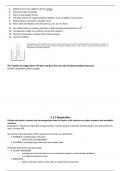
The apparatus pictured left could also be used to measure the rate of photosynthesis by counting the number of
bubbles of oxygen produced per unit time. However, bubbles vary in size so this is not an accurate measure of
the volume of oxygen produced
The volume of oxygen given off does not give the true rate of photosynthesis because:
Aerobic respiration utilises oxygen
5.2.2 Respiration
Outline why plants, animals and microorganisms need to respire, with reference to active transport and metabolic
reactions;
Respiration is the process whereby energy stored in complex organic molecules (carbohydrates, fats and proteins) is
used to make ATP.
All reactions that take place within organisms are known as metabolism.
ANABOLIC; building large molecules
o amino acids to polypeptides
CATABOLIC; breaking large molecules into smaller ones
Metabolic processes requiring energy:
ACTIVE TRANSPORT
o moving ions and molecules across a membrane against a concentration gradient
o e.g sodium-potassium pump
SECRETION
o large molecules made in some cells are exported by exocytosis
, CELL DIVISION
o mitosis & meiosis
ENDOCYTOSIS
o bulk movement of large molecules into cells
MOVEMENT
o muscle contraction
o movement of vesicles through cytoplasm
o movement of cilia and flagella
Some energy from catabolic reactions is released in the form of heat. Also maintaining body temperature!!
The structure of ATP;
Nucleotide
Ribose sugar
3 phosphate groups
Adenine nitrogenous base
Similarities & differences between ATP & DNA nucleotide?
Similarities
Pentose sugar
Nitrogenous base (some DNA nucleotides have adenine also)
Phosphate group
Differences
ATP DNA
Ribose Deoxyribose
Adenine only Also Thymine, Guanine, Cytosine
3 phosphate groups 1 phosphate group
(c) state that;
ATP provides the immediate source of energy for biological processes
ATP is the ‘Universal Energy Currency’ of Cells
Produced where energy is released (ADP + P + energy → ATP);
Small, water soluble molecule which allows it to be moved around cell easily;
Breaks down to release energy where required (ATP → ADP + P + energy);
Immediate source of energy;
Energy released in small ‘packets’;
Rapid turnover;
Links catabolic and anabolic reactions;
Found in all / most, cells & all organisms;
Releases energy;
Phosphate removed by hydrolysis;
Releases 30kJ/mol of energy;
Energy released for metabolism e.g respiration;
Energy released in small packets;
Why is ATP a better immediate energy source than Glucose?
Reactions require energy instantaneously and in small packets otherwise the organism would die
Energy release from ATP hydrolysis is instantaneous
6. Measure length of bubble;
7. After certain length of time;
8. Calculate volume of oxygen (length of bubble x area of capillary tube lumen);
9. Repeat; ignore anomalies, calculate mean
10. Move lamp set distances towards plant e.g.10, 20, 30, 40cm;
2
11. Use a light meter to measure intensity or light intensity proportional to 1/d ;
12. Let apparatus settle at a constant rate at each distance;
13. Monitor temperature changes with a thermometer;
14. Control variables;
The apparatus pictured left could also be used to measure the rate of photosynthesis by counting the number of
bubbles of oxygen produced per unit time. However, bubbles vary in size so this is not an accurate measure of
the volume of oxygen produced
The volume of oxygen given off does not give the true rate of photosynthesis because:
Aerobic respiration utilises oxygen
5.2.2 Respiration
Outline why plants, animals and microorganisms need to respire, with reference to active transport and metabolic
reactions;
Respiration is the process whereby energy stored in complex organic molecules (carbohydrates, fats and proteins) is
used to make ATP.
All reactions that take place within organisms are known as metabolism.
ANABOLIC; building large molecules
o amino acids to polypeptides
CATABOLIC; breaking large molecules into smaller ones
Metabolic processes requiring energy:
ACTIVE TRANSPORT
o moving ions and molecules across a membrane against a concentration gradient
o e.g sodium-potassium pump
SECRETION
o large molecules made in some cells are exported by exocytosis
, CELL DIVISION
o mitosis & meiosis
ENDOCYTOSIS
o bulk movement of large molecules into cells
MOVEMENT
o muscle contraction
o movement of vesicles through cytoplasm
o movement of cilia and flagella
Some energy from catabolic reactions is released in the form of heat. Also maintaining body temperature!!
The structure of ATP;
Nucleotide
Ribose sugar
3 phosphate groups
Adenine nitrogenous base
Similarities & differences between ATP & DNA nucleotide?
Similarities
Pentose sugar
Nitrogenous base (some DNA nucleotides have adenine also)
Phosphate group
Differences
ATP DNA
Ribose Deoxyribose
Adenine only Also Thymine, Guanine, Cytosine
3 phosphate groups 1 phosphate group
(c) state that;
ATP provides the immediate source of energy for biological processes
ATP is the ‘Universal Energy Currency’ of Cells
Produced where energy is released (ADP + P + energy → ATP);
Small, water soluble molecule which allows it to be moved around cell easily;
Breaks down to release energy where required (ATP → ADP + P + energy);
Immediate source of energy;
Energy released in small ‘packets’;
Rapid turnover;
Links catabolic and anabolic reactions;
Found in all / most, cells & all organisms;
Releases energy;
Phosphate removed by hydrolysis;
Releases 30kJ/mol of energy;
Energy released for metabolism e.g respiration;
Energy released in small packets;
Why is ATP a better immediate energy source than Glucose?
Reactions require energy instantaneously and in small packets otherwise the organism would die
Energy release from ATP hydrolysis is instantaneous


