
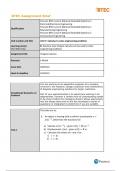
BTEC Assignment Brief
Pearson BTEC Level 3 National Extended Diploma in
Electrical/Electronic Engineering
Pearson BTEC Level 3 National Extended Diploma in
Qualification
Manufacturing Engineering
Pearson BTEC Level 3 National Extended Diploma in
Aeronautical Engineering
Unit number and title Unit 7: Calculus to solve engineering problems
Learning aim(s) B: Examine how Integral calculus can be used to solve
(For NQF only) engineering problems
Assignment title Integral Calculus
Assessor S.Walsh
Issue date 04/01/22
Hand in deadline 25/01/22
You are working as an apprentice engineer at a company
involved in the research, design production and maintenance
of bespoke engineering solutions for larger customers.
Vocational Scenario or
Part of your apprenticeship is to spend time working in all
Context
departments, however a certain level of understanding needs
to be shown before the managing director allows apprentices
into the design team and so she has developed a series of
questions on integration to determine if you are suitable.
The tasks are to:
1. An object is moving with a uniform acceleration 𝑎 =
2𝑚𝑠 −2 , determine the functions for:
a) Velocity 𝑣(𝑚𝑠 −1 ) – given 𝑣(0) = 𝑵 𝑚𝑠 −1
Task 1 b) Displacement 𝑠(𝑚) – given 𝑠(0) = 𝟓 𝑚
c) Calculate the values of 𝑣 and 𝑠 for:
i) 𝑡 = 𝟏 𝑠
ii) 𝑡 = 𝟑 𝑠
, Find the indefinite integral of the function:
𝟏
𝒚 = 𝑵𝒕𝟐 + 𝟐𝒆𝟑𝒕 + + 𝑵 𝐜𝐨𝐬(𝟑𝒕)
𝒕
Calculate the definite integral of the function:
𝟐
𝟏
∫ 𝑵𝒕𝟐 + 𝟐𝒆𝟑𝒕 + + 𝑵 𝐜𝐨𝐬(𝟑𝒕) 𝒅𝒕
𝟏 𝒕
2. The extension, 𝑦, of a material with an applied force, 𝐹, is
given by 𝒚 = 𝒆𝟎.𝟎𝟎𝟏𝑭 .
a) Calculate the work done if the force increases from 100
Newtons to 500 Newtons using:
i) An analytical integration technique
ii) A numerical integration technique
[Note: the work done is given by the area under the curve]
b) Compare the two answers
c) Using a computer spreadsheet increase the number of
values used for your numerical method
d) Analyse any affect the size of numerical step has on the
result.
3. A telecommunications signal is given by the following
trigonometric voltage function 𝒗 = 𝑵 𝐬𝐢𝐧(𝒙), calculate
the:
a) Average voltage
b) Root mean square (R.M.S) voltage
Over a range of 0 ≤ 𝑥 ≤ 𝜋 radians.
[ Note the trigonometric identity 𝑐𝑜𝑠(2𝑥) = 1 − 2 𝑠𝑖𝑛2 (𝑥) ]
2
BTEC Assignment Brief v1.0
BTEC Internal Assessment QDAM January 2015
, 4. A complex function can be modelled by the equation:
𝒚 = 𝟑𝒙𝟐 . 𝐜𝐨𝐬(𝒙𝟑 )
a) Find the indefinite integral of the complex function
using a substitution method.
5. The acceleration of an object moving in a strange way has
been modelled as 𝒂 = 𝒆𝒙 . 𝒙 .
a) Use integration by parts to find an equation to model
the velocity 𝑣 if 𝑣 = ∫ 𝑒 𝑥 . 𝑥 𝑑𝑥.
b) Is the problem any different if you find 𝑣 = ∫ 𝑥. 𝑒 𝑥 𝑑𝑥?
6. Newton’s law of cooling proposes that the rate of change
of temperature is proportional to the temperature
difference and can be modelled using the equation:
𝒅𝑻
= −𝒌𝑻
𝒅𝒕
By separating the variables this can also be written as:
𝒅𝑻
= −𝒌 𝒅𝒕
𝑻
where:
𝑇 = 𝑇𝑒𝑚𝑝𝑒𝑟𝑎𝑡𝑢𝑟𝑒 𝑑𝑖𝑓𝑓𝑒𝑟𝑒𝑛𝑐𝑒 𝑏𝑒𝑡𝑤𝑒𝑒𝑛 𝑡ℎ𝑒 𝑚𝑎𝑡𝑒𝑟𝑖𝑎𝑙
𝑎𝑛𝑑 𝑡ℎ𝑒 𝑎𝑚𝑏𝑖𝑒𝑛𝑡 𝑡𝑒𝑚𝑝𝑒𝑟𝑎𝑡𝑢𝑟𝑒 𝑇 = 𝑇𝑚𝑎𝑡 − 𝑇𝑎𝑚𝑏 .
𝑘 = 𝑐𝑜𝑜𝑙𝑖𝑛𝑔 𝑐𝑜𝑛𝑠𝑡𝑎𝑛𝑡, 𝑡 = 𝑡𝑖𝑚𝑒 𝑖𝑛 𝑚𝑖𝑛𝑢𝑡𝑒𝑠.
a) Integrate both sides of the equation and show that the
temperature difference is given by:
𝑻 = 𝒆−𝒌𝒕
b) If the material temperature falls from 70 ℃ to 20 ℃ in
N minutes and 𝑇𝑎𝑚𝑏 = 15 ℃, calculate the value of k.
Checklist of evidence Your informal report should contain:
required
• analysis
• worked solutions to the problems
Each worked solution should be laid out clearly and contain
brief explanations of the stages of the calculation to indicate
3
BTEC Assignment Brief v1.0
BTEC Internal Assessment QDAM January 2015
, your understanding of how calculus can be used to solve an
engineering problem. Graphs should be well presented and
clearly labelled and comparisons between methods should be
accurate and well presented.
Criteria covered by this task:
Unit/Criteria
To achieve the criteria you must show that you are able to:
reference
Evaluate, using technically correct language and a logical structure, the
correct integral calculus and numerical integration solutions for each
7/B.D2
type of given routine and non-routine functions, including at least two
set in an engineering context.
Find accurately the integral calculus and numerical integration solutions
7/B.M2 for each type of given routine and non-routine function, and find the
properties of periodic functions.
7/B.P4 Find the indefinite integral for each type of given routine function.
Find the numerical value of the definite integral for each type of given
7/B.P5
routine function.
Find, using numerical integration and integral calculus, the area under
7/B.P6
curves for each type of given routine definitive function.
Sources of information http://www.mathsisfun.com/index.htm
to support you with this
Assignment http://www.mathcentre.ac.uk/students/topics
Other assessment
materials attached to Student Datasets
this Assignment Brief
Q1, Q3, Q6
Student
N Value
1 1
2 2
3 3
4 4
5 5
6 6
7 7
8 8
9 9
10 10
4
BTEC Assignment Brief v1.0
BTEC Internal Assessment QDAM January 2015
,
Pearson BTEC Level 3 National Extended Diploma in
Electrical/Electronic Engineering
Pearson BTEC Level 3 National Extended Diploma in
Qualification
Manufacturing Engineering
Pearson BTEC Level 3 National Extended Diploma in
Aeronautical Engineering
Unit number and title Unit 7: Calculus to solve engineering problems
Learning aim(s) B: Examine how Integral calculus can be used to solve
(For NQF only) engineering problems
Assignment title Integral Calculus
Assessor S.Walsh
Issue date 04/01/22
Hand in deadline 25/01/22
You are working as an apprentice engineer at a company
involved in the research, design production and maintenance
of bespoke engineering solutions for larger customers.
Vocational Scenario or
Part of your apprenticeship is to spend time working in all
Context
departments, however a certain level of understanding needs
to be shown before the managing director allows apprentices
into the design team and so she has developed a series of
questions on integration to determine if you are suitable.
The tasks are to:
1. An object is moving with a uniform acceleration 𝑎 =
2𝑚𝑠 −2 , determine the functions for:
a) Velocity 𝑣(𝑚𝑠 −1 ) – given 𝑣(0) = 𝑵 𝑚𝑠 −1
Task 1 b) Displacement 𝑠(𝑚) – given 𝑠(0) = 𝟓 𝑚
c) Calculate the values of 𝑣 and 𝑠 for:
i) 𝑡 = 𝟏 𝑠
ii) 𝑡 = 𝟑 𝑠
, Find the indefinite integral of the function:
𝟏
𝒚 = 𝑵𝒕𝟐 + 𝟐𝒆𝟑𝒕 + + 𝑵 𝐜𝐨𝐬(𝟑𝒕)
𝒕
Calculate the definite integral of the function:
𝟐
𝟏
∫ 𝑵𝒕𝟐 + 𝟐𝒆𝟑𝒕 + + 𝑵 𝐜𝐨𝐬(𝟑𝒕) 𝒅𝒕
𝟏 𝒕
2. The extension, 𝑦, of a material with an applied force, 𝐹, is
given by 𝒚 = 𝒆𝟎.𝟎𝟎𝟏𝑭 .
a) Calculate the work done if the force increases from 100
Newtons to 500 Newtons using:
i) An analytical integration technique
ii) A numerical integration technique
[Note: the work done is given by the area under the curve]
b) Compare the two answers
c) Using a computer spreadsheet increase the number of
values used for your numerical method
d) Analyse any affect the size of numerical step has on the
result.
3. A telecommunications signal is given by the following
trigonometric voltage function 𝒗 = 𝑵 𝐬𝐢𝐧(𝒙), calculate
the:
a) Average voltage
b) Root mean square (R.M.S) voltage
Over a range of 0 ≤ 𝑥 ≤ 𝜋 radians.
[ Note the trigonometric identity 𝑐𝑜𝑠(2𝑥) = 1 − 2 𝑠𝑖𝑛2 (𝑥) ]
2
BTEC Assignment Brief v1.0
BTEC Internal Assessment QDAM January 2015
, 4. A complex function can be modelled by the equation:
𝒚 = 𝟑𝒙𝟐 . 𝐜𝐨𝐬(𝒙𝟑 )
a) Find the indefinite integral of the complex function
using a substitution method.
5. The acceleration of an object moving in a strange way has
been modelled as 𝒂 = 𝒆𝒙 . 𝒙 .
a) Use integration by parts to find an equation to model
the velocity 𝑣 if 𝑣 = ∫ 𝑒 𝑥 . 𝑥 𝑑𝑥.
b) Is the problem any different if you find 𝑣 = ∫ 𝑥. 𝑒 𝑥 𝑑𝑥?
6. Newton’s law of cooling proposes that the rate of change
of temperature is proportional to the temperature
difference and can be modelled using the equation:
𝒅𝑻
= −𝒌𝑻
𝒅𝒕
By separating the variables this can also be written as:
𝒅𝑻
= −𝒌 𝒅𝒕
𝑻
where:
𝑇 = 𝑇𝑒𝑚𝑝𝑒𝑟𝑎𝑡𝑢𝑟𝑒 𝑑𝑖𝑓𝑓𝑒𝑟𝑒𝑛𝑐𝑒 𝑏𝑒𝑡𝑤𝑒𝑒𝑛 𝑡ℎ𝑒 𝑚𝑎𝑡𝑒𝑟𝑖𝑎𝑙
𝑎𝑛𝑑 𝑡ℎ𝑒 𝑎𝑚𝑏𝑖𝑒𝑛𝑡 𝑡𝑒𝑚𝑝𝑒𝑟𝑎𝑡𝑢𝑟𝑒 𝑇 = 𝑇𝑚𝑎𝑡 − 𝑇𝑎𝑚𝑏 .
𝑘 = 𝑐𝑜𝑜𝑙𝑖𝑛𝑔 𝑐𝑜𝑛𝑠𝑡𝑎𝑛𝑡, 𝑡 = 𝑡𝑖𝑚𝑒 𝑖𝑛 𝑚𝑖𝑛𝑢𝑡𝑒𝑠.
a) Integrate both sides of the equation and show that the
temperature difference is given by:
𝑻 = 𝒆−𝒌𝒕
b) If the material temperature falls from 70 ℃ to 20 ℃ in
N minutes and 𝑇𝑎𝑚𝑏 = 15 ℃, calculate the value of k.
Checklist of evidence Your informal report should contain:
required
• analysis
• worked solutions to the problems
Each worked solution should be laid out clearly and contain
brief explanations of the stages of the calculation to indicate
3
BTEC Assignment Brief v1.0
BTEC Internal Assessment QDAM January 2015
, your understanding of how calculus can be used to solve an
engineering problem. Graphs should be well presented and
clearly labelled and comparisons between methods should be
accurate and well presented.
Criteria covered by this task:
Unit/Criteria
To achieve the criteria you must show that you are able to:
reference
Evaluate, using technically correct language and a logical structure, the
correct integral calculus and numerical integration solutions for each
7/B.D2
type of given routine and non-routine functions, including at least two
set in an engineering context.
Find accurately the integral calculus and numerical integration solutions
7/B.M2 for each type of given routine and non-routine function, and find the
properties of periodic functions.
7/B.P4 Find the indefinite integral for each type of given routine function.
Find the numerical value of the definite integral for each type of given
7/B.P5
routine function.
Find, using numerical integration and integral calculus, the area under
7/B.P6
curves for each type of given routine definitive function.
Sources of information http://www.mathsisfun.com/index.htm
to support you with this
Assignment http://www.mathcentre.ac.uk/students/topics
Other assessment
materials attached to Student Datasets
this Assignment Brief
Q1, Q3, Q6
Student
N Value
1 1
2 2
3 3
4 4
5 5
6 6
7 7
8 8
9 9
10 10
4
BTEC Assignment Brief v1.0
BTEC Internal Assessment QDAM January 2015
,


