Unit 3:
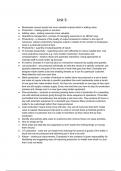
● Businesses convert inputs into more valuable outputs which is adding value.
● Production - making goods or services.
● Adding value - making resources more valuable.
● Operations management - process of managing resources in an efficient way.
● Productivity - a measure of the quality of output produced in relation to the input of
resources. Labour productivity measures output in relation to the number of employees
input in a particular period of time.
● Productivity = quantity of output/quantity of inputs
● To increase productivity - organising work more efficiently to reduce wasted time. Use
more productive resources e.g. more modern machinery. Automation and
computerisation - employ robots and automatic machinery. Using approaches to
motivate staff to work harder eg bonuses.
● It's hard to increase it in service jobs so it should be measured by quality and quantity.
● Job production - are produced individually to meet the needs of a specific customer, are
typically expensive because of the amount of work that goes into them. Examples are
designer made clothes suits and wedding dresses so it can fit a particular customer.
Need attention and care each time.
● Batch production - a number of identical or similar items are produced in a set or batch
are made at regular intervals in specific quantities/ like sushi restaurants make a bunch
of one type then make another bunch. So they can concentrate on one type of item each
time but still supply a steady supply. Every now and then you have to stop the production
process and change over to a new type using similar equipment.
● Flow production - products or services passing down a line of production it's a repeating
one with identical products going through the same sequence of operations. Chocolate
and bottled drink manufacturers are example.s and coca cola. They produce 24 hours a
day with automatic equipment in a standard way. However Many products customers
prefer to be customised rather than mass-produced.
● Lean production means doing more with less. Any use of resources that don't create
value is wasted. Businesses hold stock in order to convert these to finished goods to
meet orders of customers but it is costly to hold them so they reduce this by lean
production.
● Identify what activity adds value to customers then remove those non-value activities.
● How to simply do this
1. Work areas are kept tidy and organised so don't waste time finding things or moving
them around.
2. JIT production - costs are cut simply from reducing the amount of goods a firm holds in
stock that can be produced and delivered just in time to be sold.
3. Kaizen - continuous improvement. Everybody in the company is given responsibility for
identifying and suggesting ways of improving production no matter how small it is, just
that it cuts out waste.
● Businesses convert inputs into more valuable outputs which is adding value.
● Production - making goods or services.
● Adding value - making resources more valuable.
● Operations management - process of managing resources in an efficient way.
● Productivity - a measure of the quality of output produced in relation to the input of
resources. Labour productivity measures output in relation to the number of employees
input in a particular period of time.
● Productivity = quantity of output/quantity of inputs
● To increase productivity - organising work more efficiently to reduce wasted time. Use
more productive resources e.g. more modern machinery. Automation and
computerisation - employ robots and automatic machinery. Using approaches to
motivate staff to work harder eg bonuses.
● It's hard to increase it in service jobs so it should be measured by quality and quantity.
● Job production - are produced individually to meet the needs of a specific customer, are
typically expensive because of the amount of work that goes into them. Examples are
designer made clothes suits and wedding dresses so it can fit a particular customer.
Need attention and care each time.
● Batch production - a number of identical or similar items are produced in a set or batch
are made at regular intervals in specific quantities/ like sushi restaurants make a bunch
of one type then make another bunch. So they can concentrate on one type of item each
time but still supply a steady supply. Every now and then you have to stop the production
process and change over to a new type using similar equipment.
● Flow production - products or services passing down a line of production it's a repeating
one with identical products going through the same sequence of operations. Chocolate
and bottled drink manufacturers are example.s and coca cola. They produce 24 hours a
day with automatic equipment in a standard way. However Many products customers
prefer to be customised rather than mass-produced.
● Lean production means doing more with less. Any use of resources that don't create
value is wasted. Businesses hold stock in order to convert these to finished goods to
meet orders of customers but it is costly to hold them so they reduce this by lean
production.
● Identify what activity adds value to customers then remove those non-value activities.
● How to simply do this
1. Work areas are kept tidy and organised so don't waste time finding things or moving
them around.
2. JIT production - costs are cut simply from reducing the amount of goods a firm holds in
stock that can be produced and delivered just in time to be sold.
3. Kaizen - continuous improvement. Everybody in the company is given responsibility for
identifying and suggesting ways of improving production no matter how small it is, just
that it cuts out waste.