

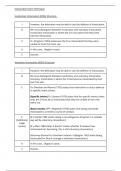
Intoxication Exam Technique
Involuntary Intoxication (IDEA) Structure
I However, the defendant may be able to use the defence of intoxication.
D We must distinguish between involuntary and voluntary intoxication.
Involuntary intoxication is where the D is not aware that they have
become intoxicated.
E R v Kingston (1994) states was the D so intoxicated that they were
unable to form the mens rea.
A In this case… (Apply to case).
C Overall…
Voluntary Intoxication (IDEA) Structure
I However, the defendant may be able to use the defence of intoxication.
D We must distinguish between involuntary and voluntary intoxication.
Voluntary intoxication is where the D has become intoxicated by their
own free will.
E R v Sheehan and Moore (1975) states that intoxication is only a defence
to specific intent crimes.
(Specific Intent) R v Lipman (1970) states that for specific intent crimes
only, the D must be so intoxicated that they are unable to form the
mens rea.
(Basic Intent) DPP v Majewski (1976) states that being voluntarily
intoxicated is a reckless course of conduct.
E [R v Hardie 1985 states taking a non-dangerous drug but in a reckless
[Additional way will be voluntary intoxication.]
Legal
Issues] [R v Allen 1988 states it doesn’t matter whether D realises how
intoxicated he’s becoming, this is still voluntary intoxication.]
[Attorney General For Northern Ireland v Gallagher 1963 states being
intoxicated for Dutch courage is voluntary intoxication.]
A In this case… (Apply to case).
C Overall…
Involuntary Intoxication (IDEA) Structure
I However, the defendant may be able to use the defence of intoxication.
D We must distinguish between involuntary and voluntary intoxication.
Involuntary intoxication is where the D is not aware that they have
become intoxicated.
E R v Kingston (1994) states was the D so intoxicated that they were
unable to form the mens rea.
A In this case… (Apply to case).
C Overall…
Voluntary Intoxication (IDEA) Structure
I However, the defendant may be able to use the defence of intoxication.
D We must distinguish between involuntary and voluntary intoxication.
Voluntary intoxication is where the D has become intoxicated by their
own free will.
E R v Sheehan and Moore (1975) states that intoxication is only a defence
to specific intent crimes.
(Specific Intent) R v Lipman (1970) states that for specific intent crimes
only, the D must be so intoxicated that they are unable to form the
mens rea.
(Basic Intent) DPP v Majewski (1976) states that being voluntarily
intoxicated is a reckless course of conduct.
E [R v Hardie 1985 states taking a non-dangerous drug but in a reckless
[Additional way will be voluntary intoxication.]
Legal
Issues] [R v Allen 1988 states it doesn’t matter whether D realises how
intoxicated he’s becoming, this is still voluntary intoxication.]
[Attorney General For Northern Ireland v Gallagher 1963 states being
intoxicated for Dutch courage is voluntary intoxication.]
A In this case… (Apply to case).
C Overall…


