

Theory Of Crime
What Ought To Be The Basis Explanation
Of Criminalising Conduct?
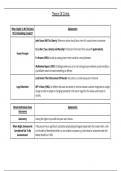
John Stuart Mill ‘On Liberty’: Where an action should be a crime if it causes harm to someone.
H.L.A Hart ‘Law, Liberty and Morality’: Protection from harm from yourself (paternalism).
Harm Principle
R v Brown (1993): As well as causing harm, there could be a moral element.
Wolfenden Report (1957): Challenges where an act is not hurting anyone whether purely morality is
a justifiable reason to make something an offence.
Lord Devlin ‘The Enforcement Of Morals’: An action is a crime because it's immoral.
Legal Moralism DPP v Shaw (1962): An offence that was not written in criminal statute could be recognised as a legal
charge in order to adapt to changing standards in life and in regard to the values and morals of
society.
Should Individuals Have Explanation
Autonomy
Autonomy Having the rights to yourself and your own choices.
When Might Someone Be If the person has a significant substantial physical/psychological impairment that makes them a risk
Considered Not To Be to the safety of themselves/others or are unable to express e.g. brain dead or sectioned under the
Autonomous? Mental Health Act 1983.
What Ought To Be The Basis Explanation
Of Criminalising Conduct?
John Stuart Mill ‘On Liberty’: Where an action should be a crime if it causes harm to someone.
H.L.A Hart ‘Law, Liberty and Morality’: Protection from harm from yourself (paternalism).
Harm Principle
R v Brown (1993): As well as causing harm, there could be a moral element.
Wolfenden Report (1957): Challenges where an act is not hurting anyone whether purely morality is
a justifiable reason to make something an offence.
Lord Devlin ‘The Enforcement Of Morals’: An action is a crime because it's immoral.
Legal Moralism DPP v Shaw (1962): An offence that was not written in criminal statute could be recognised as a legal
charge in order to adapt to changing standards in life and in regard to the values and morals of
society.
Should Individuals Have Explanation
Autonomy
Autonomy Having the rights to yourself and your own choices.
When Might Someone Be If the person has a significant substantial physical/psychological impairment that makes them a risk
Considered Not To Be to the safety of themselves/others or are unable to express e.g. brain dead or sectioned under the
Autonomous? Mental Health Act 1983.


