

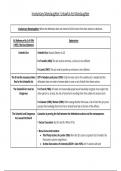
Involuntary Manslaughter: Unlawful Act Manslaughter
Involuntary Manslaughter: Where the defendant does not intend to kill the victim from their actions or decisions.
AG Reference No 3 of 1994 Explanation
(1997): The Four Elements
Unlawful Act Unlawful Act: Assault, Battery or s20
R v Franklin (1883): The act must be criminal, a civil act is not sufficient.
R v Lamb (1967): The act must be positive an omission is not sufficient.
The D had the necessary Mens DPP v Newbury and Jones (1976): Only the mens rea for the unlawful act is needed and the
Rea for the Unlawful Act defendant does not need to foresee death or even a risk of death from these actions.
The Unlawful Act must be R v Church (1966): All sober and reasonable people would inevitably recognise must subject the
Dangerous other person to, at least, the risk of some harm resulting there from, albeit not serious harm.
R v Dawson (1985); Watson (1989): When seeing whether there was a risk of harm the jury must
possess the knowledge that the D had or should have had at the time of the offence.
The Unlawful and Dangerous Causation is proving the link between the defendants actions and the consequences.
Act caused the Death
> Factual Causation: But for test (R v White 1910).
> Novus Actus Interveniens:
● Third Party Actions (R v Jordan 1956): Were the D’s actions so potent that it renders the
third party’s actions insignificant.
● Victims Own Actions (R v Kennedy 2007/R v Cato 1976): Are V’s actions daft and
Involuntary Manslaughter: Where the defendant does not intend to kill the victim from their actions or decisions.
AG Reference No 3 of 1994 Explanation
(1997): The Four Elements
Unlawful Act Unlawful Act: Assault, Battery or s20
R v Franklin (1883): The act must be criminal, a civil act is not sufficient.
R v Lamb (1967): The act must be positive an omission is not sufficient.
The D had the necessary Mens DPP v Newbury and Jones (1976): Only the mens rea for the unlawful act is needed and the
Rea for the Unlawful Act defendant does not need to foresee death or even a risk of death from these actions.
The Unlawful Act must be R v Church (1966): All sober and reasonable people would inevitably recognise must subject the
Dangerous other person to, at least, the risk of some harm resulting there from, albeit not serious harm.
R v Dawson (1985); Watson (1989): When seeing whether there was a risk of harm the jury must
possess the knowledge that the D had or should have had at the time of the offence.
The Unlawful and Dangerous Causation is proving the link between the defendants actions and the consequences.
Act caused the Death
> Factual Causation: But for test (R v White 1910).
> Novus Actus Interveniens:
● Third Party Actions (R v Jordan 1956): Were the D’s actions so potent that it renders the
third party’s actions insignificant.
● Victims Own Actions (R v Kennedy 2007/R v Cato 1976): Are V’s actions daft and


