

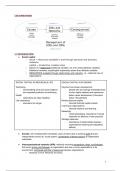
LECTURES RANO
L1: INTRODUCTION
● Social capital:
○ social → resources available in and through personal and business
networks
capital → productive, creates value
○ feature of a relationship (relational variable), not of an entity (attribute variable).
Relational variables; equal/higher explanatory power than attribute variables
○ RESOURCES available through relationships and networks, i.e., relational view of
organizations
SOCIAL CAPITAL IN INDIVIDUALS LIFE SOCIAL CAPITAL IN ECONOMY
Well-being Payment and career development:
- sensemaking work and social relations - people who are strongly embedded tend
are important predictors of well-being to earn higher salaries and experience
Health faster career development (“structural
- networkers are often healthier holes”, Ronald Burt)
Life expectancy Raising financial capital:
- etworkers live longer - informal financial capital market.
Learning in organizations:
- informal relations and learning.
Marketing:
- verbal advertising, importance of social
networks for diffusion of new products
Strategic alliances:
- importance of relationships between
organizations (learning and reputation
effects)
● Society: set of independent individuals, each of whom acts to achieve goals that are
independently arrived at. social system; combination of theses actions of independent
individuals
● Interorganizational networks (IOR): relatively enduring transactions, flows, and linkages
that occur among and between an organization and one or more organizations in its
environment. exchange and flow of resources between organizations
○ Absence of ‘true’ hierarchy (no boss)
1
, ● Power of six degrees: two people on Earth can be connected through a chain of
acquaintances with no more than six intermediate connections. We are all linked through
social connections. One single link: enormous effect (six degrees of Kevin Bacon)
L2: DEFINITIONS, TYPES AND CHARACTERISTICS OF RELATIONSHIPS BETWEEN
ORGANIZATIONS AND NETWORKS OF ORGANIZATIONS
● Open system: needs input from the environment.
○ L6: system that interacts with the environment.
There are other actors that send you information and knowledge.
→ From the perspective of the ego this is indegree (incoming flow).
→ From perspective of the alter this is outdegree (authors are sending
something)
○ Pestle: used to gain an appreciation of the organization’s external environment within
which it operates
● Closed system: isolated, doesn’t need to collaborate, has all the resources itself
● Input; raw materials, human resources, capital, technology, information
● transformation; employee’s work, managerial activities, technological/operational activities
● output; product and services, financial results, information
● Intra: social networks within organizations
● Inter-organisational networks (ION): social networks between organizations. networks has
multiple relationships
● is Inter-organisational relations (IOR): relations between organizations. specific interaction
within network
○ affected by needs (organizational goals/functions) / access to resources / agreement
to pursue particular goals reduce uncertainty
→ ION and IOR as dependent;
- Why do organizations form relationships with other organizations?
- How do IORs form, develop, dissolve? How are they managed?
- Which factors explain changes in network structures over time?
→ ION and IOR as independent;
- effect of ION/IOR on behavior/outcomes of organizations?
- To what extent do different networks structure the impact on the project's success?
● Resource deficit: (common in IOR/ION): organizations lack all necessary resources
to attain their goal. drives to form ties with other organizations + achieve mutual
benefit
→ exchange theory
REDUCE UNCERTAINTY
● Internal: designing organizational structures to produce a closed and stable system in the
core technology component.
● External: organizations can make relations with other organizations more reliable and
predictable. ⇒ Interdependence
STRATEGIES
1. Cooperative strategy; together with company that already has new technology
2
, → to obtain reliable commitments from other actors (this requires making a
commitment in return). while such commitments reduce uncertainty, they also
place constraints on future action
2. Competitive strategy; invest in new technology
→ Maintaining alternative resources (prevents concentration of power over the
organization)
Seeking more power or prestige (gaining power without increased commitment)
● Resource dependence theory: Organizations are not self-sufficient and need to manage
resource dependencies to reduce uncertainties in their environment
○ greater the organization’s dependence on the resources of other actors, and the
lesser the availability of alternative sources, the greater the power of these actors
over the organization
○ The actors use the political power to impose their interests & demands on the
organization
○ aim buffering/bridging; to access resources, to stabilize outcomes / market rents, to
prevent environmental control, to coordinate the respective interests of actors
● Isomorph: mechanism by which organizations conform to rules, values, beliefs of
their institutional context → process by which organizations become similar in
structure, practices, or behavior over time.
○ Coercive: state, regulators that exercise legitimated power over organizations;
impose norms with fines, sanctions
○ Mimetic: organizations tend to imitate other organizations (especially successful
ones)
○ Normative: pressure for conformity arising from culture and norms of
professionalism.
NETWORK
● Network set of objects (nodes/positions/vertices/actors) and relations (edges/ties/links)
nodes (can be anything)
ties (link between 2 nodes)→ strength, (in)direct, contractual form,
single/multiplex, content
set of nodes
○ Social closure: realized ties (observed)
○ Structural hole: absent ties (not connected). 2 people connected by other person *
* structural holes and social actions → the nodes do not all have to be connected in triad
● Conduit: broker. action spanning the structural hole
● Tertius gaudus: 3th who benefits from competition between other 2. Create possibilities /
new idea’s / knowledge flow. make sure other 2 do not connect
ability of the broker to use her position for selfish interests
3
L1: INTRODUCTION
● Social capital:
○ social → resources available in and through personal and business
networks
capital → productive, creates value
○ feature of a relationship (relational variable), not of an entity (attribute variable).
Relational variables; equal/higher explanatory power than attribute variables
○ RESOURCES available through relationships and networks, i.e., relational view of
organizations
SOCIAL CAPITAL IN INDIVIDUALS LIFE SOCIAL CAPITAL IN ECONOMY
Well-being Payment and career development:
- sensemaking work and social relations - people who are strongly embedded tend
are important predictors of well-being to earn higher salaries and experience
Health faster career development (“structural
- networkers are often healthier holes”, Ronald Burt)
Life expectancy Raising financial capital:
- etworkers live longer - informal financial capital market.
Learning in organizations:
- informal relations and learning.
Marketing:
- verbal advertising, importance of social
networks for diffusion of new products
Strategic alliances:
- importance of relationships between
organizations (learning and reputation
effects)
● Society: set of independent individuals, each of whom acts to achieve goals that are
independently arrived at. social system; combination of theses actions of independent
individuals
● Interorganizational networks (IOR): relatively enduring transactions, flows, and linkages
that occur among and between an organization and one or more organizations in its
environment. exchange and flow of resources between organizations
○ Absence of ‘true’ hierarchy (no boss)
1
, ● Power of six degrees: two people on Earth can be connected through a chain of
acquaintances with no more than six intermediate connections. We are all linked through
social connections. One single link: enormous effect (six degrees of Kevin Bacon)
L2: DEFINITIONS, TYPES AND CHARACTERISTICS OF RELATIONSHIPS BETWEEN
ORGANIZATIONS AND NETWORKS OF ORGANIZATIONS
● Open system: needs input from the environment.
○ L6: system that interacts with the environment.
There are other actors that send you information and knowledge.
→ From the perspective of the ego this is indegree (incoming flow).
→ From perspective of the alter this is outdegree (authors are sending
something)
○ Pestle: used to gain an appreciation of the organization’s external environment within
which it operates
● Closed system: isolated, doesn’t need to collaborate, has all the resources itself
● Input; raw materials, human resources, capital, technology, information
● transformation; employee’s work, managerial activities, technological/operational activities
● output; product and services, financial results, information
● Intra: social networks within organizations
● Inter-organisational networks (ION): social networks between organizations. networks has
multiple relationships
● is Inter-organisational relations (IOR): relations between organizations. specific interaction
within network
○ affected by needs (organizational goals/functions) / access to resources / agreement
to pursue particular goals reduce uncertainty
→ ION and IOR as dependent;
- Why do organizations form relationships with other organizations?
- How do IORs form, develop, dissolve? How are they managed?
- Which factors explain changes in network structures over time?
→ ION and IOR as independent;
- effect of ION/IOR on behavior/outcomes of organizations?
- To what extent do different networks structure the impact on the project's success?
● Resource deficit: (common in IOR/ION): organizations lack all necessary resources
to attain their goal. drives to form ties with other organizations + achieve mutual
benefit
→ exchange theory
REDUCE UNCERTAINTY
● Internal: designing organizational structures to produce a closed and stable system in the
core technology component.
● External: organizations can make relations with other organizations more reliable and
predictable. ⇒ Interdependence
STRATEGIES
1. Cooperative strategy; together with company that already has new technology
2
, → to obtain reliable commitments from other actors (this requires making a
commitment in return). while such commitments reduce uncertainty, they also
place constraints on future action
2. Competitive strategy; invest in new technology
→ Maintaining alternative resources (prevents concentration of power over the
organization)
Seeking more power or prestige (gaining power without increased commitment)
● Resource dependence theory: Organizations are not self-sufficient and need to manage
resource dependencies to reduce uncertainties in their environment
○ greater the organization’s dependence on the resources of other actors, and the
lesser the availability of alternative sources, the greater the power of these actors
over the organization
○ The actors use the political power to impose their interests & demands on the
organization
○ aim buffering/bridging; to access resources, to stabilize outcomes / market rents, to
prevent environmental control, to coordinate the respective interests of actors
● Isomorph: mechanism by which organizations conform to rules, values, beliefs of
their institutional context → process by which organizations become similar in
structure, practices, or behavior over time.
○ Coercive: state, regulators that exercise legitimated power over organizations;
impose norms with fines, sanctions
○ Mimetic: organizations tend to imitate other organizations (especially successful
ones)
○ Normative: pressure for conformity arising from culture and norms of
professionalism.
NETWORK
● Network set of objects (nodes/positions/vertices/actors) and relations (edges/ties/links)
nodes (can be anything)
ties (link between 2 nodes)→ strength, (in)direct, contractual form,
single/multiplex, content
set of nodes
○ Social closure: realized ties (observed)
○ Structural hole: absent ties (not connected). 2 people connected by other person *
* structural holes and social actions → the nodes do not all have to be connected in triad
● Conduit: broker. action spanning the structural hole
● Tertius gaudus: 3th who benefits from competition between other 2. Create possibilities /
new idea’s / knowledge flow. make sure other 2 do not connect
ability of the broker to use her position for selfish interests
3


