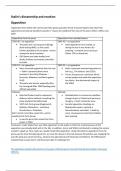
Stalin’s dictatorship and reaction
Opposition
‘Opposition from within the Communist Party posed a greater threat to Soviet leaders than that from
opponents and cultural dissidents outside it.’ Assess the validity of this view of the years 1941 to 1964. June
2018
Opposition from the party Opposition from outside/citizens
1941-45 – no opposition 1941-45 – no opposition
• The party was not trying to challenge • Little opposition from outside, as
Stalin during WW2, as this could during the war it was hard to do
further destabilise the situation + terror anything + constant terror pressure
among the party members (Order 270 on desertion)
• GKO (party and state bodies) and
Stavka (military command) controlled
by Stalin
1945-53 – no opposition 1945-53 – no opposition
• More invented opposition than the real • Stalin’s paranoia invented opposition to
-> Stalin’s paranoia (there were him (e.g., The doctors’ plot 1953)
tensions in the Party (Zhdanov – • Terror and pressure continued, which
favourite, Malenkov and Beria against scared people and made the opposition
him)) less likely + the detrimental impact of
• The party was tensed, especially after the WW2
the Leningrad affair 1948 (leading party
officials executed)
1953-64 1953-64
• Marchal Zhukov tried to implement • Destabilisation in communist satellites:
defence reform without consulting the change of gov in Poland and uprising in
party (replaced by Malinovski) Hungary -> both crashed by army
• 1957 Anti-Party group (Kaganovich, • Societal opposition (readings on
Molotov, Malenkov) – outvoting Mayakovski square, uprising in
Khrushchev in Presidium Novocherkassk, samizdat) -> dealt by
But! Central committee saved him, and he army, consequences tried to be hidden;
expelled Anti-Party Group peer-policing
• It was the party that ousted him from
power in 1964.
Conclusion: under Stalin there was little opposition to the leader in 1941-53, mostly because all the
opposition was already dealt with in the 30s. In addition, terror and WW2 contributed to making the society
scared to speak up. Thus, Stalin as a leader faced little opposition. Under Khrushchev opposition from the
party was the most threatening to him, as it put him down in the end, because Khrushchev was changing the
way the party was structured (e.g., division into agricultural and industrial committees). His 1956 speech
marked thaw in party terror and they were able to challenge him.
The opposition faced by Khrushchev in the years 1953-64 was far less that that faced by Stalin in the years
1928-41.
, Opposition was smaller Opposition was bigger
Less opposition from the party: More opposition from the party:
• It might have looked like there was less • Marchal Zhukov tried to implement
opposition just because Stalin tended to defence reform without consulting the
invent plotting against him (e.g., army party (replaced by Malinovski), while Stalin
purges) and often purged, arrested and did not have to deal with the army.
expelled party members just in case. • 1957 Anti-Party group (Kaganovich,
• There was dissatisfaction, but not Molotov, Malenkov) – almost outvoting
opposition from the party members over
Khrushchev in Presidium
his reforms – so no direct opposition.
But! Central committee saved him, and he expelled
• When Khrushchev came to power, people
Anti-Party Group
already learnt from Stalin that they would
be killed if they would oppose; thanks to More opposition from the outside:
Stalin, Kh faced less opposition. • Destabilisation in communist satellites:
• Kh did not have to deal with old Bolsheviks change of gov in Poland and uprising in
who had their own opinions and were Hungary -> both crashed by army; there
threatening (Kirov, Ryluitin) like Stalin did. were only minor uprisings under Stalin.
Less opposition from the society: More opposition from the society:
• More freedoms were allowed, and many • Societal opposition (readings on
cultural reforms were implemented, Mayakovski square, uprising in
improving living standards after Novocherkassk, samizdat) -> dealt by army,
Novocherkassk uprising. consequences tried to be hidden; peer-
• Kh did not have to implement policing.
collectivisation and so did not have to deal
with the peasant unrest.
Conclusion: opposition was much greater as Khrushchev himself denounced terror and High Stalinism in his
1956 speech, thus making an impression to allow free speech and thinking. He was not as scary as Stalin and
was not terrorizing the Party, which was able to undermine him in the end. Stalin only created an illusion of
the opposition to him.
Politics
‘How far was Stalin’s USSR between 1928 and 1953 a totalitarian state?’
Totalitarism is a form of government and a political system that prohibits all opposition parties, outlaws
individual and group opposition to the state and its claims and exercises an extremely high if not complete
degree of control and regulation over public and private life by propaganda.
Was a totalitarian state Was not a totalitarian state
• Use of propaganda in mass media and arts • During WW2 the attack on religion was
to influence and control citizens. Stalin paused so that the society had something
depicted as next Lenin, War hero and one to compensate for their losses – freedom of
of us. Cult of personality after war. religion.
• No opposition party was allowed to exist. • There was a relax in mass terror and mass
There were trials against fractionalists arrests after 1938, signalled by Stalin’s
Zinoviev and Kamenev in 1936 and Bukhari speech and purge of NKVD and Yezhov and
in 1938. no mass purged after WW2.
• Before WW2, the arts were less controlled:
writers, who did not directly criticise Stalin
Opposition
‘Opposition from within the Communist Party posed a greater threat to Soviet leaders than that from
opponents and cultural dissidents outside it.’ Assess the validity of this view of the years 1941 to 1964. June
2018
Opposition from the party Opposition from outside/citizens
1941-45 – no opposition 1941-45 – no opposition
• The party was not trying to challenge • Little opposition from outside, as
Stalin during WW2, as this could during the war it was hard to do
further destabilise the situation + terror anything + constant terror pressure
among the party members (Order 270 on desertion)
• GKO (party and state bodies) and
Stavka (military command) controlled
by Stalin
1945-53 – no opposition 1945-53 – no opposition
• More invented opposition than the real • Stalin’s paranoia invented opposition to
-> Stalin’s paranoia (there were him (e.g., The doctors’ plot 1953)
tensions in the Party (Zhdanov – • Terror and pressure continued, which
favourite, Malenkov and Beria against scared people and made the opposition
him)) less likely + the detrimental impact of
• The party was tensed, especially after the WW2
the Leningrad affair 1948 (leading party
officials executed)
1953-64 1953-64
• Marchal Zhukov tried to implement • Destabilisation in communist satellites:
defence reform without consulting the change of gov in Poland and uprising in
party (replaced by Malinovski) Hungary -> both crashed by army
• 1957 Anti-Party group (Kaganovich, • Societal opposition (readings on
Molotov, Malenkov) – outvoting Mayakovski square, uprising in
Khrushchev in Presidium Novocherkassk, samizdat) -> dealt by
But! Central committee saved him, and he army, consequences tried to be hidden;
expelled Anti-Party Group peer-policing
• It was the party that ousted him from
power in 1964.
Conclusion: under Stalin there was little opposition to the leader in 1941-53, mostly because all the
opposition was already dealt with in the 30s. In addition, terror and WW2 contributed to making the society
scared to speak up. Thus, Stalin as a leader faced little opposition. Under Khrushchev opposition from the
party was the most threatening to him, as it put him down in the end, because Khrushchev was changing the
way the party was structured (e.g., division into agricultural and industrial committees). His 1956 speech
marked thaw in party terror and they were able to challenge him.
The opposition faced by Khrushchev in the years 1953-64 was far less that that faced by Stalin in the years
1928-41.
, Opposition was smaller Opposition was bigger
Less opposition from the party: More opposition from the party:
• It might have looked like there was less • Marchal Zhukov tried to implement
opposition just because Stalin tended to defence reform without consulting the
invent plotting against him (e.g., army party (replaced by Malinovski), while Stalin
purges) and often purged, arrested and did not have to deal with the army.
expelled party members just in case. • 1957 Anti-Party group (Kaganovich,
• There was dissatisfaction, but not Molotov, Malenkov) – almost outvoting
opposition from the party members over
Khrushchev in Presidium
his reforms – so no direct opposition.
But! Central committee saved him, and he expelled
• When Khrushchev came to power, people
Anti-Party Group
already learnt from Stalin that they would
be killed if they would oppose; thanks to More opposition from the outside:
Stalin, Kh faced less opposition. • Destabilisation in communist satellites:
• Kh did not have to deal with old Bolsheviks change of gov in Poland and uprising in
who had their own opinions and were Hungary -> both crashed by army; there
threatening (Kirov, Ryluitin) like Stalin did. were only minor uprisings under Stalin.
Less opposition from the society: More opposition from the society:
• More freedoms were allowed, and many • Societal opposition (readings on
cultural reforms were implemented, Mayakovski square, uprising in
improving living standards after Novocherkassk, samizdat) -> dealt by army,
Novocherkassk uprising. consequences tried to be hidden; peer-
• Kh did not have to implement policing.
collectivisation and so did not have to deal
with the peasant unrest.
Conclusion: opposition was much greater as Khrushchev himself denounced terror and High Stalinism in his
1956 speech, thus making an impression to allow free speech and thinking. He was not as scary as Stalin and
was not terrorizing the Party, which was able to undermine him in the end. Stalin only created an illusion of
the opposition to him.
Politics
‘How far was Stalin’s USSR between 1928 and 1953 a totalitarian state?’
Totalitarism is a form of government and a political system that prohibits all opposition parties, outlaws
individual and group opposition to the state and its claims and exercises an extremely high if not complete
degree of control and regulation over public and private life by propaganda.
Was a totalitarian state Was not a totalitarian state
• Use of propaganda in mass media and arts • During WW2 the attack on religion was
to influence and control citizens. Stalin paused so that the society had something
depicted as next Lenin, War hero and one to compensate for their losses – freedom of
of us. Cult of personality after war. religion.
• No opposition party was allowed to exist. • There was a relax in mass terror and mass
There were trials against fractionalists arrests after 1938, signalled by Stalin’s
Zinoviev and Kamenev in 1936 and Bukhari speech and purge of NKVD and Yezhov and
in 1938. no mass purged after WW2.
• Before WW2, the arts were less controlled:
writers, who did not directly criticise Stalin