“Do the cosmological arguments succeed in proving the existence of God”- ESSAY PLAN
COSMOLOGICAL
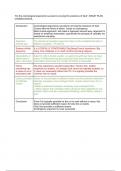
Introduction Cosmological arguments succeed in proving the existence of God.
Comso take the forms of either- Cause or contingency,
Most crucial argument I will make is Aquinas's second way- argument is
based on empirical observation, specifically the principle of causality we
experience everyday.
Aquinas’s The atemporal causation argument relies on the metaphysical idea of
second way efficient causation - Ps and Cs
Science infinite It is LOGICALLY CONCEIVABLE Big Bang/Crunch hypothesis, Big
sequence. bang, time collapses in on itself, another big bang happens
Impossibility of Saturn's orbit is double Jupiter, so Jupiter should have twice as many
infinite time to orbits. If infinite time has gone past then they have the same, this is
pass- saturn/jup impossible and proves the concept of infinity is impossible
Hume- We only experience constant conjunction. Hume's fork- neither
everything has empirical nor analytic. An analytic truth cannot be logically doubted, so
a cause is not a C does not necessarily follow from P2. it is logically possible the
necessary truth universe has no cause
Leibniz principle Draws on his principle of sufficient reason and his particular distinction
of sufficient between necessary and contingent facts. 'events cannot occur for no
reason reason'.
-Makes a distinction between necessary and contingent facts.
-Leibniz argues that contingent facts cannot be fully explained by one
another, there must be a necessary fact/being, which leibniz claims is
god.
Conclusion Even if its logically possible for the uni to exist without a cause, this
does not provide sufficient reason for why the uni exists.
Only God provides a sufficient reason.
Contingency argument is most successful
COSMOLOGICAL
Introduction Cosmological arguments succeed in proving the existence of God.
Comso take the forms of either- Cause or contingency,
Most crucial argument I will make is Aquinas's second way- argument is
based on empirical observation, specifically the principle of causality we
experience everyday.
Aquinas’s The atemporal causation argument relies on the metaphysical idea of
second way efficient causation - Ps and Cs
Science infinite It is LOGICALLY CONCEIVABLE Big Bang/Crunch hypothesis, Big
sequence. bang, time collapses in on itself, another big bang happens
Impossibility of Saturn's orbit is double Jupiter, so Jupiter should have twice as many
infinite time to orbits. If infinite time has gone past then they have the same, this is
pass- saturn/jup impossible and proves the concept of infinity is impossible
Hume- We only experience constant conjunction. Hume's fork- neither
everything has empirical nor analytic. An analytic truth cannot be logically doubted, so
a cause is not a C does not necessarily follow from P2. it is logically possible the
necessary truth universe has no cause
Leibniz principle Draws on his principle of sufficient reason and his particular distinction
of sufficient between necessary and contingent facts. 'events cannot occur for no
reason reason'.
-Makes a distinction between necessary and contingent facts.
-Leibniz argues that contingent facts cannot be fully explained by one
another, there must be a necessary fact/being, which leibniz claims is
god.
Conclusion Even if its logically possible for the uni to exist without a cause, this
does not provide sufficient reason for why the uni exists.
Only God provides a sufficient reason.
Contingency argument is most successful