Section 1 : Physical Chemistry
Rate Equations
The Rate Equation
The rate of a chemical reaction is related to the conc. of reactants by a rate equation of the form:
Rate = k [A]m [B]n
• Where m + n are the orders of reaction w/respect to reactants A + B and k is the rate constant.
- Order of reaction: the power to which the conc. of a reactant is raised in the rate equation.
➜ The orders m + n are restricted to the values 0, 1, + 2 for the exam.
- Rate constant: the proportionality constant which links the rate of reaction to the concentrations
in the rate equation.
Effects of Changes in Concentration on Rate
For the reaction: B + C + D → E + F, the rate equation is: rate = k [B]2 [D]
• This means that the order of reaction w/ respect to B is 2, the order of reaction w/ respect to C is 0
(as it does not appear in the rate equation) + the order of reaction w/ respect to D is 1. The overall
order = 2 + 0 + 1 = 3
- Doubling the conc. of B would quadruple the rate as (x2)2 = x4.
- Doubling the conc. of C would have no effect on the rate as (x2)0 = x1.
- Doubling the conc. of D would double the rate as (x2)1 = x2.
- Doubling the conc. of B, C + D would ↑ the rate by a factor of (x2)3 = x8.
Units of the Rate Constant
• The units of rate = mol dm-3 s-1 and the units of conc. = mol dm-3
• The units of the rate constant, k, depend on the overall order of reaction + the units can be calculated
as shown:
- For a general rate equation: k [A]2 [B] the overall order = 3.
- ∴ rate = k x (conc.)3
- Rearranging to nd k:
➜ k = mol dm-3 s-1 / (mol dm-3)3 = mol dm-3 s-1 / mol3 dm-9 = mol-2 dm6 s-1
• ∴ when overall order = 1, units of rate constant = s-1
• ∴ when overall order = 2, units of rate constant = mol-1 dm3 s-1
Effect of Temperature on the Rate Constant
The rate constant is dependent on temp. If a constant temp. had not been maintained, the rate would
have varied based on changes in concentrations of reactants as well as temp.
• As temp. ↑, the rate constant ↑.
• The rate constant ↑ exponentially as temp. ↑.
The Arrhenius Equation
The Arrhenius equation links the rate constant w/ activation energy + temp. It is written as:
k = Ae–Ea/RT
• where A is a constant (known as the Arrhenius constant), Ea is the activation energy, R is the gas
constant (8.31 J K-1 mol-1) + T is the temp. in K.
• In this equation Ea has units J mol-1. This means that Ea/RT does not have any units as J mol-1 is
divided by (J K-1 mol-1 x K). e–Ea/RT will not have any units either, so A will have the same units as k.
Graphical Analysis
The equation k = Ae–Ea/RT can be rearranged into the form ln k = –Ea/RT
+ ln A
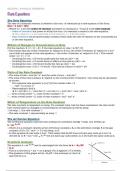
• This is in the form y = mx + c so a graph of ln k against 1/T is drawn.
• The gradient of this graph will be –Ea/RT + the intercept w/ the ln k
axis will be ln A.
fi
Rate Equations
The Rate Equation
The rate of a chemical reaction is related to the conc. of reactants by a rate equation of the form:
Rate = k [A]m [B]n
• Where m + n are the orders of reaction w/respect to reactants A + B and k is the rate constant.
- Order of reaction: the power to which the conc. of a reactant is raised in the rate equation.
➜ The orders m + n are restricted to the values 0, 1, + 2 for the exam.
- Rate constant: the proportionality constant which links the rate of reaction to the concentrations
in the rate equation.
Effects of Changes in Concentration on Rate
For the reaction: B + C + D → E + F, the rate equation is: rate = k [B]2 [D]
• This means that the order of reaction w/ respect to B is 2, the order of reaction w/ respect to C is 0
(as it does not appear in the rate equation) + the order of reaction w/ respect to D is 1. The overall
order = 2 + 0 + 1 = 3
- Doubling the conc. of B would quadruple the rate as (x2)2 = x4.
- Doubling the conc. of C would have no effect on the rate as (x2)0 = x1.
- Doubling the conc. of D would double the rate as (x2)1 = x2.
- Doubling the conc. of B, C + D would ↑ the rate by a factor of (x2)3 = x8.
Units of the Rate Constant
• The units of rate = mol dm-3 s-1 and the units of conc. = mol dm-3
• The units of the rate constant, k, depend on the overall order of reaction + the units can be calculated
as shown:
- For a general rate equation: k [A]2 [B] the overall order = 3.
- ∴ rate = k x (conc.)3
- Rearranging to nd k:
➜ k = mol dm-3 s-1 / (mol dm-3)3 = mol dm-3 s-1 / mol3 dm-9 = mol-2 dm6 s-1
• ∴ when overall order = 1, units of rate constant = s-1
• ∴ when overall order = 2, units of rate constant = mol-1 dm3 s-1
Effect of Temperature on the Rate Constant
The rate constant is dependent on temp. If a constant temp. had not been maintained, the rate would
have varied based on changes in concentrations of reactants as well as temp.
• As temp. ↑, the rate constant ↑.
• The rate constant ↑ exponentially as temp. ↑.
The Arrhenius Equation
The Arrhenius equation links the rate constant w/ activation energy + temp. It is written as:
k = Ae–Ea/RT
• where A is a constant (known as the Arrhenius constant), Ea is the activation energy, R is the gas
constant (8.31 J K-1 mol-1) + T is the temp. in K.
• In this equation Ea has units J mol-1. This means that Ea/RT does not have any units as J mol-1 is
divided by (J K-1 mol-1 x K). e–Ea/RT will not have any units either, so A will have the same units as k.
Graphical Analysis
The equation k = Ae–Ea/RT can be rearranged into the form ln k = –Ea/RT
+ ln A
• This is in the form y = mx + c so a graph of ln k against 1/T is drawn.
• The gradient of this graph will be –Ea/RT + the intercept w/ the ln k
axis will be ln A.
fi