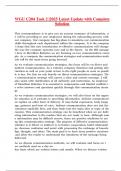
Outline and evaluate the nature of virtual relationships (16 marks)
AO1: Outline
• Self-disclosure of computer-mediated communication (CMC) compared to face to face
(FTF)
• Hyper personal model
• Reduced cues
• Absence of gating
Evaluation – 4xPEEL
• (+) Supporting evidence Baker and Oswald
• (+) Empowers ‘gated’ individuals
• (-) NVC cues are not absent
• (-) Low historical validity
AO1 Outline the Individuals using social networking sites exercise different levels of self-
following: disclosure. People feel more secure about disclosing intimate and
sensitive information in private (private messaging) because of the
• Self-disclosure control over disclosure to a selected individual. When sharing self-
of computer- disclosures in more visible ways with a wider audience (e.g., on a
mediated Facebook wall), people are more selective over the content. Anonymity
communication can explain the relatively high levels of self-disclosure in internet
(CMC) relationships. The danger of self-disclosure in face-to-face interactions is
compared to that confidentiality might be violated, or the other person might respond
face to face negatively (ridicule or rejection). We are more likely to disclose personal
(FTF) information to people we don’t know and probably will never see again.
• Hyper personal The stranger does not have access to an individual’s social circle;
model therefore, the confidentiality problem is less of an issue.
• Reduced cues
• Absence of A key feature in virtual relationships is that the sender of a message has
gating more time to manipulate their image. An individual could be hyper-honest
or hyper-dishonest. Relationships develop quickly and they are often more
intense and intimate.
Virtual relationships lack non-verbal cues such as our facial expressions
and tone of voice. This leads to deindividuation because it reduces
people’s sense of individual identity. This may encourage disinhibition and
the use of blunt communication. Individuals will be less likely to initiate a
relationship with someone who is impersonal or offensive
In online relationships there is an absence of barriers or ‘gates’ that
normally limit the opportunities for those considered less attractive,
individuals with speech defects, those who are shy or less socially skilled
etc. A consequence of removing the gating features is that a person’s true
self is more likely to be active in internet relationships than it is in face-to-
face interactions
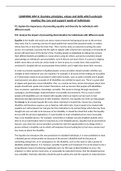
AO1: Outline
• Self-disclosure of computer-mediated communication (CMC) compared to face to face
(FTF)
• Hyper personal model
• Reduced cues
• Absence of gating
Evaluation – 4xPEEL
• (+) Supporting evidence Baker and Oswald
• (+) Empowers ‘gated’ individuals
• (-) NVC cues are not absent
• (-) Low historical validity
AO1 Outline the Individuals using social networking sites exercise different levels of self-
following: disclosure. People feel more secure about disclosing intimate and
sensitive information in private (private messaging) because of the
• Self-disclosure control over disclosure to a selected individual. When sharing self-
of computer- disclosures in more visible ways with a wider audience (e.g., on a
mediated Facebook wall), people are more selective over the content. Anonymity
communication can explain the relatively high levels of self-disclosure in internet
(CMC) relationships. The danger of self-disclosure in face-to-face interactions is
compared to that confidentiality might be violated, or the other person might respond
face to face negatively (ridicule or rejection). We are more likely to disclose personal
(FTF) information to people we don’t know and probably will never see again.
• Hyper personal The stranger does not have access to an individual’s social circle;
model therefore, the confidentiality problem is less of an issue.
• Reduced cues
• Absence of A key feature in virtual relationships is that the sender of a message has
gating more time to manipulate their image. An individual could be hyper-honest
or hyper-dishonest. Relationships develop quickly and they are often more
intense and intimate.
Virtual relationships lack non-verbal cues such as our facial expressions
and tone of voice. This leads to deindividuation because it reduces
people’s sense of individual identity. This may encourage disinhibition and
the use of blunt communication. Individuals will be less likely to initiate a
relationship with someone who is impersonal or offensive
In online relationships there is an absence of barriers or ‘gates’ that
normally limit the opportunities for those considered less attractive,
individuals with speech defects, those who are shy or less socially skilled
etc. A consequence of removing the gating features is that a person’s true
self is more likely to be active in internet relationships than it is in face-to-
face interactions