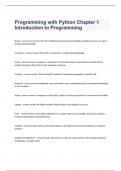
Best Python Coding and Programming Notes from Beginner to Professional
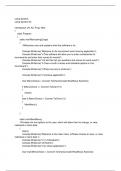
Python is a high-level, interpreted programming language that emphasizes code readability and simplicity. It has gained immense popularity among developers due to its versatility, extensive libraries, and user-friendly syntax. Here are some key points to keep in mind when working with Python: Syntax: Python uses whitespace indentation to delimit blocks of code, eliminating the need for explicit braces or keywords. It promotes code readability and enforces a consistent coding style. Variables and Data Types: Python has dynamic typing, which means variables are created and assigned values on the fly. Common data types include integers, floats, strings, booleans, lists, tuples, and dictionaries. Control Flow: Python provides control flow structures like if-else statements, loops (for and while), and logical operators (and, or, not) to control the flow of execution based on conditions. Functions: Functions in Python are defined using the def keyword. They allow you to encapsulate reusable blocks of code. Functions can have parameters and can return values using the return statement. Modules and Packages: Python has a rich ecosystem of modules and packages that extend its functionality. Modules are individual files containing Python code, while packages are directories that contain multiple modules. You can import modules and packages using the import statement. Exception Handling: Python provides a robust exception handling mechanism to catch and handle errors during runtime. You can use try, except, finally, and raise statements to handle exceptions gracefully and ensure proper program execution. File I/O: Python offers built-in functions and libraries to read from and write to files. You can open files using the open() function, specify the mode (read, write, append), and perform various operations such as reading line by line or writing data. Object-Oriented Programming (OOP): Python supports OOP principles such as encapsulation, inheritance, and polymorphism. You can create classes, define methods and attributes, and instantiate objects to implement OOP concepts. Libraries and Frameworks: Python has a vast collection of libraries and frameworks for various domains, including web development (Django, Flask), scientific computing (NumPy, Pandas), machine learning (TensorFlow, PyTorch), and more. These libraries provide pre-built functions and tools to simplify complex tasks. Documentation and Community: Python has extensive documentation available at , providing detailed information on language features and standard libraries. Additionally, Python has a thriving community of developers who contribute packages, provide support through forums, and share code examples and tutorials. Remember to write clean, well-documented code and follow Python's coding conventions (PEP 8) to ensure readability and maintainability. Python's simplicity and extensive ecosystem make it an excellent choice for a wide range of applications, from simple scripts to complex enterprise systems.
Written for
- Institution
- Secondary school
- Coding and Programming
- School year
- 1
Document information
- Uploaded on
- June 17, 2023
- Number of pages
- 64
- Written in
- 2021/2022
- Type
- Interview
- Company
- Unknown
- Person
- Unknown
Subjects
-
coding
-
coding
-
programming
-
programming
-
codingwithpython
-
python
-
codinglanguage
-
programmingwithpython