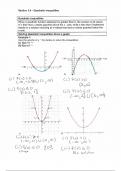
solving quadratic inequalities given a graph
Solving quadratic inequalities given a graph in algebra involves determining the intervals or regions on the graph where the quadratic inequality is true. The graph of a quadratic function is a parabola, and the inequality can be expressed in the form ax^2 + bx + c 0, ax^2 + bx + c 0, ax^2 + bx + c ≥ 0, or ax^2 + bx + c ≤ 0, depending on the specific inequality. To solve the quadratic inequality, we examine the shape of the parabola and identify the regions where the graph is above or below the x-axis, depending on the given inequality symbol. The solutions to the quadratic inequality are the intervals or regions on the graph that satisfy the inequality condition. By analyzing the graph, we can determine the range of values for which the quadratic inequality is true and make informed decisions or conclusions based on the given information
École, étude et sujet
- Établissement
-
Austin Community College
- Cours
-
College algebra (64088)
Infos sur le Document
- Publié le
- 17 juin 2023
- Nombre de pages
- 1
- Écrit en
- 2022/2023
- Type
- Notes de cours
- Professeur(s)
- Carmen mccullough
- Contient
- Toutes les classes
Sujets

Document également disponible en groupe