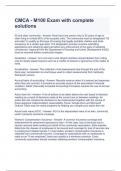
CMCA - M100 Exam with complete solutions
55 and older community - Answer- Must have one person who is 55 years of age or older living in at least 80% of its occupied units. The community must be designated "55 and older" to qualify as this type of housing that legally prohibits children and limits occupancy to a certain age span. The designation process involves submitting applications and obtaining approval before any enforcement of the ages of residents commences. Approval from the Department of Housing and Urban Development (HUD) must be received before construction begins. Abstention - Answer- Is to not cast a vote. Board members should abstain from voting only for clearly stated reasons such as a conflict of interest or ignorance of the matter at hand. Acceleration - Answer- The collection of all assessments due through the end of the fiscal year. Acceleration is a technique used to collect assessments from habitually delinquent owners. Accrual basis of accounting - Answer- Records revenue when it is earned and expenses when they are incurred. It provides an accurate picture of the association's financial condition. GAAP (Generally Accepted Accounting Principles) requires the use of accrual accounting. Action item list - Answer- A list of actions to be taken before the next board of directors meeting as a result of decisions made at the current one or between meetings. An action item list contains the decisions to be implemented together with the names of those assigned implementation responsibility. Excel, Google Docs and Microsoft Outlook Tasks may be useful programs for helping you compile your action item list. Actual cash value (ACV) - Answer- ACV is the depreciated value of an item, commonly used in property insurance coverage. Workers' Compensation Insurance - Answer- A common insurance coverage and endorsement for personnel exposures to loss—in this case, loss of services due to injuries received while working on behalf of the community association. State statutes determine the classes of employees to be insured and coverage for loss of services due to employment related injuries. In most states, workers' compensation insurance is obtained from commercial insurers. Coverage for associations with no employees is rated on an "if any employee" basis and usually is a minimum premium. Every community association should consider obtaining workers' compensation insurance. Wrongful acts - Answer- Legal claims can be brought against a community association based on the manner in which it conducts its business. Examples of "wrongful acts" include the failure to file taxes, collect assessments, maintain replacement reserves, or deliver core services to its residents (member/owners and tenants). Directors and officers (D&O) liability insurance is designed to pay for damages arising from wrongful acts that do not lead to property damage, bodily injury, advertising injury, or personal injury. Yield - Answer- One of three essential investment objectives for community associations, yield is the amount of return on an investment. The other two essential investment objectives are liquidity and safety. Zero-base budgeting - Answer- A method of budget preparation where all amounts are set to zero and the budget amount must be justified, instead of assuming the line item is needed and adjusting the amount for the coming year. The zerobase approach keeps you from accepting this year's figures at face value. It requires you to analyze the reasons for the actual amounts spent. The actual dollar figure may be less or more than the budgeted figure because of circumstances you cannot assume will exist during the coming year. For example, lawn maintenance costs during a dry season will be low— but a community cannot assume that the coming year will be just as dry. Work order/response form - Answer- A form for assigning maintenance work to be done. With some planning, it can be used— To document owner and tenant requests To assign maintenance tasks to both maintenance staff and contractors As a response form to be returned to an owner or tenant, indicating that work was completed or confirming that it was assigned As a basis for allocating charges, when appropriate A work order/response form has several benefits. It— Identifies whether the need is an emergency or not Requires attention Allows follow-up to evaluate satisfactio Provides a means of monitoring costs Provides a history of the repairs that have been made Documents any problems with contractors reported by owners or tenants Indicates if the work is a recurring problem necessitating further evaluation Most software programs have work order/response forms as part of their system. Warranty - Answer- A promise or guarantee that parts, materials, or labor will last for a designated period of time. Warranties required should be part of the RFP (request for proposal) packet when a community association is interested in receiving proposals for a particular project. In addition, any contract the association signs should state the agreed upon warranties clearly and in detail. A warranty should state: What is covered For how long What is not covered What the contractor will do if the work or product proves defective Waiver of lien - Answer- Contract provision that gives up the right to make a claim against the community association for payments not received. A waiver of lien should be used when a project involves the heavy use of materials or subcontractors—e.g., some type of construction project—and the community association wants to avoid the risk of having to pay for materials or subcontractors if the contractor fails to do so. A performance bond, payment bond, and waiver of lien all provide for the community association's financial protection if the contractor should default. Waiver of subrogation - Answer- A common insurance contract endorsement designed to minimize a community association's property exposure to loss, the waiver of subrogation prohibits the insurer from attempting to seek restitution from a third party who causes any kind of loss to the insured. This type of arrangement is allowable under certain circumstances where the insured could be held liable for a claim that is paid. In other words, a waiver of subrogation is the endorsement that deletes the right of the association to seek reimbursement for a covered loss from the owner who caused the damage. Also commonly known as a "waiver of the transfer of recovery rights." Waiver of the transfer of recovery rights - Answer- A common insurance contract endorsement designed to minimize a community association's property exposure to loss, the waiver of the transfer of recovery rights prohibits the insurer from attempting to seek restitution from a third party who causes any kind of loss to the insured. This type of arrangement is allowable under certain circumstances where the insured could be held liable for a claim that is paid. In other words, a waiver of the transfer of recovery rights is the endorsement that deletes the right of the association to seek reimbursement for a covered loss from the owner who caused the damage. Also commonly known as a "waiver of subrogation." Waiver provision - Answer- Contract provision that states that a waiver (permission) by one party of any breach of contract (failure to fulfill a provision) by the other party shall not act as a general waiver of future breaches. In other words, each party says to the other, "If we let you slide on any contract requirement at any time, it doesn't mean we're letting you slide on any other requirements, or even on that one a second time— unless we decide to let you do it again." Work order/response form - Answer- A form for assigning maintenance work to be done. With some planning, it can be used— • To document owner and tenant requests • To assign maintenance tasks to both maintenance staff and contractors • As a response form to be returned to an owner or tenant, indicating that work was completed or confirming that it was assigned • As a basis for allocating charges, when appropriate A work order/response form has several benefits. It— • Identifies whether the need is an emergency or not • Requires attention • Allows follow-up to evaluate satisfaction • Provides a means of monitoring costs • Provides a history of the repairs that have been made • Documents any problems with contractors reported by owners or tenants • Indicates if the work is a recurring problem necessitating further evaluation Most software programs have work order/response forms as part of their system. Treasury bonds - Answer- Investment option that matures in more than 10 years. Treasury bonds are issued in denominations from $1,000 to $100,000. They are also interest-bearing with interest paid every six months. When the bond matures, the buyer receives the full face value. Treasury bonds are among the safest investment options for community associations because payment is guaranteed by the government. Treasury notes - Answer- Investment option that matures in one to 10 years. Treasury notes are issued in denominations from $1,000 to $100,000. They are also interest-bearing with interest paid every six months. When the note matures, the buyer receives the full face value. Treasury notes are among the safest investment options for community associations because payment is guaranteed by the government. Turnover - Answer- That date upon which homeowners gain control of their association from the developer. Typically, turnover occurs at an annual or special meeting of the homeowners. U. S. Bankruptcy Code - Answer- The purpose of bankruptcy laws is to help honest people and businesses find a way to pay their debt or get a fresh start. Bankruptcy laws help people who can no longer pay their creditors start anew—by liquidating assets to pay their debts or by creating a repayment plan. Among many other corrections and revisions, and with the strong lobbying efforts of CAI staff and volunteers, the Bankruptcy Prevention and Consumer Protection Act passed in 2005 contained a small provision benefitting community associations. It clarified that associations have the authority to collect assessments that come due after the date the homeowner filed for bankruptcy. Umbrella association - Answer- Governance structure where there is more than one residential community association grouped together. Often there is
Written for
- Institution
- CMCA - M100
- Course
- CMCA - M100
Document information
- Uploaded on
- June 16, 2023
- Number of pages
- 43
- Written in
- 2022/2023
- Type
- Exam (elaborations)
- Contains
- Questions & answers
Subjects
-
cmca m100 exam with complete solutions

Document also available in package deal