

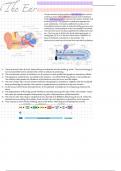
The Ear
The ear consists of three sections, the outer ear (pinna and
auditory canal), the middle ear (ossicles and Eustachian
tube), and the inner ear ( semicircular canals, cochlear and
auditory nerve). The tympanic membrane separates the
outer middle ears. The outer middle both contain air at
atmospheric pressure which is maintained by yawning and
swallowing. The Eustachian tube is connected to the throat.
The oval and round windows separate the middle and inner
ear. The inner ear is filled with fluid called perilymph or
endolymph (if it is in the ear) which allows vibrations to
pass to the basilar membrane in the cochlear. The
semicircular canals are involved with maintaining balance.
1. The pinna acts like a funnel, channelling soundwaves into the auditory canal. The sound energy is
now concentrated onto a smaller area, which increases its intensity.
2. The soundwaves consist of variations in air pressure, which makes the tympanic membrane vibrate.
3. The tympanic membrane is connected to the malleus - one of the three tiny bones in the middle ear.
The malleus then passes the vibrations of the eardrum onto the incus and the stapes.
4. The oval window has a much smaller area than the tympanic membrane. Together with the increased
force produced by the ossicles, this results in greater pressure variations at the oval window.
5. As the sound wave travels through the ear, it’s amplitude increases but it’s frequency remains the
same.
6. The displacement of fluid by sound vibrations activates sensory hair cells within the cochlear. These
hair cells are mechanoreceptors that process tiny hair-like extensions called stereocilia.
7. The cilia on hair cells vary in length and will resonate to a different frequency of sound. When the
stereocilia are moved by the cochlear fluid, the hair cell will depolarise to generate a nerve impulse.
8. This impulse is sent via the auditory nerve to the brain, where they are interpreted as sounds.
,Loudness and Intensity
Most human ear drums vibrate between 20 Hz and 20,000
Hz. Any sounds below 20Hz are called infrasound and any
above 20,000Hz are called ultrasound. If a sound is too low or
too fast then humans are unable to hear it. Different
animals can hear different frequencies. For example dogs
can hear sounds between 67 Hz and 45,000 Hz. This means
that sounds can be used a pest detergents without having an
impact on humans. The range of sound that human’s hear
can reduce due to damage to the ear drum or the cochlear
losing sensitivity due to prolonged exposure to loud noises or
with age. It is usually higher frequencies that can’t be heard
with age. Men’s hearing worsens quicker than women and
the average middle age adult can only hear up to 14,000 Hz.
You can often measure loudness using a decibel meter. The
decibel scale is a logarithmic scale which measures the intensity
level compared to the human threshold of hearing. The perceived
loudness of a sound depends on its frequency as well as its
intensity. Two different frequencies with the same loudness
will have different intensity levels on the dB scale. The dBA
scale is an adjusted decibel scale which is designed to take into
account the ear’s response to different frequencies. On dBA
scale, sounds of the same intensity have the same loudness for
the average human ear.
1. Start by generating a control frequency of 1000Hz at a particular intensity level.
2. Generate another sound at a different frequency. Vary the volume of this sound until it
appears to have the same loudness as the 1000 Hz frequency. Measure the intensity level at
this volume.
3. Repeat this for several different frequencies, and plot the resulting curve on a graph.
4. Change the intensity level of the control frequency and repeat steps, two and three.
5. If you measure intensity level in decibels, then the loudness of the sound is given in Phons.
ncrease new intensity Intensity
in loudness
>z
P
ΔL X log IL = 10 log
original
M
I= A
intensity Threshold
of hearing
intensity
The ear consists of three sections, the outer ear (pinna and
auditory canal), the middle ear (ossicles and Eustachian
tube), and the inner ear ( semicircular canals, cochlear and
auditory nerve). The tympanic membrane separates the
outer middle ears. The outer middle both contain air at
atmospheric pressure which is maintained by yawning and
swallowing. The Eustachian tube is connected to the throat.
The oval and round windows separate the middle and inner
ear. The inner ear is filled with fluid called perilymph or
endolymph (if it is in the ear) which allows vibrations to
pass to the basilar membrane in the cochlear. The
semicircular canals are involved with maintaining balance.
1. The pinna acts like a funnel, channelling soundwaves into the auditory canal. The sound energy is
now concentrated onto a smaller area, which increases its intensity.
2. The soundwaves consist of variations in air pressure, which makes the tympanic membrane vibrate.
3. The tympanic membrane is connected to the malleus - one of the three tiny bones in the middle ear.
The malleus then passes the vibrations of the eardrum onto the incus and the stapes.
4. The oval window has a much smaller area than the tympanic membrane. Together with the increased
force produced by the ossicles, this results in greater pressure variations at the oval window.
5. As the sound wave travels through the ear, it’s amplitude increases but it’s frequency remains the
same.
6. The displacement of fluid by sound vibrations activates sensory hair cells within the cochlear. These
hair cells are mechanoreceptors that process tiny hair-like extensions called stereocilia.
7. The cilia on hair cells vary in length and will resonate to a different frequency of sound. When the
stereocilia are moved by the cochlear fluid, the hair cell will depolarise to generate a nerve impulse.
8. This impulse is sent via the auditory nerve to the brain, where they are interpreted as sounds.
,Loudness and Intensity
Most human ear drums vibrate between 20 Hz and 20,000
Hz. Any sounds below 20Hz are called infrasound and any
above 20,000Hz are called ultrasound. If a sound is too low or
too fast then humans are unable to hear it. Different
animals can hear different frequencies. For example dogs
can hear sounds between 67 Hz and 45,000 Hz. This means
that sounds can be used a pest detergents without having an
impact on humans. The range of sound that human’s hear
can reduce due to damage to the ear drum or the cochlear
losing sensitivity due to prolonged exposure to loud noises or
with age. It is usually higher frequencies that can’t be heard
with age. Men’s hearing worsens quicker than women and
the average middle age adult can only hear up to 14,000 Hz.
You can often measure loudness using a decibel meter. The
decibel scale is a logarithmic scale which measures the intensity
level compared to the human threshold of hearing. The perceived
loudness of a sound depends on its frequency as well as its
intensity. Two different frequencies with the same loudness
will have different intensity levels on the dB scale. The dBA
scale is an adjusted decibel scale which is designed to take into
account the ear’s response to different frequencies. On dBA
scale, sounds of the same intensity have the same loudness for
the average human ear.
1. Start by generating a control frequency of 1000Hz at a particular intensity level.
2. Generate another sound at a different frequency. Vary the volume of this sound until it
appears to have the same loudness as the 1000 Hz frequency. Measure the intensity level at
this volume.
3. Repeat this for several different frequencies, and plot the resulting curve on a graph.
4. Change the intensity level of the control frequency and repeat steps, two and three.
5. If you measure intensity level in decibels, then the loudness of the sound is given in Phons.
ncrease new intensity Intensity
in loudness
>z
P
ΔL X log IL = 10 log
original
M
I= A
intensity Threshold
of hearing
intensity


