

X-Rays
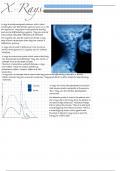
X-rays are electromagnetic photons with a short
wavelength, that fall between gamma and UV in the
EM Spectrum. They have a wave-particle duality
and can be diffracted by crystals. They can also be
transmitted, absorbed, reflected and refracted.
The crystals can also be used to prove that x-rays
have a short wavelength when they are used as a
diffraction grating.
X-rays can be used to determine DNA structure,
atomic arrangements in crystals and in medical
imaging.
X-rays are transverse waves which means that they
can be polarised and defracted. They also travel in
straight lines at the speed of light.
There are 4 interaction methods between x-rays
and matter. These are simple scattering,
photoelectric effect, Compton effect and Pair
production.
X-rays are not charged which means that they cannot be affected by magnetic or electric
fields. However they can ionise air molecules. They penetrate all matter except for high density
materials.
100 kv X-rays can stimulate photoelectric emission
that causes certain materials to fluoresce or
50 kv flow. They can also darken photographic
emulsions.
The detection plate is close to the patient and
the X-ray tube is far away from the patient to
increase image sharpness. The patient keeps
still to reduce blurriness. There is a lead grid
to stop fogging and reduce contrast. There is
a intensifying screen with crystals that
fluoresce to absorb X-rays and re-emit the
energy as visible light.
,X-Ray Production
There are a set of requirements for X-ray production. These are a source of electrons, means of
excelerating electrons and a means of decelerating electrons. There are two methods of producing
electrons. These are interaction between electrons and nucleus, and ejection of an electron and
replacement by dropping to a lower level.
Interaction between electrons and nucleus
A fast moving electron decelerates when it hits
a metal target. The electron penetrates the atom
of the metal target and enters the electric field
of the positive nucleus. The kinetic energy lost
is due to deceleration. The change is then
converted into equal amounts of x-ray
photons.
The shape of target allows exit of x-rays
through the window. This is cooled by oil flow 100KV
as electron collision produces heat. accelerate
to the
electrons
X-ray tube is not 100% efficient
X
mA e-
X-rays RVp e-energy X-ray
energy
Ejection of an electron and replacement by a drop to a lower level
There is no interaction involved. A fast moving electron Ek = ve
collides with a metal target. The fast moving electron
penetrates the atom of the metal target and knocks out of ev
the inner shell an electron. An outershell electron moves F = h
Max
down to occupy the lower energy level. The difference in
energy levels is equal to the energy of the X-ray photon
emitted.
,Photoelectric Effect
The photoelectric effect is the emission of free electrons
from an atom when X-ray photons interact with matter.
The work function is the minimum amount of energy to
free the electron.
Energy of the emitted electrons can be measured to
determine energy of the X-ray and detecting the X-ray
E - E = Ek of the electron + O
2
X-ray Photon energy = work function+ the Max kinetic energy of the electron
In order for the kinetic energy to be a maximum the work function needs to be a minimum
The change in energy levels of an electron dropped to replace ejected electrons is equal to the photon
energy emitted
X-rays are electromagnetic photons with a short
wavelength, that fall between gamma and UV in the
EM Spectrum. They have a wave-particle duality
and can be diffracted by crystals. They can also be
transmitted, absorbed, reflected and refracted.
The crystals can also be used to prove that x-rays
have a short wavelength when they are used as a
diffraction grating.
X-rays can be used to determine DNA structure,
atomic arrangements in crystals and in medical
imaging.
X-rays are transverse waves which means that they
can be polarised and defracted. They also travel in
straight lines at the speed of light.
There are 4 interaction methods between x-rays
and matter. These are simple scattering,
photoelectric effect, Compton effect and Pair
production.
X-rays are not charged which means that they cannot be affected by magnetic or electric
fields. However they can ionise air molecules. They penetrate all matter except for high density
materials.
100 kv X-rays can stimulate photoelectric emission
that causes certain materials to fluoresce or
50 kv flow. They can also darken photographic
emulsions.
The detection plate is close to the patient and
the X-ray tube is far away from the patient to
increase image sharpness. The patient keeps
still to reduce blurriness. There is a lead grid
to stop fogging and reduce contrast. There is
a intensifying screen with crystals that
fluoresce to absorb X-rays and re-emit the
energy as visible light.
,X-Ray Production
There are a set of requirements for X-ray production. These are a source of electrons, means of
excelerating electrons and a means of decelerating electrons. There are two methods of producing
electrons. These are interaction between electrons and nucleus, and ejection of an electron and
replacement by dropping to a lower level.
Interaction between electrons and nucleus
A fast moving electron decelerates when it hits
a metal target. The electron penetrates the atom
of the metal target and enters the electric field
of the positive nucleus. The kinetic energy lost
is due to deceleration. The change is then
converted into equal amounts of x-ray
photons.
The shape of target allows exit of x-rays
through the window. This is cooled by oil flow 100KV
as electron collision produces heat. accelerate
to the
electrons
X-ray tube is not 100% efficient
X
mA e-
X-rays RVp e-energy X-ray
energy
Ejection of an electron and replacement by a drop to a lower level
There is no interaction involved. A fast moving electron Ek = ve
collides with a metal target. The fast moving electron
penetrates the atom of the metal target and knocks out of ev
the inner shell an electron. An outershell electron moves F = h
Max
down to occupy the lower energy level. The difference in
energy levels is equal to the energy of the X-ray photon
emitted.
,Photoelectric Effect
The photoelectric effect is the emission of free electrons
from an atom when X-ray photons interact with matter.
The work function is the minimum amount of energy to
free the electron.
Energy of the emitted electrons can be measured to
determine energy of the X-ray and detecting the X-ray
E - E = Ek of the electron + O
2
X-ray Photon energy = work function+ the Max kinetic energy of the electron
In order for the kinetic energy to be a maximum the work function needs to be a minimum
The change in energy levels of an electron dropped to replace ejected electrons is equal to the photon
energy emitted


