Topic 6: Celestial Observations
Specification
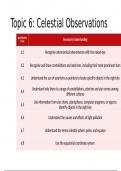
Point Necessary Understanding
6.1 Recognise astronomical phenomenon with the naked-eye
6.2 Recognise and draw constellations and asterisms, including their most prominent stars
6.3 Understand the use of asterisms as pointers to locate specific objects in the night sky
Understand why there is a range of constellations, asterism and star names among
6.4 different cultures
Use information from star charts, planispheres, computer programs, or apps to
6.5
identify objects in the night sky
6.6 Understand the causes and effects of light pollution
6.7 Understand the terms celestial sphere, poles, and equator
6.8 Use the equatorial coordinate system
,6.1 Recognise common astronomical phenomena visible to the naked eye
A few naked eye astronomical phenomenon are
visible in the Earth’s sky:
[4]
Galax
[1] [2] ies
Sun Nebul
ae
Gas and dust
residue from a
supernova
Star
Clusters
Stars held together
[3] by self-gravitation[5]
Moon
,6.1 Recognise common astronomical phenomena visible to the naked eye
A few naked eye astronomical phenomenon are
visible in the Earth’s sky:
[1]
Double
Stars [2] [3]
Constella
tions
A group of stars
Asterisms
Observed patterns
or group of stars
[3]
, 6.1 Recognise common astronomical phenomena visible to the naked eye
A few naked eye astronomical phenomenon are
visible in the Earth’s sky:
Comet
Snowballs of frozen
gas, rock, and dust
that spews a trial
[1] when heated
Meteor
[3]
Dust and debris that Planets
burns up in
[2] atmosphere Celestial bodies that
don’t twinkle
Specification
Point Necessary Understanding
6.1 Recognise astronomical phenomenon with the naked-eye
6.2 Recognise and draw constellations and asterisms, including their most prominent stars
6.3 Understand the use of asterisms as pointers to locate specific objects in the night sky
Understand why there is a range of constellations, asterism and star names among
6.4 different cultures
Use information from star charts, planispheres, computer programs, or apps to
6.5
identify objects in the night sky
6.6 Understand the causes and effects of light pollution
6.7 Understand the terms celestial sphere, poles, and equator
6.8 Use the equatorial coordinate system
,6.1 Recognise common astronomical phenomena visible to the naked eye
A few naked eye astronomical phenomenon are
visible in the Earth’s sky:
[4]
Galax
[1] [2] ies
Sun Nebul
ae
Gas and dust
residue from a
supernova
Star
Clusters
Stars held together
[3] by self-gravitation[5]
Moon
,6.1 Recognise common astronomical phenomena visible to the naked eye
A few naked eye astronomical phenomenon are
visible in the Earth’s sky:
[1]
Double
Stars [2] [3]
Constella
tions
A group of stars
Asterisms
Observed patterns
or group of stars
[3]
, 6.1 Recognise common astronomical phenomena visible to the naked eye
A few naked eye astronomical phenomenon are
visible in the Earth’s sky:
Comet
Snowballs of frozen
gas, rock, and dust
that spews a trial
[1] when heated
Meteor
[3]
Dust and debris that Planets
burns up in
[2] atmosphere Celestial bodies that
don’t twinkle