Topic 2: The Lunar Disc
Specification
Point Necessary Understanding
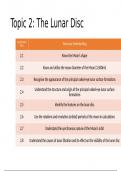
2.1 Know the Moon’s shape
2.2 Know and utilise the mean diameter of the Moon (3,500km)
2.3 Recognise the appearance of the principal naked-eye lunar surface formations
Understand the structure and origin of the principal naked-eye lunar surface
2.4
formations
2.5 Identify the features on the lunar disc
2.6 Use the rotations and revolution (orbital) periods of the moon in calculations
2.7 Understand the synchronous nature of the Moon’s orbit
2.8 Understand the causes of lunar libration and its effect on the visibility of the lunar disc
, 1.1 Know the Moon’s shape
1.2 Know and utilise the mean diameter of the Moon
(3,500km)
[1] [2
Moon’s mean diameter = 3,500km
“Oblate Spheroid” = sphere squashed from the top
Value varies depending on which diamete
Descriptive Feature: Using basic geometry, area calculations ar
the circumference around the poles <
circumference around the equator
Specification
Point Necessary Understanding
2.1 Know the Moon’s shape
2.2 Know and utilise the mean diameter of the Moon (3,500km)
2.3 Recognise the appearance of the principal naked-eye lunar surface formations
Understand the structure and origin of the principal naked-eye lunar surface
2.4
formations
2.5 Identify the features on the lunar disc
2.6 Use the rotations and revolution (orbital) periods of the moon in calculations
2.7 Understand the synchronous nature of the Moon’s orbit
2.8 Understand the causes of lunar libration and its effect on the visibility of the lunar disc
, 1.1 Know the Moon’s shape
1.2 Know and utilise the mean diameter of the Moon
(3,500km)
[1] [2
Moon’s mean diameter = 3,500km
“Oblate Spheroid” = sphere squashed from the top
Value varies depending on which diamete
Descriptive Feature: Using basic geometry, area calculations ar
the circumference around the poles <
circumference around the equator