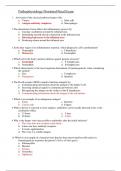
ATI Pathophysiology Proctored Final Exam.
Pathophysiology Proctored Final Exam.1. Activation of the classical pathway begins with: a. Viruses c. Mast cells b. Antigen-antibody complexes d. Macrophages 2. The chemotactic factor affects the inflammatory process by: a. Causing vasodilation around the inflamed area b. Stimulating smooth muscle contraction in the inflamed area c. Directing leukocytes to the inflamed area d. Producing edema around the inflamed area 3. In the later stages of an inflammatory response, which phagocytic cell is predominant? a. Neutrophils c. Chemokines b. Monocytes d. Eosinophils 4. Which cell is the body’s primary defense against parasite invasion? a. Eosinophil c. T lymphocytes b. Neutrophils d. B lymphocytes 5. Which characteristic is the most important determinant of immunogenicity when considering the antigen? a. Size c. Complexity b. Foreignness d. Quantity 6. The B-cell receptor (BCR) complex functions uniquely by: a. Communicating information about the antigen to the helper T cell b. Secreting chemical signals to communicate between cells c. Recognizing the antigen on the surface of the B lymphocyte d. Communicating information about the antigen to the cell nucleus 7. Which is an example of an endogenous antigen? a. Yeast c. Bacteria b. Cancer cells d. Fungus 8. When a person is exposed to most antigens, antibodies can be usually detected in his or her circulation within: a. 12 hours c. 3 days b. 24 hours d. 6 days 9. Why is the herpes virus inaccessible to antibodies after the initial infection? a. The virus does not circulate in the blood. b. It does not have antibody receptors. c. It resists agglutination. d. The virus is a soluble antigen. 10. Which is an example of a bacterial toxin that has been inactivated but still retains its immunogenicity to protect the person? (Select all that apply.) a. Poliomyelitis b. Measles c. Tetanus d. Gonorrhea e. Diphtheria
Written for
- Institution
- Pathophysiology
- Course
- Pathophysiology
Document information
- Uploaded on
- June 13, 2023
- Number of pages
- 12
- Written in
- 2022/2023
- Type
- Exam (elaborations)
- Contains
- Questions & answers
Subjects
-
pathophysiology proctored final exam

Also available in package deal