
The Pupil Reflex
8.2 ii) Understand how the pupil dilates and contracts.
Structure of The Eye
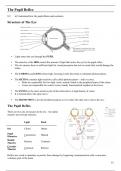
• Light enters the eye through the PUPIL.
• The muscles of the IRIS control the amount of light that enters the eye by the pupil reflex.
• The iris ensures there is sufficient light for visual perception but not too much that would damage the
retina.
• The CORNEA and LENS refract light, focusing it onto the retina to stimulate photoreceptors.
• The RETINA contains light-sensitive cells called photoreceptors – rods or cones.
o Rods are responsible for low light vision, mainly found in the peripheral parts of the retina.
o Cones are responsible for colour vision, mainly found packed together in the fovea.
• The FOVEA is the most sensitive part of the retina due to a high density of cones.
• It is located above the optic nerve.
• The BLIND SPOT is devoid of photoreceptors as it is where the optic nerve leaves the eye.
The Pupil Reflex
There are two sets of muscles in the iris – the radial
muscles and circular muscles:
Light Dark
Iris Closes Opens
Pupil
Constricted Dilated
Diameter
Radial
Relaxes Contracts
Muscles
Circular
Contracts Relaxes
Muscles
Reflex arcs work to minimise or protect from damage by bypassing communication with a conscious,
voluntary part of the brain.
13
8.2 ii) Understand how the pupil dilates and contracts.
Structure of The Eye
• Light enters the eye through the PUPIL.
• The muscles of the IRIS control the amount of light that enters the eye by the pupil reflex.
• The iris ensures there is sufficient light for visual perception but not too much that would damage the
retina.
• The CORNEA and LENS refract light, focusing it onto the retina to stimulate photoreceptors.
• The RETINA contains light-sensitive cells called photoreceptors – rods or cones.
o Rods are responsible for low light vision, mainly found in the peripheral parts of the retina.
o Cones are responsible for colour vision, mainly found packed together in the fovea.
• The FOVEA is the most sensitive part of the retina due to a high density of cones.
• It is located above the optic nerve.
• The BLIND SPOT is devoid of photoreceptors as it is where the optic nerve leaves the eye.
The Pupil Reflex
There are two sets of muscles in the iris – the radial
muscles and circular muscles:
Light Dark
Iris Closes Opens
Pupil
Constricted Dilated
Diameter
Radial
Relaxes Contracts
Muscles
Circular
Contracts Relaxes
Muscles
Reflex arcs work to minimise or protect from damage by bypassing communication with a conscious,
voluntary part of the brain.
13


