
Gametes
Gametes
• Gametes are the male and female sex cells found in all organisms that reproduce sexually.
• They join together at fertilisation to form a zygote, which divides and develops into a new organism.
• In animals, the male gametes are sperm and the female gametes are egg cells (ova).
• Gametes are produced by meiosis in reproductive organs.
Chromosomes in Gametes
• Normal body cells contain the full number of chromosomes. E.g. humans have 2 sets of 23 chromosomes –
one from each parent – giving each body cell a total of 46 chromosomes.
• Gametes contain half the number of chromosomes as body cells – they only contain 1 set.
• Since each gamete contains half of the full number of chromosomes, fertilisation creates a zygote with the full
number of chromosomes.
• (Fertilisation: The exact moment when the nuclei of the male and female gametes fuse.)
• Combining genetic material from two individuals makes offspring that are genetically unique.
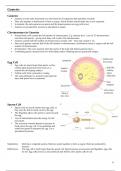
Egg Cell
• Egg cells are much larger than sperm, as they
contain lipid and protein food reserves to
nourish the developing embryo.
• Follicle cells form a protective coating.
• The zona pellucida is a protective glycoprotein
layer that sperm have to penetrate.
Sperm Cell
• Sperm cells are much smaller than egg cells, as
they must be able to easily swim to the egg.
• The flagellum allows the sperm to swim towards
the egg.
• Lots of mitochondria provide energy for tail
movement.
• The acrosome contains digestive enzymes to
break down the egg cell’s zona pellucida and
enable the sperm to penetrate the egg. It is a
specialised lysosome.
Similarities: Both have a haploid nucleus. Both are joined together to form a zygote. Both are produced by
meiosis.
Differences: The egg cell is much larger than the sperm cell. Sperm possess an acrosome and flagellum; egg cells
do not. Egg cells possess a zona pellucida and follicle cells; sperm cells do not.
9
, Fertilisation
Acrosome Reaction
1. Sperm reach the ovum.
2. The acrosome reaction is triggered by chemicals released from the cells surrounding the ovum.
3. The acrosome is a vesicle containing digestive enzymes. It swells and fuses with the sperm cell surface
membrane.
4. Digestive enzymes from the acrosome are released by exocytosis
5. The digestive enzymes break through the corona radiata and the zona pellucida.
Cortical Reaction
1. The sperm’s membrane fuses with the egg cell’s membrane.
2. The sperm nucleus enters the ovum. The tail is discarded
3. The egg cell releases the contents of vesicles called cortical granules (lysosomes) into the space between the
cell membrane and the zona pellucida
4. Enzymes from the cortical granules cause the zona pellucida to thicken, making it impenetrable to other
sperm. They are released by exocytosis.
5. The sperm nucleus fuses with the egg nucleus.
Similarities: Both reactions involve exocytosis and the use of vesicles.
Difference: In the acrosome reaction, the zona pellucida is broken down by digestive enzymes, whereas in the
cortical reaction, the zona pellucida is thickened by cortical granules.
10
Gametes
• Gametes are the male and female sex cells found in all organisms that reproduce sexually.
• They join together at fertilisation to form a zygote, which divides and develops into a new organism.
• In animals, the male gametes are sperm and the female gametes are egg cells (ova).
• Gametes are produced by meiosis in reproductive organs.
Chromosomes in Gametes
• Normal body cells contain the full number of chromosomes. E.g. humans have 2 sets of 23 chromosomes –
one from each parent – giving each body cell a total of 46 chromosomes.
• Gametes contain half the number of chromosomes as body cells – they only contain 1 set.
• Since each gamete contains half of the full number of chromosomes, fertilisation creates a zygote with the full
number of chromosomes.
• (Fertilisation: The exact moment when the nuclei of the male and female gametes fuse.)
• Combining genetic material from two individuals makes offspring that are genetically unique.
Egg Cell
• Egg cells are much larger than sperm, as they
contain lipid and protein food reserves to
nourish the developing embryo.
• Follicle cells form a protective coating.
• The zona pellucida is a protective glycoprotein
layer that sperm have to penetrate.
Sperm Cell
• Sperm cells are much smaller than egg cells, as
they must be able to easily swim to the egg.
• The flagellum allows the sperm to swim towards
the egg.
• Lots of mitochondria provide energy for tail
movement.
• The acrosome contains digestive enzymes to
break down the egg cell’s zona pellucida and
enable the sperm to penetrate the egg. It is a
specialised lysosome.
Similarities: Both have a haploid nucleus. Both are joined together to form a zygote. Both are produced by
meiosis.
Differences: The egg cell is much larger than the sperm cell. Sperm possess an acrosome and flagellum; egg cells
do not. Egg cells possess a zona pellucida and follicle cells; sperm cells do not.
9
, Fertilisation
Acrosome Reaction
1. Sperm reach the ovum.
2. The acrosome reaction is triggered by chemicals released from the cells surrounding the ovum.
3. The acrosome is a vesicle containing digestive enzymes. It swells and fuses with the sperm cell surface
membrane.
4. Digestive enzymes from the acrosome are released by exocytosis
5. The digestive enzymes break through the corona radiata and the zona pellucida.
Cortical Reaction
1. The sperm’s membrane fuses with the egg cell’s membrane.
2. The sperm nucleus enters the ovum. The tail is discarded
3. The egg cell releases the contents of vesicles called cortical granules (lysosomes) into the space between the
cell membrane and the zona pellucida
4. Enzymes from the cortical granules cause the zona pellucida to thicken, making it impenetrable to other
sperm. They are released by exocytosis.
5. The sperm nucleus fuses with the egg nucleus.
Similarities: Both reactions involve exocytosis and the use of vesicles.
Difference: In the acrosome reaction, the zona pellucida is broken down by digestive enzymes, whereas in the
cortical reaction, the zona pellucida is thickened by cortical granules.
10


