Physics
● To find the amount of time it takes a pendulum to
make a spin, time ~25 circles, and then divide by
https://www.freeexamacademy.com/revision/ the same number as the number of circles.
P2. Motion
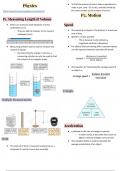
P1. Measuring Length & Volume
● Rulers can measure small distances of a few Speed
centimeters (cm).
○ They are able to measure to the nearest ● The speed of an object is the distance it travels per
millimeter (mm). unit of time.
● Speed is a scalar quantity
○ This is because it only contains a
magnitude (without a direction).
● Measuring cylinders can be used to measure the ● For objects that are moving with a constant speed,
volume of liquids. use the equation below to calculate the speed:
○ By measuring the change in volume, a
measuring cylinder can also be used to find
the volume of an irregular shape.
● The equation for calculating the average speed of
an object is:
Triangle
Multiple Measurements
Acceleration
● is defined as the rate of change in velocity
○ In other words, it describes how much an
object's velocity changes every second
TIME
● The equation below is used to calculate the
average acceleration of an object:
● The interval of time is measured using clocks or a
stopwatch SI unit for time is the second(s)
, Distance time graphs
● Where:
○ a = acceleration in meters per second
squared (m/s2).
○ Δv = change in velocity in meters per
second (m/s).
○ Δt = time taken in seconds (s).
● The change in velocity is found by the difference
between the initial and final velocity, as written
below:
change in velocity = final velocity − initial velocity
Mass and Weight
● Mass is a measure of the quantity of matter in an
object at rest relative to the observer
○ Mass is a scalar quantity.
○ The SI unit for mass is the kilogram (kg).
● Weight is a gravitational force on an object with
mass.
○ Weight is a force, so it is a vector quantity
Speed time graphs ○ The SI units for force are newton's (N).
● Density is defined as:
The mass per unit volume of a material
● Objects made from low-density materials typically
have a low mass
● Similarly, sized objects made from high-density
materials have a high mass
○ For example, a bag full of feathers is far
lighter compared to a similar bag full of
metal
● To find the amount of time it takes a pendulum to
make a spin, time ~25 circles, and then divide by
https://www.freeexamacademy.com/revision/ the same number as the number of circles.
P2. Motion
P1. Measuring Length & Volume
● Rulers can measure small distances of a few Speed
centimeters (cm).
○ They are able to measure to the nearest ● The speed of an object is the distance it travels per
millimeter (mm). unit of time.
● Speed is a scalar quantity
○ This is because it only contains a
magnitude (without a direction).
● Measuring cylinders can be used to measure the ● For objects that are moving with a constant speed,
volume of liquids. use the equation below to calculate the speed:
○ By measuring the change in volume, a
measuring cylinder can also be used to find
the volume of an irregular shape.
● The equation for calculating the average speed of
an object is:
Triangle
Multiple Measurements
Acceleration
● is defined as the rate of change in velocity
○ In other words, it describes how much an
object's velocity changes every second
TIME
● The equation below is used to calculate the
average acceleration of an object:
● The interval of time is measured using clocks or a
stopwatch SI unit for time is the second(s)
, Distance time graphs
● Where:
○ a = acceleration in meters per second
squared (m/s2).
○ Δv = change in velocity in meters per
second (m/s).
○ Δt = time taken in seconds (s).
● The change in velocity is found by the difference
between the initial and final velocity, as written
below:
change in velocity = final velocity − initial velocity
Mass and Weight
● Mass is a measure of the quantity of matter in an
object at rest relative to the observer
○ Mass is a scalar quantity.
○ The SI unit for mass is the kilogram (kg).
● Weight is a gravitational force on an object with
mass.
○ Weight is a force, so it is a vector quantity
Speed time graphs ○ The SI units for force are newton's (N).
● Density is defined as:
The mass per unit volume of a material
● Objects made from low-density materials typically
have a low mass
● Similarly, sized objects made from high-density
materials have a high mass
○ For example, a bag full of feathers is far
lighter compared to a similar bag full of
metal