
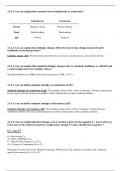
3.1.4.1 Can you explain that reactions can be endothermic or exothermic?
Endothermic Exothermic
Energy Requires energy Releases Energy
Bond Bond breaking Bond making
ΔH Positive Negative
3.1.4.1 Can you explain that enthalpy change (ΔH) is the heat energy change measured under
conditions of constant pressure?
Enthalpy change (ΔH): The heat energy transferred in a reaction at constant pressure, measured in KJ mol-1.
3.1.4.1 Can you explain that standard enthalpy changes refer to standard conditions, i.e. 100 kPa and
a stated temperature (for example, ΔH298)?
Standard conditions are 100kPa and a stated temperature (298K = 25 °C).
3.1.4.1 Can you define standard enthalpy of combustion (ΔCH)?
Standard Enthalpy of Combustion (ΔCH): The enthalpy change when 1 mole of substance is burned completely in
excess oxygen with all reactants and products in their standard states in their standard conditions.
3.1.4.1 Can you define standard enthalpy of formation (ΔfH)?
Standard Enthalpy of Formation (ΔfH): The enthalpy change when 1 mole of substance is formed from its
constituent elements with all reactants and products in their standard states under standard conditions.
3.1.4.2 Can you explain that heat change, q, in a reaction is given by the equation q = mcΔT where m
is the mass of the substance that has a temperature change ΔT and a specific heat capacity c?
Q = mcΔT
Q = Heat energy (J)
m = Mass of Substance (g)
C = Specific Heat Capacity (J g-1 K-1)
ΔT = Change in Temperature (K or °C)
Remember: Use the mass of the substance being heat, NOT the fuel. The substance is usually water, which has
specific heat capacity of 4.18 J g-1 K-1.
, 3.1.4.2 Can you use the equation q = mcΔT to calculate the molar enthalpy change for a reaction?
ΔH = Q/n
ΔH = Molar Enthalpy Change
Q = Heat Energy (J)
n = moles
3.1.4.2 Can you use the equation q = mcΔT in related calculations?
3.1.4 Have you carried out a practical actvity to measure an enthalpy change?
Combustion Reaction:
• To find the enthalpy of combustion of a flammable liquid, burn the liquid in a calorimeter.
• As the fuel burns, it heats the water.
• Calculate the heat energy that has been absorbed by the water (Q) using the mass of the water (m), the
temperature change (ΔT) and the specific heat capacity of water (4.18 J g-1 K-1).
• Calculate the number of moles of fuel burnt to find the molar enthalpy change.
Sources of error:
• Ideally, all of the heat released by the fuel would be absorbed by the water, but in any calorimetry experiment,
heat is always lost to the surroundings. This means that the value of ΔH will be lower than expected.
• When you burn a fuel, some of the combustion may be incomplete (less energy is given out, so ΔH is lower
than expected).
• The reaction is not instantaneous, so it is unclear when the reaction has finished. Therefore, the value of ΔT
may not be accurate.
• One way to reduce error (from heat lost to the surroundings) is to measure the heat capacity of the calorimeter
as a whole (found by determining ΔT when a known amount of substance with an accurately known ΔH is
tested).
Calorimetry can also be used to calculate the enthalpy change for reactions that happen in solution, such as
neutralisation, dissolution or displacement.
Neutralisation Reaction:
• To find the enthalpy change for a neutralisation reaction, add a known volume of acid to an insulated
container (e.g. polystyrene cup) and measure the temperature.
• Then add a known volume of alkali and record the temperature of the mixture at regular intervals (e.g. every
minute) over a period of time (e.g. 15 minutes).
• Stir the solution to ensure it is evenly heated.
• Find the temperature change of the solution and use it to calculate the enthalpy change of the reaction.
• You can assume that all solutions have the same density as water (i.e. 1cm3 of solution has a mass of 1g).
3.1.4.3 Can you explain Hess's law?
Hess’s Law: the enthalpy change for a reaction is independent of rates taken (and only depends on the initial and final
states).
I.e. Enthalpy Change A → B is the same as A → C → B
Hess’s law can be used to calculate enthalpy changes that you can’t find directly by doing an experiment.
Endothermic Exothermic
Energy Requires energy Releases Energy
Bond Bond breaking Bond making
ΔH Positive Negative
3.1.4.1 Can you explain that enthalpy change (ΔH) is the heat energy change measured under
conditions of constant pressure?
Enthalpy change (ΔH): The heat energy transferred in a reaction at constant pressure, measured in KJ mol-1.
3.1.4.1 Can you explain that standard enthalpy changes refer to standard conditions, i.e. 100 kPa and
a stated temperature (for example, ΔH298)?
Standard conditions are 100kPa and a stated temperature (298K = 25 °C).
3.1.4.1 Can you define standard enthalpy of combustion (ΔCH)?
Standard Enthalpy of Combustion (ΔCH): The enthalpy change when 1 mole of substance is burned completely in
excess oxygen with all reactants and products in their standard states in their standard conditions.
3.1.4.1 Can you define standard enthalpy of formation (ΔfH)?
Standard Enthalpy of Formation (ΔfH): The enthalpy change when 1 mole of substance is formed from its
constituent elements with all reactants and products in their standard states under standard conditions.
3.1.4.2 Can you explain that heat change, q, in a reaction is given by the equation q = mcΔT where m
is the mass of the substance that has a temperature change ΔT and a specific heat capacity c?
Q = mcΔT
Q = Heat energy (J)
m = Mass of Substance (g)
C = Specific Heat Capacity (J g-1 K-1)
ΔT = Change in Temperature (K or °C)
Remember: Use the mass of the substance being heat, NOT the fuel. The substance is usually water, which has
specific heat capacity of 4.18 J g-1 K-1.
, 3.1.4.2 Can you use the equation q = mcΔT to calculate the molar enthalpy change for a reaction?
ΔH = Q/n
ΔH = Molar Enthalpy Change
Q = Heat Energy (J)
n = moles
3.1.4.2 Can you use the equation q = mcΔT in related calculations?
3.1.4 Have you carried out a practical actvity to measure an enthalpy change?
Combustion Reaction:
• To find the enthalpy of combustion of a flammable liquid, burn the liquid in a calorimeter.
• As the fuel burns, it heats the water.
• Calculate the heat energy that has been absorbed by the water (Q) using the mass of the water (m), the
temperature change (ΔT) and the specific heat capacity of water (4.18 J g-1 K-1).
• Calculate the number of moles of fuel burnt to find the molar enthalpy change.
Sources of error:
• Ideally, all of the heat released by the fuel would be absorbed by the water, but in any calorimetry experiment,
heat is always lost to the surroundings. This means that the value of ΔH will be lower than expected.
• When you burn a fuel, some of the combustion may be incomplete (less energy is given out, so ΔH is lower
than expected).
• The reaction is not instantaneous, so it is unclear when the reaction has finished. Therefore, the value of ΔT
may not be accurate.
• One way to reduce error (from heat lost to the surroundings) is to measure the heat capacity of the calorimeter
as a whole (found by determining ΔT when a known amount of substance with an accurately known ΔH is
tested).
Calorimetry can also be used to calculate the enthalpy change for reactions that happen in solution, such as
neutralisation, dissolution or displacement.
Neutralisation Reaction:
• To find the enthalpy change for a neutralisation reaction, add a known volume of acid to an insulated
container (e.g. polystyrene cup) and measure the temperature.
• Then add a known volume of alkali and record the temperature of the mixture at regular intervals (e.g. every
minute) over a period of time (e.g. 15 minutes).
• Stir the solution to ensure it is evenly heated.
• Find the temperature change of the solution and use it to calculate the enthalpy change of the reaction.
• You can assume that all solutions have the same density as water (i.e. 1cm3 of solution has a mass of 1g).
3.1.4.3 Can you explain Hess's law?
Hess’s Law: the enthalpy change for a reaction is independent of rates taken (and only depends on the initial and final
states).
I.e. Enthalpy Change A → B is the same as A → C → B
Hess’s law can be used to calculate enthalpy changes that you can’t find directly by doing an experiment.


