
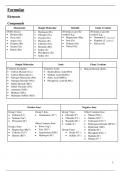
Formulae
Elements
Compounds
Monatomic Simple Molecular Metallic Giant Covalent
(Noble Gases) • Hydrogen (H2) (Formula is just the (Formula is just the
• Helium (He) • Nitrogen (N2) symbol) E.g.: symbol) E.g.:
• Neon (Ne) • Oxygen (O2) • Magnesium (Mg) • Diamond (C (Diamond))
• Argon (Ar) • Fluorine (F2) • Iron (Fe) • Graphite (C (graphite))
• Krypton (Kr) • Chlorine (Cl2) • Sodium (Na) • Silicon (Si)
• Xenon (Xe) • Bromine (Br2) • Nickel (Ni)
• Radon (Rn) • Iodine (I2)
• Phosphorus (P4)
• Sulfur (S2)
Simple Molecular Ionic Giant Covalent
Common Examples: Common Acids: • Silicon Dioxide (SiO2)
• Carbon Dioxide (Co2) • Hydrochloric Acid (HCl)
• Carbon Monoxide (C) • Sulfuric Acid (H2SO4)
• Nitrogen Monoxide (NO) • Nitric Acid (HNO3)
• Nitrogen Dioxide (NO2) • Phosphoric Acid (H3PO4)
• Sulfur Dioxide (SO2)
• Sulfur Trioxide (SO3)
• Ammonia (NH3)
• Methane (CH4)
• Hydrogen Sulfide (H2S)
Positive Ions Negative Ions
Group 1 Ions: Group 3 Ions: Group 7 Ions: Other Common Ions:
• Lithium (Li+) • Aluminium (Al3+) • Fluoride (F–) • Nitrate (NO3–)
• Sodium (Na+) • Chloride (Cl–) • Sulfate (SO42–)
• Potassium (K+) • Bromide (Br–) • Carbonate (CO32–)
Other Common Ions: • Iodide (I–) • Hydrogencarbonate (HCO3–)
Group 2 Ions: • Silver (Ag+) • Hydroxide (OH–)
• Magnesium (Mg2+) • Zinc (Zn2+) Group 6 Ions: • Hydride (H–)
• Calcium (Ca2+) • Ammonium (NH4+) • Oxide (O2–) • Phosphate (PO43–)
• Barium (Ba2+) • Hydrogen (H+) • Sulfide (S2–) • Hydride (H–)
• Nitride (N3–)
1
,Ionic Bonding
Ionic bonding is the result of electrostatic attraction between oppositely charged ions, which results in a crystal lattice
structure.
Misconceptions of Ionic Bonding
1. Ions in ionic bonds are not only bonded to the ion it donated its electron to.
2. There are no atoms in ionic compounds, only ions.
Properties of Ionic Bonding
Very high melting and boiling points
• Ionic bonds between oppositely charged ions are very strong.
• Lots of energy is required to overcome and break this force of attraction.
Very brittle
• Ionic compounds have a regular lattice structure.
• If one layer in the lattice moves, ions of the same charge will move next to each other.
• The repulsion between ions of the same charge causes the structure to break.
Conducts electricity when molten or in aqueous solution
• When molten or in aqueous solution, the ions are free to move, so can carry a charge.
• (When solid, the ions are held in place, so cannot carry a charge).
Can dissolve in polar solvents, like water
• In polar molecules, part of the molecule has a small negative charge and other parts have small positive
charges.
• These charged parts pull ions away from the lattice, causing it to dissolve.
Metallic Bonding
Metallic bonding is the electrostatic attraction between the positively charged metal cations in the lattice and the
negatively charged delocalised electrons.
Properties of Metallic Crystals
Very high melting points
• There are strong forces of attraction between the positive cations and the negatively charged delocalised
electrons.
• Lots of energy is required to overcome and break this force of attraction.
Conducts electricity
• Metallic crystals have a sea of delocalised electrons which are free to move, so can carry a charge.
Malleable / Ductile
• The layers of cations in a metallic crystal are in a regular lattice arrangement with equally sized ions, so the
layers can slide over each other.
Shiny
• Due to the delocalised electrons.
2
, Covalent Bonding
A covalent bond is the attraction between a shared pair of electrons and 2 nuclei.
Covalent bonds are the result of electrostatic attraction between the area of electron density (pair of e -) and the two
nuclei. Covalent bonds are very strong.
Giant covalent structures have no set numbers of atoms, e.g. diamond can have any large number of carbon atoms.
Simple covalent molecules have a set number of atoms, e.g. water = H20 or hydrogen peroxide = H2O2.
Exceptions to the Octet Rule
• Molecules such as Boron Trifluoride (BF3) is technically ‘electron deficient’ (it does not
have a full shell).
• Phosphorus can form either PCl3 or PCl5, depending on how much Cl is available.
• In PCl5, phosphorus is said to have expanded its octet.
Properties of Covalent Substances
(Generally) Non-Conductive
• There are no ions or delocalised electrons in covalent substances to carry a charge.
Simple Covalent Molecules have low melting/boiling points (so are gases, liquids or low m/p solids)
• To melt/boil simple covalent molecules, you only need to break the weak intermolecular forces, so little
energy is required.
Giant Covalent Structures all have very high melting/boiling points.
• To melt/boil giant covalent structures, you have to overcome the very strong covalent bonds between the
atoms, so lots of energy is required.
Diamond and Graphite Sublime
• Both diamond and graphite are giant covalent structures: they have such high melting points that upon
reaching the melting point, the atoms spread far apart and form a gas.
Diamond
• Each carbon atom is covalently bonded to 4 other carbon atoms, arranged in a tetrahedral shape – this makes
diamond extremely hard.
• All the outer electrons are held in localised bonds; hence diamond does not conduct electricity.
Graphite
• The carbon atoms are arranged in sheets of flat hexagons covalently bonded with 3 bonds each – the 4th outer
electron of each carbon atom is delocalised. The sheets are held together by Van der Waals forces.
• The delocalised electrons are free to move along the sheets and so can carry a charge.
• The weak bonds between the layers in graphite are easily broken, so the sheets can slide over each other.
3
Elements
Compounds
Monatomic Simple Molecular Metallic Giant Covalent
(Noble Gases) • Hydrogen (H2) (Formula is just the (Formula is just the
• Helium (He) • Nitrogen (N2) symbol) E.g.: symbol) E.g.:
• Neon (Ne) • Oxygen (O2) • Magnesium (Mg) • Diamond (C (Diamond))
• Argon (Ar) • Fluorine (F2) • Iron (Fe) • Graphite (C (graphite))
• Krypton (Kr) • Chlorine (Cl2) • Sodium (Na) • Silicon (Si)
• Xenon (Xe) • Bromine (Br2) • Nickel (Ni)
• Radon (Rn) • Iodine (I2)
• Phosphorus (P4)
• Sulfur (S2)
Simple Molecular Ionic Giant Covalent
Common Examples: Common Acids: • Silicon Dioxide (SiO2)
• Carbon Dioxide (Co2) • Hydrochloric Acid (HCl)
• Carbon Monoxide (C) • Sulfuric Acid (H2SO4)
• Nitrogen Monoxide (NO) • Nitric Acid (HNO3)
• Nitrogen Dioxide (NO2) • Phosphoric Acid (H3PO4)
• Sulfur Dioxide (SO2)
• Sulfur Trioxide (SO3)
• Ammonia (NH3)
• Methane (CH4)
• Hydrogen Sulfide (H2S)
Positive Ions Negative Ions
Group 1 Ions: Group 3 Ions: Group 7 Ions: Other Common Ions:
• Lithium (Li+) • Aluminium (Al3+) • Fluoride (F–) • Nitrate (NO3–)
• Sodium (Na+) • Chloride (Cl–) • Sulfate (SO42–)
• Potassium (K+) • Bromide (Br–) • Carbonate (CO32–)
Other Common Ions: • Iodide (I–) • Hydrogencarbonate (HCO3–)
Group 2 Ions: • Silver (Ag+) • Hydroxide (OH–)
• Magnesium (Mg2+) • Zinc (Zn2+) Group 6 Ions: • Hydride (H–)
• Calcium (Ca2+) • Ammonium (NH4+) • Oxide (O2–) • Phosphate (PO43–)
• Barium (Ba2+) • Hydrogen (H+) • Sulfide (S2–) • Hydride (H–)
• Nitride (N3–)
1
,Ionic Bonding
Ionic bonding is the result of electrostatic attraction between oppositely charged ions, which results in a crystal lattice
structure.
Misconceptions of Ionic Bonding
1. Ions in ionic bonds are not only bonded to the ion it donated its electron to.
2. There are no atoms in ionic compounds, only ions.
Properties of Ionic Bonding
Very high melting and boiling points
• Ionic bonds between oppositely charged ions are very strong.
• Lots of energy is required to overcome and break this force of attraction.
Very brittle
• Ionic compounds have a regular lattice structure.
• If one layer in the lattice moves, ions of the same charge will move next to each other.
• The repulsion between ions of the same charge causes the structure to break.
Conducts electricity when molten or in aqueous solution
• When molten or in aqueous solution, the ions are free to move, so can carry a charge.
• (When solid, the ions are held in place, so cannot carry a charge).
Can dissolve in polar solvents, like water
• In polar molecules, part of the molecule has a small negative charge and other parts have small positive
charges.
• These charged parts pull ions away from the lattice, causing it to dissolve.
Metallic Bonding
Metallic bonding is the electrostatic attraction between the positively charged metal cations in the lattice and the
negatively charged delocalised electrons.
Properties of Metallic Crystals
Very high melting points
• There are strong forces of attraction between the positive cations and the negatively charged delocalised
electrons.
• Lots of energy is required to overcome and break this force of attraction.
Conducts electricity
• Metallic crystals have a sea of delocalised electrons which are free to move, so can carry a charge.
Malleable / Ductile
• The layers of cations in a metallic crystal are in a regular lattice arrangement with equally sized ions, so the
layers can slide over each other.
Shiny
• Due to the delocalised electrons.
2
, Covalent Bonding
A covalent bond is the attraction between a shared pair of electrons and 2 nuclei.
Covalent bonds are the result of electrostatic attraction between the area of electron density (pair of e -) and the two
nuclei. Covalent bonds are very strong.
Giant covalent structures have no set numbers of atoms, e.g. diamond can have any large number of carbon atoms.
Simple covalent molecules have a set number of atoms, e.g. water = H20 or hydrogen peroxide = H2O2.
Exceptions to the Octet Rule
• Molecules such as Boron Trifluoride (BF3) is technically ‘electron deficient’ (it does not
have a full shell).
• Phosphorus can form either PCl3 or PCl5, depending on how much Cl is available.
• In PCl5, phosphorus is said to have expanded its octet.
Properties of Covalent Substances
(Generally) Non-Conductive
• There are no ions or delocalised electrons in covalent substances to carry a charge.
Simple Covalent Molecules have low melting/boiling points (so are gases, liquids or low m/p solids)
• To melt/boil simple covalent molecules, you only need to break the weak intermolecular forces, so little
energy is required.
Giant Covalent Structures all have very high melting/boiling points.
• To melt/boil giant covalent structures, you have to overcome the very strong covalent bonds between the
atoms, so lots of energy is required.
Diamond and Graphite Sublime
• Both diamond and graphite are giant covalent structures: they have such high melting points that upon
reaching the melting point, the atoms spread far apart and form a gas.
Diamond
• Each carbon atom is covalently bonded to 4 other carbon atoms, arranged in a tetrahedral shape – this makes
diamond extremely hard.
• All the outer electrons are held in localised bonds; hence diamond does not conduct electricity.
Graphite
• The carbon atoms are arranged in sheets of flat hexagons covalently bonded with 3 bonds each – the 4th outer
electron of each carbon atom is delocalised. The sheets are held together by Van der Waals forces.
• The delocalised electrons are free to move along the sheets and so can carry a charge.
• The weak bonds between the layers in graphite are easily broken, so the sheets can slide over each other.
3


