
Article: How effective are
pharmaceuticals for cognitive
enhancement in healthy adults?
- Carl A Roberts, Andrew Jones, Harry Sumnall, Suzanne H Gage & Catharine Montgomery -
-2020-
Abstract
Modafinil, methyphenidate (MPH) and D -amphetamine (D-amph) are putative cognitive enhancers.
However, efficacy of cognitive enhancement has yet to be fully established. We examined cognitive
performance in healthy non-sleep-deprived adults following modafinil, MPH, or D -amph vs placebo
in 3 meta-analyses, using subgroup analysis by cognitive domain; executive functions (updating,
switching, inhibitory control, access to semantic/long term memory), spatial working memory, recall,
selective attention, and sustained attention. We adhered to PRISMA (evidence-based). We identified
k = 47 studies for analysis; k = 14 studies (64 effect sizes) for modafinil, k = 24 studies (47 effect sizes)
for Methylphenidate, and k = 10 (27 effect sizes) for D-amph.
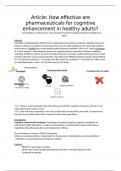
Improvements
Modafinil Methyphenidate (MPH) D-amphetamine (D-amph)
recall sustained attention
memory up- dating
Inhibitory control
Note. There is a user perception that these drugs are effective cognitive enhancers, but this is not
supported by the evidence so far.
Note. Data with these stimulants is far from positive because the effects are small, in experiments
that do not accurately reflect their actual use in the wider population.
Introduction
Cognitive enhancement strategies: Techniques intended to improve cognitive capabilities of
cognitively healthy individuals, usually by administration of psychoactive drugs, particularly in
cognitively demanding education and employment settings.
The medication is used for: ADHD & Narcolepsy
Works on neurotransmitters: Norepinephrine & Dopamine (catecholamine neurotransmitters) *
*Modafinil is a weak dopamine transporter inhibitor
Method
- PRISMA in searching for studies
- Studies had to have healthy participants that where not sleep deprived (18+)
- Compared to placebo
pharmaceuticals for cognitive
enhancement in healthy adults?
- Carl A Roberts, Andrew Jones, Harry Sumnall, Suzanne H Gage & Catharine Montgomery -
-2020-
Abstract
Modafinil, methyphenidate (MPH) and D -amphetamine (D-amph) are putative cognitive enhancers.
However, efficacy of cognitive enhancement has yet to be fully established. We examined cognitive
performance in healthy non-sleep-deprived adults following modafinil, MPH, or D -amph vs placebo
in 3 meta-analyses, using subgroup analysis by cognitive domain; executive functions (updating,
switching, inhibitory control, access to semantic/long term memory), spatial working memory, recall,
selective attention, and sustained attention. We adhered to PRISMA (evidence-based). We identified
k = 47 studies for analysis; k = 14 studies (64 effect sizes) for modafinil, k = 24 studies (47 effect sizes)
for Methylphenidate, and k = 10 (27 effect sizes) for D-amph.
Improvements
Modafinil Methyphenidate (MPH) D-amphetamine (D-amph)
recall sustained attention
memory up- dating
Inhibitory control
Note. There is a user perception that these drugs are effective cognitive enhancers, but this is not
supported by the evidence so far.
Note. Data with these stimulants is far from positive because the effects are small, in experiments
that do not accurately reflect their actual use in the wider population.
Introduction
Cognitive enhancement strategies: Techniques intended to improve cognitive capabilities of
cognitively healthy individuals, usually by administration of psychoactive drugs, particularly in
cognitively demanding education and employment settings.
The medication is used for: ADHD & Narcolepsy
Works on neurotransmitters: Norepinephrine & Dopamine (catecholamine neurotransmitters) *
*Modafinil is a weak dopamine transporter inhibitor
Method
- PRISMA in searching for studies
- Studies had to have healthy participants that where not sleep deprived (18+)
- Compared to placebo


