Section 1 : Physical Chemistry
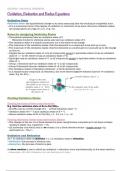
Oxidation, Reduction and Redox Equations
Oxidation State
Oxidation state: the hypothetical charge on an atom assuming that the bonding is completely ionic.
• It is a numerical value of the degree of oxidation or reduction of an atom. Non-zero oxidation states
are always given as a sign w/ a no. (e.g. +2).
Rules for Assigning Oxidation States
• Uncombined elements have an oxidation state of 0.
- Elements bonded to identical atoms also have an oxidation state of 0.
• The oxidation state of a simple monatomic ion is the same as its charge.
• The total sum of the oxidation states of all the elements in a compound must add up to zero.
• The total sum of the oxidation states of all the elements in a molecular ion must add up to the charge
on the ion.
• Oxygen has an oxidation state of -2 in all compounds except in peroxides where it has an oxidation
state of -1 + in OF2 where it has an oxidation state of +2.
• Hydrogen has an oxidation state of +1 in all compounds except in hydrides where it has an oxidation
state of -1.
• Group 1 elements have an oxidation state of +1 in all compounds.
• Group 2 elements have an oxidation state of +2 in all compounds.
• The oxidation states of transition elements + p block elements vary.
• In a simple binary compound (2 elements), the more electronegative element has the -ve oxidation
state. E.g. for SO42-…
Finding Oxidation States
Finding Oxidation States from Formulae
E.g. nd the oxidation state of Zn in Zn(OH)2.
• Zn(OH)2 has an overall charge of 0 ∴ overall oxidation state = 0
• Oxidation state of O = -2 and oxidation state of H = +1
• Hence oxidation state of Zn in Zn(OH)2 = 0 - 2 x (-2 + 1) = +2
Finding Oxidation States from Systematic Names
• The charge on the ion of a d block element is given using Roman numerals as it can have multiple
oxidation states (e.g. copper(II) = +2).
• All molecular ions which end in -te contain d or p block element atoms + oxygen atoms (e.g.
carbonate ion = CO32-).
Oxidation and Reduction
An ↑ in oxidation state is oxidation + a ↓ in oxidation state is reduction.
• Oxidation: the process of electron loss.
• Reduction: the process of electron gain.
A redox reaction is one in which an oxidation + reduction occur simultaneously in the same reaction.
• Remember: OIL RIG (Oxidation Is Loss Reduction Is Gain)
fi
Oxidation, Reduction and Redox Equations
Oxidation State
Oxidation state: the hypothetical charge on an atom assuming that the bonding is completely ionic.
• It is a numerical value of the degree of oxidation or reduction of an atom. Non-zero oxidation states
are always given as a sign w/ a no. (e.g. +2).
Rules for Assigning Oxidation States
• Uncombined elements have an oxidation state of 0.
- Elements bonded to identical atoms also have an oxidation state of 0.
• The oxidation state of a simple monatomic ion is the same as its charge.
• The total sum of the oxidation states of all the elements in a compound must add up to zero.
• The total sum of the oxidation states of all the elements in a molecular ion must add up to the charge
on the ion.
• Oxygen has an oxidation state of -2 in all compounds except in peroxides where it has an oxidation
state of -1 + in OF2 where it has an oxidation state of +2.
• Hydrogen has an oxidation state of +1 in all compounds except in hydrides where it has an oxidation
state of -1.
• Group 1 elements have an oxidation state of +1 in all compounds.
• Group 2 elements have an oxidation state of +2 in all compounds.
• The oxidation states of transition elements + p block elements vary.
• In a simple binary compound (2 elements), the more electronegative element has the -ve oxidation
state. E.g. for SO42-…
Finding Oxidation States
Finding Oxidation States from Formulae
E.g. nd the oxidation state of Zn in Zn(OH)2.
• Zn(OH)2 has an overall charge of 0 ∴ overall oxidation state = 0
• Oxidation state of O = -2 and oxidation state of H = +1
• Hence oxidation state of Zn in Zn(OH)2 = 0 - 2 x (-2 + 1) = +2
Finding Oxidation States from Systematic Names
• The charge on the ion of a d block element is given using Roman numerals as it can have multiple
oxidation states (e.g. copper(II) = +2).
• All molecular ions which end in -te contain d or p block element atoms + oxygen atoms (e.g.
carbonate ion = CO32-).
Oxidation and Reduction
An ↑ in oxidation state is oxidation + a ↓ in oxidation state is reduction.
• Oxidation: the process of electron loss.
• Reduction: the process of electron gain.
A redox reaction is one in which an oxidation + reduction occur simultaneously in the same reaction.
• Remember: OIL RIG (Oxidation Is Loss Reduction Is Gain)
fi