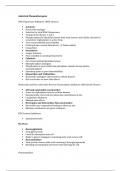
Antiviral Chemotherapies
DNA Polymerase Inhibitors (DNA Viruses)
Aciclovir:
Nucleoside analogue
Selective for viral DNA Polymerases
Treatment for Herpes 1 and 2
Phosphorylated by thymidine kinase both viral (mono) and cellular (di and tri)
as Aciclovir triphosphate is active form
Poor oral availability and solubility
Prodrug forms created Valaciclovir (L-Valine added)
Competitive
Penciclovir:
Longer duration
Poor solubility so prodrug Famciclovir
Cidofovir:
For viruses lacking thymidine kinase
Monophosphate analogues
Phosphonate is more stable than phosphate (mimics deoxycytidine
monophosphate)
Extremely polar so poor bioavailability
Idoxuridine and Trifluridine:
Nucleoside analogues elaborated by cellular kinases
Not as selective so more side effects
Nucleoside and Non-nucleoside Reverse Transcriptase Inhibitors (RNA Based Viruses)
AZT and Lamivudine (nucleoside):
Active in triphosphate form by cellular kinases
Enzymatically converted into adenosine nucleobases in situ
Competitive inhibitors
Multiple side effects
Nevirapine and Delavirdine (Non-nucleoside):
Reversible non-competitive binding to allosteric site
Mutation of allosteric site gives resistance
HIV Protease Inhibitors
Apartyl proteases
Flu Virus
Haemagglutinin:
Viral glycoprotein
Curial for absorption into cell
Binds to glycol-conjugates containing sialic acid on host cell
Neuraminidase:
Viral protein cleaves sialic acid removing it from glycoproteins
Blocking neuraminidase prevents virus infecting the cell
Neuraminidase
DNA Polymerase Inhibitors (DNA Viruses)
Aciclovir:
Nucleoside analogue
Selective for viral DNA Polymerases
Treatment for Herpes 1 and 2
Phosphorylated by thymidine kinase both viral (mono) and cellular (di and tri)
as Aciclovir triphosphate is active form
Poor oral availability and solubility
Prodrug forms created Valaciclovir (L-Valine added)
Competitive
Penciclovir:
Longer duration
Poor solubility so prodrug Famciclovir
Cidofovir:
For viruses lacking thymidine kinase
Monophosphate analogues
Phosphonate is more stable than phosphate (mimics deoxycytidine
monophosphate)
Extremely polar so poor bioavailability
Idoxuridine and Trifluridine:
Nucleoside analogues elaborated by cellular kinases
Not as selective so more side effects
Nucleoside and Non-nucleoside Reverse Transcriptase Inhibitors (RNA Based Viruses)
AZT and Lamivudine (nucleoside):
Active in triphosphate form by cellular kinases
Enzymatically converted into adenosine nucleobases in situ
Competitive inhibitors
Multiple side effects
Nevirapine and Delavirdine (Non-nucleoside):
Reversible non-competitive binding to allosteric site
Mutation of allosteric site gives resistance
HIV Protease Inhibitors
Apartyl proteases
Flu Virus
Haemagglutinin:
Viral glycoprotein
Curial for absorption into cell
Binds to glycol-conjugates containing sialic acid on host cell
Neuraminidase:
Viral protein cleaves sialic acid removing it from glycoproteins
Blocking neuraminidase prevents virus infecting the cell
Neuraminidase