ABOLITION AND WOMEN'S RIGHTS MOVEMENTS, PART 1 TEST QUESTIONS
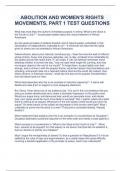
ABOLITION AND WOMEN'S RIGHTS MOVEMENTS, PART 1 TEST QUESTIONS What was most likely the author's immediate purpose in writing "What to the Slave is the Fourth of July?" Are the great principles of political freedom and of natural justice, embodied in that Declaration of Independence, extended to us? Which best describes why this is an example of inductive reasoning? But I fancy I hear some one of my audience say, "It is just in this circumstance that you and your brother abolitionists fail to make a favorable impression on the public mind. Would you argue more, and denounce less; would you persuade more, and rebuke less; your cause would be much more likely to succeed." But, I submit, where all is plain there is nothing to be argued. What point in the anti-slavery creed would you have me argue? On what branch of the subject do the people of this country need light? Must I undertake to prove that the slave is a man? That point is conceded already. Nobody doubts it. Which statement best explains why this is an example of a counterclaim by Douglass? Which excerpt is a counterclaim in "What to the Slave is the Fourth of July?"
Written for
- Institution
- ABOLITION AND WOMEN\'S RIGHTS MOVEMENTS, PART 1
- Course
- ABOLITION AND WOMEN\'S RIGHTS MOVEMENTS, PART 1
Document information
- Uploaded on
- June 9, 2023
- Number of pages
- 4
- Written in
- 2022/2023
- Type
- Exam (elaborations)
- Contains
- Questions & answers
Subjects
- part 1
-
abolition and womens rights movements
-
abolition and womens rights movements
-
what was most likely the authors immediate purpos
-
what do the rhetorical questions in the excerpt su
-
wh

Also available in package deal