Self defence evaluation:
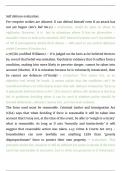
Pre-emptive strikes are allowed: D can defend himself even if an attack has
not yet begun (AG’s Ref No.2.) - evaluation: Could be open to abuse by
vigilantes. However, it is fair in situations where D has no alternative -
shouldn’t have to wait to be attacked. BUT battered women can’t use defence
of SD if preemptively attack their abuser – will need to use partial defences
under Coroners & Justice Act.
s.76CJIA (codified Williams) – D is judged on the facts as he believed them to
be, even if that belief was mistaken. Psychiatric evidence that D suffers from a
condition, making him more likely to perceive danger, cannot be taken into
account (Martin). If D is mistaken because he is voluntarily intoxicated, then
he cannot use defences (O’Grady) - evaluation: This seems fair, as an
objective test would be harsh. It seems unfair that the condition can’t be
considered when s.76 CJIA clearly states that self-defence is based on ‘facts as
D genuinely believed them to be’. CJIA doesn’t define self-defence & this has
led to problems deciding when it can be used & whether police should be
treated differently, (Bennet). Seems fair, as D has been reckless.
The force used must be reasonable. Criminal Justice and Immigration Act
(CJIA) says that when deciding if force is reasonable it will be taken into
account that D may not, at the time of the event, be able to ‘weigh to a nicety’
what is reasonable. As long as D acts ‘honestly and instinctively’ it will
suggest that reasonable action was taken. s.43 Crime & Courts Act 2013 -
householders can now lawfully use anything LESS than ‘grossly
disproportionate’ force to protect their own property. - evaluation: This
principle seems fair, however it will be difficult for juries to decide if the force
used was reasonable or excessive. Law is often too generous to D (Sharman).
Pre-emptive strikes are allowed: D can defend himself even if an attack has
not yet begun (AG’s Ref No.2.) - evaluation: Could be open to abuse by
vigilantes. However, it is fair in situations where D has no alternative -
shouldn’t have to wait to be attacked. BUT battered women can’t use defence
of SD if preemptively attack their abuser – will need to use partial defences
under Coroners & Justice Act.
s.76CJIA (codified Williams) – D is judged on the facts as he believed them to
be, even if that belief was mistaken. Psychiatric evidence that D suffers from a
condition, making him more likely to perceive danger, cannot be taken into
account (Martin). If D is mistaken because he is voluntarily intoxicated, then
he cannot use defences (O’Grady) - evaluation: This seems fair, as an
objective test would be harsh. It seems unfair that the condition can’t be
considered when s.76 CJIA clearly states that self-defence is based on ‘facts as
D genuinely believed them to be’. CJIA doesn’t define self-defence & this has
led to problems deciding when it can be used & whether police should be
treated differently, (Bennet). Seems fair, as D has been reckless.
The force used must be reasonable. Criminal Justice and Immigration Act
(CJIA) says that when deciding if force is reasonable it will be taken into
account that D may not, at the time of the event, be able to ‘weigh to a nicety’
what is reasonable. As long as D acts ‘honestly and instinctively’ it will
suggest that reasonable action was taken. s.43 Crime & Courts Act 2013 -
householders can now lawfully use anything LESS than ‘grossly
disproportionate’ force to protect their own property. - evaluation: This
principle seems fair, however it will be difficult for juries to decide if the force
used was reasonable or excessive. Law is often too generous to D (Sharman).