1. Ways of Studying the Brain
Post- Mortem Examination
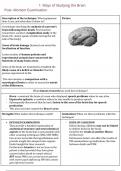
Description of the technique. What equipment Picture
does it use, and what does it show us?
A technique involving the analysis of a person’s
brain following their death. Post-mortem
researchers conduct a longitudinal study of the
brain (I.E. cannot speak, trouble moving the left
side of the body)
Areas of brain damage (lesions) can reveal the
localisation of function.
Lesion studies of human patients and
experimental animals have uncovered the
functions of many brain areas.
Areas of the brain are examined to establish the
likely cause of a deficit or disorder that the
person experienced in life.
This also involves a comparison with a
neurotypical brain in order to assess the extent
of the differences.
What famous research has used this technique?
- Broca - examined the brain of a man who displayed speech problems when he was alive
- Expressive aphasia: a condition where he was unable to produce speech
- Subsequently discovered that he had a lesion in the area of the brain key for speech
production
- This area was later named the Broca's area
Strengths What makes this technique useful? Limitations When are there problems with this
technique?
+ DETAILED EXAMINATION - ISSUE OF CAUSATION
They provide a detailed examination of Deficit during a lifetime may not be linked
anatomical structure and neurochemical to deficits found in the brain.
aspects of the brain that is not possible with Could be the result of another illness
other scanning techniques (ERG, ERP, fMRI) Furthermore
Can access areas like the hypothalamus and Extraneous factors can affect the results of
provide insight into deeper brain regions PM examinations eg medication, the time
Useful insight for later research between death and PME
Furthermore Invasive is not an issue as the
patient is dead provided they have given
consent before death to remain ethical.
BUT many PMEs are carried out on patients
with severe psych deficits eg HM who cannot
give informed consent
Post- Mortem Examination
Description of the technique. What equipment Picture
does it use, and what does it show us?
A technique involving the analysis of a person’s
brain following their death. Post-mortem
researchers conduct a longitudinal study of the
brain (I.E. cannot speak, trouble moving the left
side of the body)
Areas of brain damage (lesions) can reveal the
localisation of function.
Lesion studies of human patients and
experimental animals have uncovered the
functions of many brain areas.
Areas of the brain are examined to establish the
likely cause of a deficit or disorder that the
person experienced in life.
This also involves a comparison with a
neurotypical brain in order to assess the extent
of the differences.
What famous research has used this technique?
- Broca - examined the brain of a man who displayed speech problems when he was alive
- Expressive aphasia: a condition where he was unable to produce speech
- Subsequently discovered that he had a lesion in the area of the brain key for speech
production
- This area was later named the Broca's area
Strengths What makes this technique useful? Limitations When are there problems with this
technique?
+ DETAILED EXAMINATION - ISSUE OF CAUSATION
They provide a detailed examination of Deficit during a lifetime may not be linked
anatomical structure and neurochemical to deficits found in the brain.
aspects of the brain that is not possible with Could be the result of another illness
other scanning techniques (ERG, ERP, fMRI) Furthermore
Can access areas like the hypothalamus and Extraneous factors can affect the results of
provide insight into deeper brain regions PM examinations eg medication, the time
Useful insight for later research between death and PME
Furthermore Invasive is not an issue as the
patient is dead provided they have given
consent before death to remain ethical.
BUT many PMEs are carried out on patients
with severe psych deficits eg HM who cannot
give informed consent