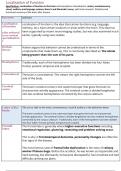
Localisation of Function
Specification: Localisation of function in the brain and hemispheric lateralisation: motor, somatosensory,
visual, auditory and language centres; Broca’s and Wernicke’s areas, split-brain research. Plasticity and
functional recovery of the brain after trauma.
Key term Definition
Localisation Localisation of function is the idea that certain functions (e.g. language,
of function
memory, etc.) have certain locations or areas within the brain. This idea has
(also referred been supported by recent neuroimaging studies, but was also examined much
to as cortical earlier, typically using case studies.
specialisation
)
Holistic Holism argues that behavior cannot be understood in terms of the
theory
components that make them up. This is commonly described as 'the whole
being greater than the sum of its parts.
Hemispheres Traditionally, each of the hemispheres has been divided into four lobes:
frontal, parietal, temporal and occipital.
Contralateral The brain is contralateral. This means the right hemisphere controls the left
side of the body.
Cerebral The brain’s cerebral cortex is the outermost layer that gives the brain its
cortex
characteristic wrinkly appearance. The cerebral cortex is divided lengthwise
into two cerebral hemispheres connected by the corpus callosum.
Lobes of the *Be sure to refer to the motor, somatosensory, visual & auditory in the definitions below
brain
The brain’s cerebral cortex is the outermost layer that gives the brain its characteristic
wrinkly appearance. The cerebral cortex is divided lengthwise into two cerebral hemispheres
connected by the corpus callosum. Traditionally, each of the hemispheres has been divided
into four lobes: frontal, parietal, temporal and occipital.
Frontal The frontal lobe is generally where higher executive functions including
lobes emotional regulation, planning, reasoning and problem solving occur.
This is why in frontotemporal dementia, personality changes are often the
first signs of the disease.
The most famous case of frontal lobe dysfunction is the story of railway
worker Phineas Gage. Before the accident, he was known as responsible and
hard-working, but afterwards, he became disrespectful, foul-mouthed and had
difficulty carrying out plans.
, Parietal lobe The parietal lobe is behind the frontal lobe, separated by the central sulcus.
Areas in the parietal lobe are responsible for integrating sensory
information, including touch, temperature, pressure and pain.
Because of the processing that occurs in the parietal lobe, we are able to, for
example, discern from touch alone that two objects touching the skin at
nearby points are distinct, rather than one object. This process is called
two-point discrimination. Different areas of the body have more sensory
receptors, and so are more sensitive than others in discerning distinct points.
Using callipers or a folded paperclip, and asking a subject to keep their eyes closed,
this test can be used to check parietal lobe function.
Occipital The occipital lobe is the major visual processing centre in the brain.
lobe The primary visual cortex, also known as V1, receives visual information
from the eyes. This information is relayed to several secondary visual
processing areas, which interpret depth, distance, location and the identity
of seen objects.
Temporal Separated from the frontal lobe by the lateral fissure, the temporal lobe also
lobe contains regions dedicated to processing sensory information, particularly
important for hearing, recognising language, and forming memories.
Auditory information: The temporal lobe contains the primary auditory
cortex, which receives auditory information from the ears and secondary
areas, and processes the information so we understand what we’re hearing
Visual processing: Certain areas in the temporal lobe make sense of complex
visual information including faces and scenes.
Memory: The medial temporal lobe contains the hippocampus, a region of the
brain important for memory, learning and emotions.
Cortical areas Located in Function of this cortical area If damaged..
which lobe?
Motor cortex In the back of This area sends signals to muscles - Damage: loss of
the frontal motor neurones. Controls control over fine
lobe, just in voluntary movements of a part of motor movements
front of the the body on the opposite side. For
central sulcus example, your right motor cortex
controls movement to your left leg.
Nerve impulses originating in motor
cortex end up at your muscles
Somatosensor At the front of It processes sensory information Damage: to the
y cortex the parietal from the skin (touch, heat, pressure right posterior
lobe, just etc). The amount of somatosensory parietal lobes may
Specification: Localisation of function in the brain and hemispheric lateralisation: motor, somatosensory,
visual, auditory and language centres; Broca’s and Wernicke’s areas, split-brain research. Plasticity and
functional recovery of the brain after trauma.
Key term Definition
Localisation Localisation of function is the idea that certain functions (e.g. language,
of function
memory, etc.) have certain locations or areas within the brain. This idea has
(also referred been supported by recent neuroimaging studies, but was also examined much
to as cortical earlier, typically using case studies.
specialisation
)
Holistic Holism argues that behavior cannot be understood in terms of the
theory
components that make them up. This is commonly described as 'the whole
being greater than the sum of its parts.
Hemispheres Traditionally, each of the hemispheres has been divided into four lobes:
frontal, parietal, temporal and occipital.
Contralateral The brain is contralateral. This means the right hemisphere controls the left
side of the body.
Cerebral The brain’s cerebral cortex is the outermost layer that gives the brain its
cortex
characteristic wrinkly appearance. The cerebral cortex is divided lengthwise
into two cerebral hemispheres connected by the corpus callosum.
Lobes of the *Be sure to refer to the motor, somatosensory, visual & auditory in the definitions below
brain
The brain’s cerebral cortex is the outermost layer that gives the brain its characteristic
wrinkly appearance. The cerebral cortex is divided lengthwise into two cerebral hemispheres
connected by the corpus callosum. Traditionally, each of the hemispheres has been divided
into four lobes: frontal, parietal, temporal and occipital.
Frontal The frontal lobe is generally where higher executive functions including
lobes emotional regulation, planning, reasoning and problem solving occur.
This is why in frontotemporal dementia, personality changes are often the
first signs of the disease.
The most famous case of frontal lobe dysfunction is the story of railway
worker Phineas Gage. Before the accident, he was known as responsible and
hard-working, but afterwards, he became disrespectful, foul-mouthed and had
difficulty carrying out plans.
, Parietal lobe The parietal lobe is behind the frontal lobe, separated by the central sulcus.
Areas in the parietal lobe are responsible for integrating sensory
information, including touch, temperature, pressure and pain.
Because of the processing that occurs in the parietal lobe, we are able to, for
example, discern from touch alone that two objects touching the skin at
nearby points are distinct, rather than one object. This process is called
two-point discrimination. Different areas of the body have more sensory
receptors, and so are more sensitive than others in discerning distinct points.
Using callipers or a folded paperclip, and asking a subject to keep their eyes closed,
this test can be used to check parietal lobe function.
Occipital The occipital lobe is the major visual processing centre in the brain.
lobe The primary visual cortex, also known as V1, receives visual information
from the eyes. This information is relayed to several secondary visual
processing areas, which interpret depth, distance, location and the identity
of seen objects.
Temporal Separated from the frontal lobe by the lateral fissure, the temporal lobe also
lobe contains regions dedicated to processing sensory information, particularly
important for hearing, recognising language, and forming memories.
Auditory information: The temporal lobe contains the primary auditory
cortex, which receives auditory information from the ears and secondary
areas, and processes the information so we understand what we’re hearing
Visual processing: Certain areas in the temporal lobe make sense of complex
visual information including faces and scenes.
Memory: The medial temporal lobe contains the hippocampus, a region of the
brain important for memory, learning and emotions.
Cortical areas Located in Function of this cortical area If damaged..
which lobe?
Motor cortex In the back of This area sends signals to muscles - Damage: loss of
the frontal motor neurones. Controls control over fine
lobe, just in voluntary movements of a part of motor movements
front of the the body on the opposite side. For
central sulcus example, your right motor cortex
controls movement to your left leg.
Nerve impulses originating in motor
cortex end up at your muscles
Somatosensor At the front of It processes sensory information Damage: to the
y cortex the parietal from the skin (touch, heat, pressure right posterior
lobe, just etc). The amount of somatosensory parietal lobes may