Written by students who passed Immediately available after payment Read online or as PDF Wrong document? Swap it for free 4.6 TrustPilot
logo-home
Exam (elaborations)

Nursing Fundamental

Rating
-
Sold
-
Pages
48
Grade
A+
Uploaded on
06-06-2023
Written in
2022/2023

1. Nursing Process Steps 1. Assessing 2. Diagnosing 3. Planning 4. Implementing 5. Evaluating 2. Assessing Steps 1. Initial Assessment (Admission assessment) 2. Problem-Focused Assessment (Pain) 3. Shift Assessment 4. Emergency Assessment (Shortness of Breath) 5. Time-Lapsed Reassessment (Home Health) 3. What is Nursing? 1. Caring 2. Art 3. Science 4. Client Centered 5. Holistic 6. Adaptive 7. Helping Profession 4. Nursing Con- cerns 5. Roles and Func- tions of the Nurse 6. Classification of Nurses 1. Health Promotion 2. Health Maintenance 3. Health Restoration 1. Caregiver 2. Communicator 3. Teacher 4. Client Advocate 5. Counselor 6. Change Agent 7. Leader 8. Manager 9. Case Manager 10. Research Consumer Stage I: Novice Stage II: Advanced Beginner Stage III: Competent 7. Quality and Safe- ty Education for Nurses (QSEN) 8. QSEN Compo- nents 9. 6 competencies of QSEN 10. Quality Improve- ment (QI) 11. Client-Centered Care (PCC) Stage IV: Proficient Stage V: Expert Framework provides quality, safe, and patient-centered care. Evidence-based care & teamwork from all members of the healthcare team. Informatics are integrated into various ways to provide care. 1. Knowledge 2. Skills 3. Attitude = Competence 1. Quality Improvement (QI) 2. Teamwork and Collaboration (TC) 3. Client-Centered Care (PCC) 4. Informatics (I) 5. Evidence-Based Practice (EBP) 6. Safety (S) Use data to monitor outcome of care process & use improvement methods to design & test changes to contin- uously improve the quality & safety of health care system. Recognizes client as source of control & full partner in providing compassionate & coord. care based on respect for client's prefs., values, & needs. 12. Informatics (I) Found in all areas of client care; some simple & complex. 13. Evidence-Based Practice (ESP) Integrating current evidence with clinical expertise & client/family values & prefs. 14. Safety (S) System Safeties: Avoid Workarounds. Use Barcode Medication Verification (BMV) Recognize standardization: Equipment & supplies. Report Error: Open Comms. 15. Consumer Individual, group of people, or community that uses a service or commodity. 16. Patient Person waiting for an undergoing medical treatment/care. 17. Client Person engages advice/services of another qualified to provide this service. 18. Caregiver Role that has traditionally included those activities that assist the client physically and psychologically while pre- serving the client's dignity. 19. Communicator Nurses id. client problems & communicate them with the healthcare team. 20. Counseling Helping client to recognize & cope with stressful psycho- logical or social problems, develop improved interperson- al relationships, & promote personal growth. 21. Change Agent Assist clients to make modifications in behavior. 22. Manager Delegates nursing activities to ancillary workers & other nurses; supervises & evaluates their performance. 23. Case Manager works with primary or staff nurses to oversee the care of a specific caseload. 24. Governance Est./maintenance of social, political, & economic arrange- ments by which practitioners control their practice, self-discipline, working conditions, & professional affairs 25. Socialization Process which individuals internalize the values, beliefs, & norms of a given society & learn to function as members of that society. 26. Stage I: Novice No experience; performance is limited, inflexible,and gov- erned by context-free rules & regs. rather than experi- ence. 27. Stage II: Ad- vanced Beginner Demonstrates marginally acceptable performance. Rec- ognizes the meaningful "aspects" of a real situation. Has experienced enough real situations to make judgments about them. 28. Stage III: Compe- tent Has 2-3 years experience; demonstrates organization- al and planning abilities. Differentiates important factors from less important aspects of care. Coordinates multiple complex demands. 29. Stage IV: Profi- Has 3 to 5 years of experience; perceives situations as cient wholes rather than in parts, as in Stage II. Uses maxims as guides for what to consider in a situation. Has holis- tic understanding of the client, which improves decision making. Focuses on long-term goals. 30. Stage V: Expert Performance is fluid, flexible, and highly proficient, no longer requires rules, guidelines, or maxims to connect an understanding of the situation to appropriate action, demonstrates highly skilled intuitive and analytic ability in new situation, is inclined to take a certain action because it felt right. 31. Telehealth use of medical info exchanged from one site to another via electronic communications to improve the patient's health status. 32. Telenursing Use of info via technology to provide nursing practice from a distance. 33. Patient Self-De- Federal law requires every adult be informed in writing on termination Act admission to health care institutions about their rights to (PSDA) accept or refuse medical care. 34. Subjective Data: Symptoms apparent to the patient affected; can be de- Assessing scribed by the person. 35. Objective Data: Assessing Signs detectable by the observer (nurse); can be tested for proper diagnosis. 36. Observation: 1. Clinical signs of distress. Data Collection 2. Threats to client safety. 3. Presence & functioning of equip. 4. Immediate environ.; including people. 37. Factors to Con- 1. Time sider-Data Col- 2. Place lection (Assess- 3. Seating Arrangements ing) 4. Distance 5. Language 38. Diagnosing 1. Analyze data Steps 2. Id. health problems, risks, & strengths. 3. Formulate diagnostic statements. 4. Nurses never Dx!!!! 39. Planning 1. Prioritize problems/diagnoses. 2. Formulate goals/desired outcome. 3. Select nursing interventions. 4. Write nursing interventions. 40. Implementing 1. Reassess the client. 2. Determine the nurse's need for assistance. 3. Implement the nursing interventions. 4. Supervise delegated care. 5. Doc. nursing activities. 41. Evaluating 1. Collect data 2. Compare data 3. Relate nursing actions to client goals 4. Draw conclusions about problems 5. Continue, modify, or terminate the client's care plan. 42. Interview Planned comms. with the patient to id. problems of mu- tual concern, evaluate change, teach, & provide sup- port/counseling. 43. Rapport Understanding between 2 or more people. 44. Critical Thinking Process of intentional higher level thinking to define a client's problem; examine the EBP for caring, & making choices in delivering proper care. 45. Clinical Reason- ing Cognitive process that uses thinking strategies to gather & analyze client info. Evaluate the relevance of the info.; decide on possible nursing actions to improve the client's physiological out- comes. 46. Critical Analysis App. of a set of questions to a particular situation/idea to determine essential info. & ideas; discard superfluous info. & ideas 47. Socratic Ques- tioning Tech. use to look beneath the surface, recognize, & ex- amine assumptions, search for inconsistencies, examine multiple view points, & differentiate the truth. 48. Inductive Rea- soning Set of facts/observations. 49. Deductive Rea- soning Reasoning from general premise to conclusion. 50. Nursing Process Systematic, rational method of planning & providing indi- vidualized nursing care 51. Trail & Error Number of approaches are tried until a solution is found 52. Intuition Problem-solving approach that relies on a nurse's inner sense. 53. Clinical Judge- ment Nursing is a decision-making process to as certain the right nursing action to be implemented at the appropriate time in the client's care. 54. Cognitive Process Thinking processes based on the knowledge of aspects of client care 55. Setting Priorities 1. Airway for Care 2. Breathing 3. Circulation 56. SMART: Plan- Specific ning Measurable Attainable Relevant Timed 57. Delegation: Plan- 1. Right Circumstances ning Steps 2. Right Task 3. Right Person 4. Right Comms. 5. Right Supervision 58. Documenting 1. Date/time Guidelines 2. Write legibly 3. Use abbreviations 4. Make a mistake; write 1 line through the sentence. 5. Doc. in the right order 6. Psychosoical issues are part of the client's health. 7. Be timely 8. Never alter a record 9. Never use the work client 59. Don't Delegate 1. Assessment 2. Interpretation of Data 3. Nursing Diagnosis 4. Nursing Care Plan 5. Evaluation 6. Care of invasive lines 7. Administering parenteral meds. (IV) 8. Insertion of NG Tubes 9. Client Edu. 10. Triage 11. Tele. advice 60. Delegate the Fol- lowing 1. Vitals 2. Intake/Output 3. Transfers 4. Ambulation (feeding and bathing) 5. Weighing 6. Attending to safety. 61. Delegate if Trained 1. Dressing changes 2. Suctioning of chronic tracheotomies 3. Gastronomy feeding 4. CPR 62. Principles of Del- egation 1. Always assess the client before delegating. 2. Task should be routine for client. 3. Must be considered safe. 4. Must know UAP's work abilities. 5. Create atmosphere allowing comms. about concerns. 63. Initial Assess- ment Preformed w/n specified time after admission. Est. to complete database for problem id., references, & comparison. Ex. Nursing admission assessment. 64. Problem-Fo- cused Assessment Ongoing process integrated w/ nursing care. Det. the status of a specific problem id. in earlier assess- ment. Ex. Hourly assessment of client's fluid intake & urinary output in ICU. 65. Emergency As- sessment Physiological crisis; id. life-threatening problems (new/overlooked problem). Ex. Rapid assessment of client's airway, breathing status, & circulation during a cardiac arrest. 66. Time-Lapsed As- sessment Several months after the initial assessment; compare the clients current status to baseline data previously ob- tained. Ex. Reassessment of client's functional health patterns at home care/outpatient setting. 67. Focused Inter- view Nurse asks the client specific questions to collect info. related to the client's problem. 68. Directive Inter- view Highly structured; the nurse controls the subject matter and asks questions in order to obtain specific info. 69. Nondirective In- terview Rapport-building interview; nurse allows the client to con- trol the purpose, subject matter, & pacing. 70. Closed Ques- tions Questions that can usually be answered with yes or no. 71. Open-Ended Questions Assoc. w/ nondirective interview, invite clients to discov- er/explore, elaborate, clarify/illustrate their thoughts/feel- ings. 72. Neutral Question Question the client can answer without direction/ pressure 73. Leading Ques- tions 74. Screening exam- ination (review of systems) from the nurse, is open ended, & is used in nondirective interviews. Contrast; usually closed/directive interview, & directs the client's answer. Brief review of essential functioning of various body parts or systems 75. Validation Act of double checking or verifying data. 76. Cues Subjective/Objective date can directly be observed by nurse; what the client informs/what the nurse can see, feel, smell, or measure. 77. Inferences Nurse's interpretation or conclusions made based on cues. Ex. Nurse observes the cues that an indication is red, hot, & swollen; nurse makes the inference that the incision is infected. 78. Vital Signs Body temperature, pulse and respiratory rates, and blood pressure; synonym for cardinal signs. 79. Body Tempera- ture Balance between the heat produced by the body and the heat lost from the body. 80. Core Tempera- ture Temp.; deep tissues of the body, abdominal/ pelvic cavity. 81. Heat Balance Amount of heat produced by the body equals the amount of heat lost. 82. Basal Metabolic Rate (BMR) Rate of energy utilization in the body required to maintain essential activities. Ex. Breathing 83. Fever/Febrile Increases the cellular metabolic rate & body temp. 84. Muscle Activity Muscle activity; including shivering, increases the meta- bolic rate. 85. Evaporation Cont. vaporization of moisture from the respiratory tract & mucosa of the mouth from the skin. 86. Pyrexia Body temperature above the normal range; fever. Range 100.4-105.8 degrees F. 87. Hyperthermia High fever; hyperpyrexia. Range 105.8-107.6 degrees F. 88. Hypothermia Abnormally low body temp. Below 96.8 degrees F. 89. Normal Tempera- ture Range 90. Most Common Types of Fever 91. Intermittent Fever 96.8-100.4 F (36-38 C) 1. Intermittent Fever 2. Relapsing Fever 3. Constant Fever 4. Remittent Rever Body temp. that alternates at regular intervals between periods of fever & periods of normal/ subnormal temper- atures. 92. Remittent Fever Cold/influenza; wide range of temp. fluctuations occurs over a 24 hr period; all of which are above normal. 93. Relapsing Fever Short febrile periods of a few days are interspersed with periods of 1-2 days of normal temp. 94. Constant Fever Body temp, fluctuates minimally but always remains above normal. 95. Fever Spike Temp. that rises to fever level rapidly; following a normal temperature & then returns to normal within a few hours. 96. Heat Exhaustion Result of excessive heat & dehydration. Paleness, dizzi- ness, nausea, vomiting, fainting, & moderately increased temperature of 101-102. 97. Heat Stroke Gen. exercising in hot weather; having warm, flushed skin, & don't sweat. Temp of usually 106 F. 98. Oral Tempera- ture The temperature reading obtained by placing the ther- mometer in the patient's mouth under the tongue. Place tip on either side of the frenulum. 99. Rectal Tempera- ture Temp. taken in the rectum; apply clean gloves, instruct client to take slow breaths during insertion, never force thermometer if resistance is felt, & insert 1.5 (adults). 100. Axillary Temper- ature Temp. taken at the armpit; pat the axilla dry if moist & tip is placed in the center of the axilla. 101. Tympanic Tem- perature The temperature reading obtained by placing an aural (ear) thermometer in the patient's ear. Pull pinna upward & backward, point probe slightly toward eardrum, & insert probe slowly using a circular motion until snug. 102. Temporal Tem- perature Measurement of body temperature at the temporal artery on the forehead. Brush hair if covering the temporal artery area, probe flush on the center of the forehead, depress button; keep depressed. Slowly slide probe midline across the fore- head to the hairline. Lift probe from the forehead & touch on the neck; behind the earlobe. 103. Pulse A wave of blood created by contraction of the left ventricle of the heart. Pulse wave represents the stroke volume (SV) output or amount of blood that enters the arteries with each ventricular contraction. 104. Cardiac Output (CO) Vol. of blood pumped into the arteries by the heart & equals the result of SV x HR per min. 105. Peripheral Pulse Pulse located away from the heart; wrist or foot. 106. Apical Pulse Central pulse located at the apex of the heart. 107. Point of Maximal Impulse (PMI) Where heartbeat is best palpable on chest wall; 5th inter- costal space, midclavicular line. 108. Tachycardia Fast heart rate (HR greater than 100bpm) 109. Bradycardia Slow heart rate (less than 60 bpm) 110. Pulse Rhythm Pattern of beats & intervals between beats. 111. Dysrthymia/Ar- rhythmia Pulse with a irregular rhythm. 112. Pulse Volume Pulse strength/amplitude; force of blood with each beat. 113. Peripheral Pulse Locations 114. Apical Pulse Lo- cations 1. Radial (most used) 2. Brachial (used for BP) 3. Carotid 4. Femoral 5. Popliteal 6. Posterior Tibial 7. Dorsalis Pedis 1. Second Intercostal Space 2. Third Intercostal Space 3. Fifth Intercostal Space, MCL/PMI 115. Respiration Act of breathing. 116. Inhalation/Inspi- ration 117. Exhalation/Expi- ration Intake of air into the lungs. Breathing out; movement of gases from lungs to the at- mosphere. 118. Ventilation The movement of air in & out of the body; inhalation & exhalation. 119. Bradypnea Abnormally slow rate of respiration usually of less than 10 breaths per min. 120. Tachypnea Abnormally rapid rate of respiration usually of more than 20 breaths per min. 121. Hyperventilation Abnormally fast breathing; deep breaths. 122. Hypoventilation Abnormally slow breathing; shallow breaths. 123. Respiratory Quality/Charac- ter Breathing that are different from normal effortless breath- ing. 124. Arterial BP Measure of the pressure exerted by blood against the walls of the arterial system. 125. Systolic Pres- sure 126. Diastolic Pres- sure 127. Pulse Pressure (PP) Pressure of the blood as a result of contraction of the ventricles; pressure of the height of the blood wave. Pressure when the ventricles are at rest. Difference between Systolic and diastolic pressure PP = SP - DP 128. Hypertension Abnormally high blood pressure; greater than 120/80. 129. normal BP range 120/80 130. Prehypertension Range 131. Hypertension Stage 1 132. Hypertension Stage 2 Systolic: 120-139 Diastolic: 80-89 Systolic: 140-159 Diastolic: 90-99 160 or higher/100 or higher 133. Hypotension Abnormally low blood pressure. 134. Sphygmo- manometer 135. Korotkoff sounds Instrument to measure BP; BP cuff. Series of 5 sounds (4 sounds followed by an absence of sound) heard during the auscultatory determination of 136. Auscultatory Gap 137. oxygen satura- tion (SpO2) BP. Produced by sudden distention of the artery because of the proximally placed pneumatic cuff. Hypertensive clients; temporary disapperance of sounds normally heard over the brachial artery when the cuff pressure is high followed by reappearance of sounds @ a lower level. Saturation value percent of all hemoglobin binding sites are occupied by oxygen. 138. Diagnosis Id. client's strengths, risks & health problems; including interpreting/analyzing data. 139. Nursing Diagno- sis 140. Status of Nurs- ing Diagnosis Describes a health problem that can be treated by nursing measures; a step in the nursing process. Clinical judgement concerning a human response to health conditions, vulnerability for that response, by an individual, family, group, or community. 1. Actual Diagnosis 2. Health Promotion Diagnosis 3. Risk Nursing Diagnosis 4. Syndrome Diagnosis 141. Actual Diagnosis Client problem that is present at the time of the nursing assessment. Ex. BP high due to anxiety. 142. Health Promo- tion Diagnosis 143. Risk Nursing Di- agnosis Clients preparedness to implement behaviors to improve their health condition. Clinical judgment that a problem doesn't exist; presence of risk factors indicates that a problem is likely to develop unless nurses intervene. 144. Risk Factors Problem likely to develop unless nurses intervene. 145. Syndrome Diag- nosis 146. Defining Charac- teristics 147. Independent Functions 148. Dependent Func- tions 149. Analyzing Data Steps 150. Nursing Inter- ventions 151. Ongoing Plan- ning Steps 152. Informal Nursing Care Plan 153. Formal Nursing Plan 154. Individualized Care Plan Assigned by a nurse's clinical judgement to describe a cluster of nursing diagnoses that have similar interven- tions. Cluster of signs and symptoms that are observed in the client and that imply a specific nursing diagnosis. Areas of health care that are unique to nursing and sep- arate and distinct from medical management. Physician-prescribed therapies and treatments. 1. Compare data against standards (id significant cues). 2. Cluster cues; generate hypothesis. 3. Id. gaps & inconsistencies. Treatment, based on clinical judgment & knowledge, that a nurse performs to enhance patient outcomes; there are nurse-initiated, physician-initiated, & collaborative inter- ventions. 1. Determine whether the client's health status has changed. 2. Set priorities for client's care during a shift. 3. Decide which problems to focus on during a shift. 4. Coord. nurse's activities; more than 1 problem can be addressed @ each client contact. Strategy for action that exists in the nurse's mind. Written guide that organizes info. about the client's care. Tailored to meet the unique needs of a specific client-needs; not addressed by the standardized plan. 155. Protocals Developed actions commonly required for particular group of clients. 156. Polices/Proce- dures Developed to govern the handling of freq. occurring situ- ations. 157. Standing Order Written document about policies, rules, regulations, or orders regarding client care. 158. Rationale Evidence-based principle given as the reason for select- ing a particular nursing intervention. 159. Multidisciplinary Care Plan 160. Collaborative Plan/Critical Pathways Standardized plan; outlines the care required for clients with common, predictable--usually medical--conditions Sequence care that must be given on each day during the projected length of stay for specific condition. 161. Priority Setting Process of est. a preferential sequence for addressing nursing diagnoses and interventions. 162. Planning Process Steps 163. Goals/Desired Outcomes 164. Nursing Out- comes Classifi- cation (NOC) 1. Setting Priorities 2. Est. client goals/desired outcome. 3. Selecting nursing interventions & activities. 4. Writing individualized nursing interventions on care plans. Describe, in terms of observable client responses, what the nurse hopes to achieve by implementing the nursing interventions. Describing client outcomes that respond to nursing inter- ventions. 165. Indicators Stated in neutral terms; each outcome includes a 5-point scale (a measure) used to rate the client's status on each indicator. 166. Goals/Desired Outcome Steps 167. Independent In- terventions 168. Dependent Inter- ventions 169. Collaborative In- terventions 170. Nursing Inter- ventions Classi- fication (NIC) 171. Implementing Steps 172. Critical Thinking Techniques 1. Provide direction for planning nursing interventions. 2. Serve criteria for evaluating client process. 3. Enable the client & nurse to determine when the prob- lem as been resolved. 4. Help maintain the client & nurse achievements. Activities that nurses are licensed to initiate on the basis of their knowledge and skills. Activities carried out under the orders or supervision of a licensed physician; other health care provider authorized to write orders to nurses. Actions the nurse carries out in collaboration with other health team members; such as physical therapists, social workers, dietitians, and physicians. Taxonomy of nursing actions each of which includes a label, a definition, and a list of activities. 1. Reassessing Client. 2. Determine the nurse's need to asst. 3. Implementing nursing interventions. 4. Supervising delegated care. 5. Doc. nursing activities. 1. Critical Analysis 2. Socratic Questioning 3. Inductive Reasoning 4. Deductive Reasoning. 173. SBAR S: Situation B: Background A: Assessment R: Recommendation Have all info. ready!!!! 174. Professional Nursing Organizations 175. Types of Posi- tioning 176. Dorsal Recum- bent 177. Suspine (Hori- zontal Recum- bent) 1. Nat'l League for Nursing (NLN) 2. Am. Nurses Assoc. (ANA); standards of professional nurse practice. 3. Nat'l Student Nurse Assoc. (NSNA) 4. Internat'l Council of Nursing (ICN) 5. American Assembly for Men in Nursing 6. National Student Nursing Assoc. 1. Dorsal Recumbent 2. Supine 3. Sitting 4. Lithotomy 5. Sims 6. Prone Back-lying position; knees flexed & hips externally ro- tated. Small pillow under the head; soles of feet on the surface. Back-lying position; leg extended; w/ w/o pillow under head. 178. Sitting Seated position; back unsupported and legs hanging freely. 179. Lithotomy Back lying; buttock at edge of table/bed legs in stirrups or at edge of bed/table. 180. Sims Side-lying position; lowermost arm behind the body, up- permost leg flexed at hip & knee. Upper arm flexed at shoulder & elbow. 181. Prone Lies on abdomen; head turned to the side; w/ or w/o pillow. 182. Inspection Visual examination of the body; using sense of sight. 183. Palpation Examination technique in which the examiner's hands are used to feel; texture, size, consistency, and location of certain body parts. 184. Ausculatation Process of listening for sounds within the body. 185. Cyanosis Bluish tinge; evident in nail beds, lips, & buccal mucosa. 186. Jaundice Yellow tinge; evident in sclera of eyes, mucous mem- brane, & skin. 187. Erthema Skin redness; assoc. rashes. 188. Vitiligo White patches on the skin caused by the destruction of melanocytes assoc. with autoimmune disorders. 189. Edema Abnormal accumulation of fluid in interstitial spaces of tissues; inflammation. 190. Alopecia Hair loss. 191. Clubbing Condition the angle between the nail & nail bed are 180 degrees or greater. 192. Blanch Test Carried out to test the capillary refill; peripheral circula- tion; should refill in 3 sec. 193. S1 Occurs when the atrioventricular (AV) valves close; lub sound/1st heart sound. 194. S2 2nd heart sound/ dub sound. 195. Reflex Automatic response to a stimulus. 196. Proprioceptors Sensory nerve terminals that occur in muscles, tendons, joints, & internal ear. 197. Hernia A protrusion of the intestine through the inguinal wall or canal. 198. 1 kg 2.2 lbs 199. 1 oz 30 mL 200. Fowler's position Semi-sitting position; the head of the bed is raised be- tween 45 and 60 degrees. 201. Semi-Fowler's Position semi-seated; position in which the patient reclines at a 30-45 degree angle. 202. Dosage Formula D/H * Q = X 203. QSEN Pain Man- agement 204. Nursing Re- search 205. 205. 1. Knowledge 2. Skills 3. Attitudes 1. Must evaluate the quality of data reported. 2. Study w/ 3 participants vs. 200 people. 3. Collectively searched using multiple databases; Com- prehensive Index of Nursing & Allied Health Literature (CINAHL). Critical Thinking Characteristics 206. Surface Temper- ature 207. Determinants of BP 1. Open-minded 2. Empathetic/sensitive to diversity. 3. Creative 4. Flexible 5. Improvement oriented 6. Realistic 7. Reflective 8. Proactive 9. Courageous 10. Patient/Persistent Temp. of the skin. 1. Pumping Action 2. Vascular Resistance 3. Blood Vol. 4. Blood Viscosity 208. Affects BP 1. Age 2. Exercise 3. Stress 4. Gender 5. Meds 6. Body Weight 7. Temp 8. Overall Health 209. Assessing Sources of Data 210. Assessing: Data Collection 211. 211. 1. Client-best source of data. 2. Support People (Emergency) 3. Client Records 4. Health Care Professionals 1. Build Rapport First. 2. Ask your questions. 3. Close the interview 4. Ask additional question during the physical assess- ment. Nursing Diagno- sis Can Change 1. Client assessment info. must match the nursing dx def. 2. Don't choose a risk or health promotion/wellness dx for any client. 212. Assessment Est. a database about the client; includes health history, physical assessment, & consultations with supports sys- tems/health professionals. Ex. physical, mental, spiritual, economic, & cultural status. 213. Nursing Skills 1. Inspection (sight) 2. Palpation (feel) 3. Percussion (sound) 4. Auscultation (listen) 214. Mental State: As- sessment Level of Consciousness (LOC); alert, oriented (know per- son, time, or place), & bizarre (responses, lethargy, con- fusion, & irritability). 215. Oversized Head Can indicate issues such as hydrocephalus. 216. Head Assess- ment Look for symmetry; including eyes, ears, & lips. Every- thing locating is the correct location. 217. Sclera White of the eye; should be white & smooth with tiny vessels noted. 218. PERRL Pupils are equal, round, and reactive to light. 219. Ear Assessment 1. Are they symmetrical? 2. Low set ear can indicate developmental delay. 3. Are they clean? 4. Eardrum intact 5. Can the patient hear? 220. Neck Assess- ment Range of motion; 1. Extension- leaning head back by locating pain. 2. Flexion- leaning head forward; nuchal rigidity. 3. Palpation- check lymph nodes. 221. Breast Assess- ment 222. Axillae Assess- ment 223. Chest Assess- ment 224. Back Assess- ment Inspect shape, symmetry, color; color could indicate some cancers. 1. Hair dispersion 2. Odor 3. Enlarged lymph nodes. 1. Movement shape 2. symmetrical 3. Even rise/fall 4. Normal vs. Barrel Chest 1. Palpate vertebrae 2. Look of abnormalities; kyphosis & scoliosis. 225. Heart Valves 1. Aortic (R) 2. Pulmonic (L) 3. Tricuspid 4. Mitral 226. Abdominal As- sessment 227. Musculoskeletal Assessment 228. Male Assess- ment 1. RUQ 2. LUQ 3. LLQ 4. RLQ Inspect in a circular motion for correct fluid sounds. 1. Range of Motion; require patient to move joints. 2. Passive; used when the patient is unable to move joints independently. 3. Assess posture, body, alignment, & symmetry. 4. Exam. gait 5. Assess muscle strength; grip test. 6. Assess peripheral pulse. 1. Hair dispersion 2. masses 3. lumps 4. hernias 5. cleanliness 229. Female Assess- ment 230. Rectum Assess- ment 1. Lymph nodes 2. hernias 3. odor 4. cleanliness 5. hair dispersion 1. External 2. Sphincter tone (deferred to MD) 3. Stool; for blood. 4. Masses 5. Hemorrhoids

Show more Read less
Institution
Course

Content preview

Nursing Fundamental
Study online at
https://quizlet.com/_990t5z
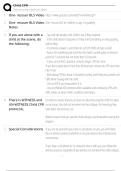
1. Nursing
1. Assessing
Process Steps
2. Diagnosing
3. Planning
4. Implementing
5. Evaluating

2. Assessing Steps 1. Initial Assessment (Admission assessment)
2. Problem-Focused Assessment (Pain)
3. Shift Assessment
4. Emergency Assessment (Shortness of Breath)
5.Time-Lapsed Reassessment (Home Health)
3. What is Nursing? 1. Caring
2. Art
3. Science
4. Client Centered
5. Holistic
6. Adaptive
7. Helping Profession

4. Nursing 1. Health Promotion
Con- cerns 2. Health Maintenance
3. Health Restoration
5. Roles and 1. Caregiver
Func- tions of 2. Communicator
the Nurse 3.Teacher
4. Client Advocate
5. Counselor
6. Change Agent
7. Leader
8. Manager
9. Case Manager
10.Research Consumer
6. Classification of Stage I: Novice
Nurses Stage II: Advanced
Beginner Stage III:
Competent
1/

, Nursing Fundamental
Study online at
https://quizlet.com/_990t5z
Stage IV:
Proficient Stage
V: Expert
7. Quality and
Safe- ty Framework provides quality, safe, and patient-
Education for centered care.
Nurses (QSEN)
Evidence-based care & teamwork from all
members of the healthcare team.

Informatics are integrated into various ways to
provide care.

8. QSEN Compo- 1. Knowledge
nents 2. Skills
3. Attitude
= Competence

9. 6 competencies 1. Quality Improvement (QI)
of QSEN 2.Teamwork and Collaboration (TC)
3. Client-Centered Care (PCC)
4. Informatics (I)
5. Evidence-Based Practice (EBP)
6. Safety (S)

10. Quality Use data to monitor outcome of care process &
Improve- ment use improvement methods to design & test
(QI) changes to contin- uously improve the quality &
safety of health care system.

11. Client-Centered Recognizes client as source of control & full
Care (PCC) partner in providing compassionate & coord. care
based on respect for client's prefs., values, &
needs.

12. Informatics (I) Found in all areas of client care; some simple &
complex.

13. Evidence- (ESP)
Based Practice
2/

, Nursing Fundamental
Study online at
https://quizlet.com/_990t5z
Integrating evidence
with clinical expertise &
current client/family values & prefs.

14. Safety (S) System Safeties: Avoid Workarounds.

Use Barcode Medication Verification (BMV)


3/

, Nursing Fundamental
Study online at
https://quizlet.com/_990t5z

Recognize standardization: Equipment &

supplies. Report Error: Open Comms.

15. Consumer Individual, group of people, or community that
uses a
service or commodity.

16. Patient Person waiting for an undergoing medical
treatment/care.

17. Client Person engages advice/services of another
qualified to
provide this service.
18. Caregiver Role that has traditionally included those activities
that
assist the client physically and psychologically
while pre- serving the client's dignity.

19. Communicator Nurses id. client problems & communicate them
with the healthcare team.

20. Counseling Helping client to recognize & cope with stressful
psycho- logical or social problems, develop
improved interperson- al relationships, &
promote personal growth.

21. Change Agent Assist clients to make modifications in behavior.

22. Manager Delegates nursing activities to ancillary workers &
other
nurses; supervises & evaluates their performance.

23. Case Manager works with primary or staff nurses to oversee the
care of a specific caseload.

24. Governance Est./maintenance of social, political, & economic
arrange- ments by which practitioners control
their practice,
4/


Written for

Institution
Study
Course

Document information

Uploaded on
June 6, 2023
Number of pages
48
Written in
2022/2023
Type
Exam (elaborations)
Contains
Questions & answers

Subjects

$12.79
Get access to the full document:

Wrong document? Swap it for free Within 14 days of purchase and before downloading, you can choose a different document. You can simply spend the amount again.
Written by students who passed
Immediately available after payment
Read online or as PDF

Get to know the seller

Seller avatar
Reputation scores are based on the amount of documents a seller has sold for a fee and the reviews they have received for those documents. There are three levels: Bronze, Silver and Gold. The better the reputation, the more your can rely on the quality of the sellers work.
YOURVERIFIEDEXAMPLUG Havard School
Follow You need to be logged in order to follow users or courses
Sold
96
Member since
3 year
Number of followers
44
Documents
5699
Last sold
3 weeks ago
YOURVERIFIEDEXAMPLUG DEALING WITH TEST BANKS, STUDY GUIDES, PAST AND NEW EXAM PAPERS .

SOLUTION MANUALS | COMPLETE TEST BANKS AND QUIZ BANKS | STUDY SET EXAMS | STUDY GUIDES | 100% VERIFIED ANSWERS AND SOLUTIONS | ALL GRADED A+ On this page you will find well elaborated Test banks, Quiz banks, Solution manuals and many more documents, offered by seller YOURVERIFIEDEXAMPLUG. I wish you a great, easy and reliable learning through your course and exams. kindly message me for any inquiries or assistance in your studies and i will be of great help. THANKYOU!!!!!!!!!!!!!!!!!!!!!!!!!!!! for orders and pre-orders, email me :~

Read more Read less
4.1

15 reviews

5
9
4
1
3
3
2
1
1
1

Trending documents

Recently viewed by you

Why students choose Stuvia

Created by fellow students, verified by reviews

Quality you can trust: written by students who passed their tests and reviewed by others who've used these notes.

Didn't get what you expected? Choose another document

No worries! You can instantly pick a different document that better fits what you're looking for.

Pay as you like, start learning right away

No subscription, no commitments. Pay the way you're used to via credit card and download your PDF document instantly.

Student with book image

“Bought, downloaded, and aced it. It really can be that simple.”

Alisha Student

Frequently asked questions