WATER TREATMENT
Coagulation
WATER TREATMENT
and flocculation
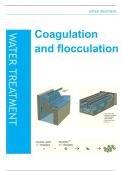
coagulant
dosing
a
e
b
d
f
c
a raw water feed
b stirring mechanism
c blending space
d floc blanket
e clear water exit
f floc exit
2+
humic acid Fe(OH)
(- charge) (+ charge)
+
,coagulation and flocculation water treatment
Framework
This module represents coagulation and flocculation.
Contents
This module has the following contents:
1. Introduction
2. Coagulation
2.1 Theory of coagulation
2.2 Coagulation in practice
3. Flocculation
3.1 Theory of floc formation
3.2 Floc formation in practice
38
, water treatment coagulation and flocculation
1 Introduction
In surface water different compounds are present
that must be removed if drinking water is to be pro-
duced. The compounds can be subdivided into:
- suspended solids
- colloidal solids
- dissolved solids.
Suspended solids have a diameter larger than 10-6
m, colloidal solids between 10-9 and 10-6 m and Figure 1 - Turbidity in surface water
dissolved solids smaller than 10-9 m.
(Figure 1) are caused by colloidal particles (order
Particles with a diameter larger than 10-5 m, and of magnitude 0.1 - 10 µm). Colloidal particles are
a specific density larger than 2,000 kg/m3 will negatively charged and repulse each other.
settle in water. Smaller particles will also settle, In the tropics high concentrations of suspended
but more slowly. solids can occur and rivers can be become “mud
In Table 1 the settling time of particles with a den- flows” (Figure 2).
sity of 2,650 kg/m3 (e.g., sand) is given. Color (Figure 3) is caused by humic substances
To be removed, particles that are smaller than (order of magnitude 0.01 µm). The charge of humic
10-5 m must be made larger or heavier. The latter substances (and thus the removal) is dependent
is impossible and, therefore, removal is only pos- upon the pH of the water.
sible by increasing the particle size.
During the coagulation process, coagulants are In Table 2 the water quality data from the surface
added to the water to aid in floc formation. These water of several rivers in the Netherlands and in
flocs are precipitates in water, wherein small par- tropical countries are given. The high values of
ticles are incorporated. organic matter and color in the Drentsche Aa are
caused by peat-containing soils (with high organic
To express the concentration of compounds in matter content) that the river crosses.
water, sum parameters are used. The most im-
portant sum parameters for surface water are
“suspended solids” concentration (dry weight), 2 Coagulation
“turbidity,” “natural organic matter” (expressed in
TOC/DOC) and “color.” The coagulation process is the dosing of a co-
“Suspended solids” concentration and turbidity
Table 1 - Settling time of particles with a density of
2,650 kg/m3
Diameter Types of particles Settling time
(m) over 30 cm
10-2 gravel 0.3 sec
10-3 coarse sand 3 sec
10-4 fine sand 38 sec
10-5 silt 33 min
10-6 bacteria 35 hours
10-7 clay 230 days
Figure 2 - Rivers in the tropics sometimes have high
10-8 colloids 63 years suspended solids contents
39
Coagulation
WATER TREATMENT
and flocculation
coagulant
dosing
a
e
b
d
f
c
a raw water feed
b stirring mechanism
c blending space
d floc blanket
e clear water exit
f floc exit
2+
humic acid Fe(OH)
(- charge) (+ charge)
+
,coagulation and flocculation water treatment
Framework
This module represents coagulation and flocculation.
Contents
This module has the following contents:
1. Introduction
2. Coagulation
2.1 Theory of coagulation
2.2 Coagulation in practice
3. Flocculation
3.1 Theory of floc formation
3.2 Floc formation in practice
38
, water treatment coagulation and flocculation
1 Introduction
In surface water different compounds are present
that must be removed if drinking water is to be pro-
duced. The compounds can be subdivided into:
- suspended solids
- colloidal solids
- dissolved solids.
Suspended solids have a diameter larger than 10-6
m, colloidal solids between 10-9 and 10-6 m and Figure 1 - Turbidity in surface water
dissolved solids smaller than 10-9 m.
(Figure 1) are caused by colloidal particles (order
Particles with a diameter larger than 10-5 m, and of magnitude 0.1 - 10 µm). Colloidal particles are
a specific density larger than 2,000 kg/m3 will negatively charged and repulse each other.
settle in water. Smaller particles will also settle, In the tropics high concentrations of suspended
but more slowly. solids can occur and rivers can be become “mud
In Table 1 the settling time of particles with a den- flows” (Figure 2).
sity of 2,650 kg/m3 (e.g., sand) is given. Color (Figure 3) is caused by humic substances
To be removed, particles that are smaller than (order of magnitude 0.01 µm). The charge of humic
10-5 m must be made larger or heavier. The latter substances (and thus the removal) is dependent
is impossible and, therefore, removal is only pos- upon the pH of the water.
sible by increasing the particle size.
During the coagulation process, coagulants are In Table 2 the water quality data from the surface
added to the water to aid in floc formation. These water of several rivers in the Netherlands and in
flocs are precipitates in water, wherein small par- tropical countries are given. The high values of
ticles are incorporated. organic matter and color in the Drentsche Aa are
caused by peat-containing soils (with high organic
To express the concentration of compounds in matter content) that the river crosses.
water, sum parameters are used. The most im-
portant sum parameters for surface water are
“suspended solids” concentration (dry weight), 2 Coagulation
“turbidity,” “natural organic matter” (expressed in
TOC/DOC) and “color.” The coagulation process is the dosing of a co-
“Suspended solids” concentration and turbidity
Table 1 - Settling time of particles with a density of
2,650 kg/m3
Diameter Types of particles Settling time
(m) over 30 cm
10-2 gravel 0.3 sec
10-3 coarse sand 3 sec
10-4 fine sand 38 sec
10-5 silt 33 min
10-6 bacteria 35 hours
10-7 clay 230 days
Figure 2 - Rivers in the tropics sometimes have high
10-8 colloids 63 years suspended solids contents
39