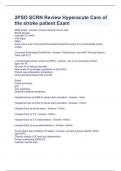
2PSO SCRN Review Hyperacute Care of the stroke patient Exam
EMS Goals - Answer- Onset/ last time known well Blood glucose maintain O2 >94% Vital signs ABCs quick neuro eval: Cincinnati Prehospital Scale/Fast exam or LA prehospital stroke screen Cincinnati Prehospital Scale/Fast - Answer- Facial droop, Arm drift, Slurring Speech, Time (call 911) LA prehospital stroke screen (LAPSS) - Answer- yes or no screening criteria: age over 45 No prior hx of seizure disorder New onset of neurologic symptoms in last 24hrs Patient was ambulatory at baseline blood glucose between 60 and 400 Exam: Facial symmetry grip arm weakness bilateral/unilateral weakness Hospital arrival via EMS to stroke alert activation - Answer- <5mn Hospital arrival via POV to stroke alert activation - Answer- <10mn Hospital Door to stroke team - Answer- <15mn Hospital Door to CT - Answer- <25mn Hospital Door to CT interpretation - Answer- <45mn Hospital Door to drug administration - Answer- <60mn Acute stroke alert Initiated (15 steps) - Answer- prevent hypoxia (SaO2 >94%) strict NPO Closely monitor LOC and any deterioration Proper positioning (HOB 30) maintain neutral neck cardiac monitor/ vital signs 18g Right AC (CTA) at least 2 patent IVs BP <185/110 isotonic fluid boluses for hypotensive patients (avoid dextrose) Initial labs: only mandated test before tPA is bedside glucose additional tests (BMP CBC PT/INR Troponin) CT CTA recommended Perfusion study Telemedicine and transfer applicable patients Initial evaluation and assessment - Answer- baseline eval/ Neuro eval pertinent medical history: Afib, DM HTN Obesity, Hyperlipidemia, smokers, African American, Hx of CVA, Immediate family with CVA, Medications, recent bleeding/surgery ABCD2 Score - Answer- predict 2-day stroke risk following TIA from 5 categories (0-7) 0-3==> 1% chance of having a stroke within 2 days >3 ==>high risk = needs immediate prevention Hunt and Hess stroke scale grade 1 - Answer- (based on SAH clinical presentation) asymptomatic, or minimal Headache and slight nuchal rigidity Hunt and Hess stroke scale grade 2 - Answer- moderate to severe headache nuchal rigidity and no neurological deficit other than cranial nerve palsy Hunt and Hess stroke scale grade 3 - Answer- drowsiness, confusion, or mild focal deficit Hunt and Hess stroke scale grade 4 - Answer- stupor, moderate to severe hemiparesis, early decerebrate posturing, vegetative disturbances Hunt and Hess stroke scale grade 5 - Answer- deep coma, decerebrate rigidity, moribund appearance Fisher Grade - Answer- predicts vasospasm after SAH based on location of the blood on the CT Fisher grade 1 - Answer- No hemorrhage Fisher grade 2 - Answer- SAH < 1mm Fisher grade 3 - Answer- SAH >1mm Fisher grade 4 - Answer- SAH of any thickness with intraventricular hemorrhage or parenchymal extension ICH Score - Answer- 30 day mortality risk score 0-6 Spetzler-Martin Grading system - Answer- used to calculate surgical risk for an AVM looks at size of the AVM, the eloquence of brain tissue, and pattern of venous drainage FOUR Score (full outline of unresponsiveness) - Answer- eye response motor response brainstem reflexes respiration each category 0-4 ==> 16 is best score MCA (anterior strokes) - Answer- hemiplegia for the contralateral side (lower face, arm and hand) contralateral sensory loss Left MCA (anterior strokes) - Answer- receptive and expressive aphasia Right MCA (anterior strokes) - Answer- neglect of the affected side/ neglect or unawareness of deficits Anterior cerebral artery (anterior strokes) - Answer- contralateral leg weakness and sensory loss, behavioral abnormalit
Written for
- Institution
- SCRN
- Course
- SCRN
Document information
- Uploaded on
- June 4, 2023
- Number of pages
- 5
- Written in
- 2022/2023
- Type
- Exam (elaborations)
- Contains
- Questions & answers
Subjects
-
2pso scrn review hyperacute care of the stroke pat

Also available in package deal