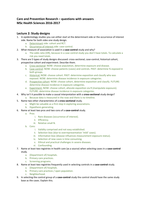
Care and Prevention Research – questions with answers
MSc Health Sciences 2016-2017
Lecture 2: Study designs
1. In epidemiology studies you can either start at the determinant side or the occurrence of interest
side. Name for both sides one study design.
a. Determinant side: cohort and RCT.
b. Occurrence of interest side: case-control.
2. What measure of association is used in a case-control study and why?
a. The odds ratio (OR), because in a case control study you don’t have totals. To calculate a
risk you need totals.
3. There are 5 types of study designs discussed: cross-sectional, case-control, historical cohort,
prospective cohort and experiment. Describe them.
a. Cross-sectional: NOW: choose population, determine exposure and disease.
b. Case-control: NOW: choose patients (cases) and controls. PAST: determine % exposed in
both groups.
c. Historical: NOW: choose cohort. PAST: determine exposition and classify who was
exposed. NOW: determine disease incidence in exposure categories.
d. Prospective cohort: NOW: choose cohort, determine exposition and classify. FUTURE:
determine disease incidence in exposure categories.
e. Experiment: NOW: choose cohort, allocate exposition via R (manipulate exposure).
FUTURE: determine disease incidence in exposure categories.
4. Why isn’t it possible to make a causal interpretation with a cross-sectional study design?
a. Because data is measured in the now and there is no timeline.
5. Name two other characteristics of a cross-sectional study.
a. Might be valuable as a first step in exploring associations.
b. Hypothesis generating.
6. Name at least two pros and two cons of a case-control study.
a. Pros:
i. Rare diseases (occurrence of interest).
ii. Efficiency.
iii. Relative small N.
b. Cons:
i. Validity comprised and not easy established.
ii. Selection bias (due to overrepresentation ‘mild’ cases).
iii. Information bias (disease influences measurement exposure-status).
iv. Selection of new cases is time consuming.
v. Ethical and practical challenges in severe diseases.
vi. Confounding.
7. Name at least two registries in health care (as a source) when selecting cases in a case-control
study.
a. (Department of) hospitals.
b. Primary care practices.
c. Screening programs.
8. Name at least two registries frequently used in selecting controls in a case-control study.
a. (Department of) hospitals.
b. Primary care practices / open population.
c. Neighborhood.
9. In selecting the control group of a case-control study the control should have the same study
base as the cases. Explain this.
MSc Health Sciences 2016-2017
Lecture 2: Study designs
1. In epidemiology studies you can either start at the determinant side or the occurrence of interest
side. Name for both sides one study design.
a. Determinant side: cohort and RCT.
b. Occurrence of interest side: case-control.
2. What measure of association is used in a case-control study and why?
a. The odds ratio (OR), because in a case control study you don’t have totals. To calculate a
risk you need totals.
3. There are 5 types of study designs discussed: cross-sectional, case-control, historical cohort,
prospective cohort and experiment. Describe them.
a. Cross-sectional: NOW: choose population, determine exposure and disease.
b. Case-control: NOW: choose patients (cases) and controls. PAST: determine % exposed in
both groups.
c. Historical: NOW: choose cohort. PAST: determine exposition and classify who was
exposed. NOW: determine disease incidence in exposure categories.
d. Prospective cohort: NOW: choose cohort, determine exposition and classify. FUTURE:
determine disease incidence in exposure categories.
e. Experiment: NOW: choose cohort, allocate exposition via R (manipulate exposure).
FUTURE: determine disease incidence in exposure categories.
4. Why isn’t it possible to make a causal interpretation with a cross-sectional study design?
a. Because data is measured in the now and there is no timeline.
5. Name two other characteristics of a cross-sectional study.
a. Might be valuable as a first step in exploring associations.
b. Hypothesis generating.
6. Name at least two pros and two cons of a case-control study.
a. Pros:
i. Rare diseases (occurrence of interest).
ii. Efficiency.
iii. Relative small N.
b. Cons:
i. Validity comprised and not easy established.
ii. Selection bias (due to overrepresentation ‘mild’ cases).
iii. Information bias (disease influences measurement exposure-status).
iv. Selection of new cases is time consuming.
v. Ethical and practical challenges in severe diseases.
vi. Confounding.
7. Name at least two registries in health care (as a source) when selecting cases in a case-control
study.
a. (Department of) hospitals.
b. Primary care practices.
c. Screening programs.
8. Name at least two registries frequently used in selecting controls in a case-control study.
a. (Department of) hospitals.
b. Primary care practices / open population.
c. Neighborhood.
9. In selecting the control group of a case-control study the control should have the same study
base as the cases. Explain this.