

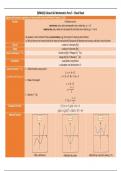
[WMA01] Edexcel IAL Mathematics Pure 3 – Cheat Sheet
Algebra and Functions, Logarithms and Exponentials, Numerical Methods (Chapter 1,2,5,8)
Function A function can be
one-to-one, one y-value corresponds to one x-value (e.g. 𝑦 = 𝑥 ! )
many-to-one, one y-value can correspond to more than one x-value (e.g. 𝑦 = sin 𝑥)
An equation is not a function if they are one-to-many. (e.g. the inverse of a many-to-one function)
i.e. Why is there not an inverse function for many-to-one functions? Because it will become one-to-many, and that is not an function
Domain x-values of a function 𝒇(𝒙)
Range y-values of a function 𝒇(𝒙)
Domain and Range 𝒇"𝟏 (𝒙) Domain of 𝒇(𝒙) à Range of 𝑓 "$ (𝒙)
Range of 𝒇(𝒙) à Domain 𝑓 "$ (𝒙)
Asymptotes y-asymptote: long division
x-asymptote: set denominator = 0
Inverse Function 𝒇"𝟏 (𝒙) 1. Define function, swap y and x
𝑓: 𝑥 ⟼ 3𝑥 + 2
(a reflection of f(x) by y=x) 𝑦 = 3𝑥 + 2 à 𝑥 = 3𝑦 + 2
2. Make y the subject
𝑥 = 3𝑦 + 2
𝑥−2
𝑦=
3
3. Rewrite 𝑓 "$ (𝒙)
𝑥−2
𝑓 "$ (𝑥) =
3
Composite Function 𝑖𝑓 𝑓(𝑥) = 𝑥 % ; 𝑔(𝑥) = 2𝑥 + 3
%
𝑓𝑔(2) = 6𝑔(2)7 = (2(2) + 3)% = 49
Modulus Function
if f(x) is defined as: reflection by y-axis reflection by x-axis (all y-values ≥ 0)
, Exponential ‘e’
asymptote: y=0
𝑥∈ℝ
crosses y-axis at (0,1)
Natural Log ‘ln’ 𝑒 &'() = 𝑝 → 𝑎𝑥 + 𝑏 = ln 𝑝
(all laws of indices apply)
ln(𝑎𝑥 + 𝑏) = 𝑞 → 𝑒 * = 𝑎𝑥 + 𝑏
Roots of f(x) Q. Type #1: Rearranging such that f(x)=0 𝑓(𝑥) = 𝑥 ! + 3𝑥 % + 4𝑥 − 12
And The roots of a function can be found by f(x) = 0 +(!"')
Show that f(x)=0 can be written as 𝑥 = F ,𝑥 ≠ 3
Iteration Formula '(!
If f(x) has a root between a and b 0 = 𝑥 ! + 3𝑥 % + 4𝑥 − 12
Sub f(a) and f(b) to see if there is a sign change. 12 − 4𝑥 = 𝑥 ! + 3𝑥 %
4(3 − 𝑥) = 𝑥 % (𝑥 + 3)
4(3 − 𝑥)
𝑥% =
𝑥+3
4(3 − 𝑥)
𝑥=# ,𝑥 ≠ 3
𝑥+3
Q. Type #2: Show that the equation has a root between a and b show that 𝑓(𝑥) = 𝑥 ! + 3𝑥 % + 4𝑥 − 12 has a single root between 1
and 2
Sub in f(a) and f(b) and compare. 𝑓(1) = −4
If there is a sign change = root is located in between 𝑓(2) = 16
∵there is a sign change, the root is located between 1 and 2.
Q. Type #3: Find 𝑥$ , 𝑥% , 𝑥! … +(!"' )
The iteration formula is given such that 𝑥.($ = F( (!(' !) ), 𝑛 ≥ 0
Iteration Formula is given as 𝑥.($ = ⋯ !
Sub 𝑥/ = a to find 𝑥$ , 𝑥% , 𝑥! … Given that 𝑥/ = 1, Find 𝑥$ , 𝑥% , 𝑥! to 2d.p.
+(!"$)
𝑥$ = F( (!($) ) = √2 = 1.41, 𝑥% = 1.20, 𝑥! = 1.30
Q. Type #4: Use an interval to show that f(x)=0 is 𝛼 The root of f(x)=0 is 𝛼. Show that 𝛼 = 1.272
Use Lower Bounds and Upper Bounds. 𝑓(1.2725) = 0.008272328
Sub f(𝛼 ±error) 𝑓(1.2715) = −0.008213624
∵there is a sign change, 1.2715 < 𝛼 < 1.2725, ∴ 𝛼 = 1.272
Algebra and Functions, Logarithms and Exponentials, Numerical Methods (Chapter 1,2,5,8)
Function A function can be
one-to-one, one y-value corresponds to one x-value (e.g. 𝑦 = 𝑥 ! )
many-to-one, one y-value can correspond to more than one x-value (e.g. 𝑦 = sin 𝑥)
An equation is not a function if they are one-to-many. (e.g. the inverse of a many-to-one function)
i.e. Why is there not an inverse function for many-to-one functions? Because it will become one-to-many, and that is not an function
Domain x-values of a function 𝒇(𝒙)
Range y-values of a function 𝒇(𝒙)
Domain and Range 𝒇"𝟏 (𝒙) Domain of 𝒇(𝒙) à Range of 𝑓 "$ (𝒙)
Range of 𝒇(𝒙) à Domain 𝑓 "$ (𝒙)
Asymptotes y-asymptote: long division
x-asymptote: set denominator = 0
Inverse Function 𝒇"𝟏 (𝒙) 1. Define function, swap y and x
𝑓: 𝑥 ⟼ 3𝑥 + 2
(a reflection of f(x) by y=x) 𝑦 = 3𝑥 + 2 à 𝑥 = 3𝑦 + 2
2. Make y the subject
𝑥 = 3𝑦 + 2
𝑥−2
𝑦=
3
3. Rewrite 𝑓 "$ (𝒙)
𝑥−2
𝑓 "$ (𝑥) =
3
Composite Function 𝑖𝑓 𝑓(𝑥) = 𝑥 % ; 𝑔(𝑥) = 2𝑥 + 3
%
𝑓𝑔(2) = 6𝑔(2)7 = (2(2) + 3)% = 49
Modulus Function
if f(x) is defined as: reflection by y-axis reflection by x-axis (all y-values ≥ 0)
, Exponential ‘e’
asymptote: y=0
𝑥∈ℝ
crosses y-axis at (0,1)
Natural Log ‘ln’ 𝑒 &'() = 𝑝 → 𝑎𝑥 + 𝑏 = ln 𝑝
(all laws of indices apply)
ln(𝑎𝑥 + 𝑏) = 𝑞 → 𝑒 * = 𝑎𝑥 + 𝑏
Roots of f(x) Q. Type #1: Rearranging such that f(x)=0 𝑓(𝑥) = 𝑥 ! + 3𝑥 % + 4𝑥 − 12
And The roots of a function can be found by f(x) = 0 +(!"')
Show that f(x)=0 can be written as 𝑥 = F ,𝑥 ≠ 3
Iteration Formula '(!
If f(x) has a root between a and b 0 = 𝑥 ! + 3𝑥 % + 4𝑥 − 12
Sub f(a) and f(b) to see if there is a sign change. 12 − 4𝑥 = 𝑥 ! + 3𝑥 %
4(3 − 𝑥) = 𝑥 % (𝑥 + 3)
4(3 − 𝑥)
𝑥% =
𝑥+3
4(3 − 𝑥)
𝑥=# ,𝑥 ≠ 3
𝑥+3
Q. Type #2: Show that the equation has a root between a and b show that 𝑓(𝑥) = 𝑥 ! + 3𝑥 % + 4𝑥 − 12 has a single root between 1
and 2
Sub in f(a) and f(b) and compare. 𝑓(1) = −4
If there is a sign change = root is located in between 𝑓(2) = 16
∵there is a sign change, the root is located between 1 and 2.
Q. Type #3: Find 𝑥$ , 𝑥% , 𝑥! … +(!"' )
The iteration formula is given such that 𝑥.($ = F( (!(' !) ), 𝑛 ≥ 0
Iteration Formula is given as 𝑥.($ = ⋯ !
Sub 𝑥/ = a to find 𝑥$ , 𝑥% , 𝑥! … Given that 𝑥/ = 1, Find 𝑥$ , 𝑥% , 𝑥! to 2d.p.
+(!"$)
𝑥$ = F( (!($) ) = √2 = 1.41, 𝑥% = 1.20, 𝑥! = 1.30
Q. Type #4: Use an interval to show that f(x)=0 is 𝛼 The root of f(x)=0 is 𝛼. Show that 𝛼 = 1.272
Use Lower Bounds and Upper Bounds. 𝑓(1.2725) = 0.008272328
Sub f(𝛼 ±error) 𝑓(1.2715) = −0.008213624
∵there is a sign change, 1.2715 < 𝛼 < 1.2725, ∴ 𝛼 = 1.272



