
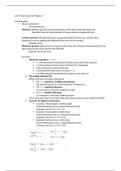
Case 1 How large was Pegasus?
Learning goals:
What is allometry?
o Formulas lecture
Allometry: Relative growth, how do proportions of the body scale with body size?
Describes how the characteristics of living creatures change with size
Isometric growth: All body parts grow at approximately the same rate, and the adult
proportions are not significantly different from those of the juvenile.
Example: arms
Allometric growth: body parts do not grow at the same rate, therefore the proportions of an
adult and juvenile will be significantly different.
Example: the head, brain
Formulas
o Allometric equation: y = a*xb
y is the parameter measured in relation to the size of the organism
x is the measure of size used as the basis for comparison,
often a measure of whole body size
a initial growth index (size of y when x = 1)
b scaling exponent (proportional change in y per unit of x)
o The scaling exponent (b)
Defines the type of scaling relationship
If b = 1 ➝isometry: no differential growth
the relative size of y to x is the same for all values of x
If b < 1 ➝negative allometry:
as x increases, y becomes relatively smaller
If b > 1 ➝positive allometry:
as x increases, y becomes relatively larger
This is true only when we compare like dimensions (mass to mass, length to length)
o Isometry for different dimensions
Example: Head Length vs. Body Length
Linear dimension (m1) vs. linear dimension (m1)
Isometry: m1/m1, b = 1/1 = 1.0
Example: Head Length vs. Body Mass
Linear Dimension (m1) vs. Cubic Dimension (m3)
Isometry: m1/m3, b = 1/3 = 0.33
Example: Surface Area vs. Body Mass
Square Dimension (m2) vs. Cubic Dimension (m3)
Isometry: m2/m3, b = 2/3 = 0.67
Learning goals:
What is allometry?
o Formulas lecture
Allometry: Relative growth, how do proportions of the body scale with body size?
Describes how the characteristics of living creatures change with size
Isometric growth: All body parts grow at approximately the same rate, and the adult
proportions are not significantly different from those of the juvenile.
Example: arms
Allometric growth: body parts do not grow at the same rate, therefore the proportions of an
adult and juvenile will be significantly different.
Example: the head, brain
Formulas
o Allometric equation: y = a*xb
y is the parameter measured in relation to the size of the organism
x is the measure of size used as the basis for comparison,
often a measure of whole body size
a initial growth index (size of y when x = 1)
b scaling exponent (proportional change in y per unit of x)
o The scaling exponent (b)
Defines the type of scaling relationship
If b = 1 ➝isometry: no differential growth
the relative size of y to x is the same for all values of x
If b < 1 ➝negative allometry:
as x increases, y becomes relatively smaller
If b > 1 ➝positive allometry:
as x increases, y becomes relatively larger
This is true only when we compare like dimensions (mass to mass, length to length)
o Isometry for different dimensions
Example: Head Length vs. Body Length
Linear dimension (m1) vs. linear dimension (m1)
Isometry: m1/m1, b = 1/1 = 1.0
Example: Head Length vs. Body Mass
Linear Dimension (m1) vs. Cubic Dimension (m3)
Isometry: m1/m3, b = 1/3 = 0.33
Example: Surface Area vs. Body Mass
Square Dimension (m2) vs. Cubic Dimension (m3)
Isometry: m2/m3, b = 2/3 = 0.67


