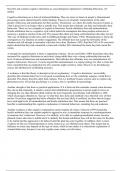
Describe and evaluate cognitive distortions as a psychological explanation to offending behaviour. (16
marks)
Cognitive distortions are a form of irrational thinking. They are errors or biases in people’s informational
processing system characterised by faulty thinking. Focus is on criminals’ interpretation of the other
people’s behaviour and justification for their actions. ‘Distortions’ are where the reality becomes twisted, so
what is perceived is no longer what is actually true. This means that criminals can deny and rationalise their
behaviour. There are two examples of cognitive distortions: hostile attribution bias and minimalisation.
Hostile attribution bias is a cognitive style which makes the assumption that there peoples actions are in
someway a negative reaction to the self. Thy assume that others are being confrontational when they are not.
This way of thinking is believed to start in childhood (Dodge and Frame, 1982). Minimalisation is where the
consequences of a situation are under-exaggerated. The offender does not accept the full reality of the
situation and will attempt to rationalise what they have done. Barbaree (1991) fond that 54% of 54 convicted
rapists denied that they had committed a crime and a further 40% minimised the harm they had caused the
victim.
A strength for minimalisation is there is supporting evidence. Alvaro and Gibbs (1996) found that when they
measured for cognitive distortions in anti-social young adults there was a strong relationship between the
level of antisocial behaviour and minimalisation. This indicates that offenders may use minimalisation wit
negative behaviours. However, it can be argued that minimalisation is a coping strategy for after a crime has
been committed than an explanation for why someone might commit a crime. However, by downplaying
crimes, the likelihood of reoffending increases.
A weakness is that this theory is descriptive but not explanatory. ‘Cognitive distortions’ successfully
describes the criminal mind, but it is not good at explaining how or why somebody acquires a mind that is
distorted. This theory describe rather than explains. This is a problem because science aims to explain why
phenomena exist. Given that psychology is a science, this is a problem for psychology.
Another strength is that there is practical applications. If it is believed that criminals commit crime because
they do not thin rationally, it stands to reason that rehabilitation programmes in prison ought to focus on
changing the way that offenders think. Indeed, the most frequently used therapy with offenders is CBT,
which encourages offenders to ‘face up’ to what they have done and establish a less distorted view of their
actions. It has been suggested that those offenders that are least likely to reoffend, are those that no longer
have such high levels of minimalisation and hostile attribution bias. This means that there are practical
benefits to understanding this cognitive explanation of criminal behaviour, extending beyond academia.
Another weakness is that cognitive explanations cannot explain all crimes. Giancola (1995) found that
hostile attribution bias can explain impulsive aggressive acts, in immediate response to a misinterpretation
of someone else’s behaviour. However, it is unlikely, to be able to explain premeditated crimes, because
planned crimes take time to unfold and it is unlikely that hostile attribution bias will be the cause for the plan
to be started and the aggression to be delayed until the plan has come together. In addition, there is more
evidence for the use of minimalisation in some crimes (e.g. sex offenders) tan others. This means that its
influence on crime may depend on the type of crime, which in turn makes it a reductionist explanation of
criminal behaviour, because it can only explain some crimes, not all crimes.
marks)
Cognitive distortions are a form of irrational thinking. They are errors or biases in people’s informational
processing system characterised by faulty thinking. Focus is on criminals’ interpretation of the other
people’s behaviour and justification for their actions. ‘Distortions’ are where the reality becomes twisted, so
what is perceived is no longer what is actually true. This means that criminals can deny and rationalise their
behaviour. There are two examples of cognitive distortions: hostile attribution bias and minimalisation.
Hostile attribution bias is a cognitive style which makes the assumption that there peoples actions are in
someway a negative reaction to the self. Thy assume that others are being confrontational when they are not.
This way of thinking is believed to start in childhood (Dodge and Frame, 1982). Minimalisation is where the
consequences of a situation are under-exaggerated. The offender does not accept the full reality of the
situation and will attempt to rationalise what they have done. Barbaree (1991) fond that 54% of 54 convicted
rapists denied that they had committed a crime and a further 40% minimised the harm they had caused the
victim.
A strength for minimalisation is there is supporting evidence. Alvaro and Gibbs (1996) found that when they
measured for cognitive distortions in anti-social young adults there was a strong relationship between the
level of antisocial behaviour and minimalisation. This indicates that offenders may use minimalisation wit
negative behaviours. However, it can be argued that minimalisation is a coping strategy for after a crime has
been committed than an explanation for why someone might commit a crime. However, by downplaying
crimes, the likelihood of reoffending increases.
A weakness is that this theory is descriptive but not explanatory. ‘Cognitive distortions’ successfully
describes the criminal mind, but it is not good at explaining how or why somebody acquires a mind that is
distorted. This theory describe rather than explains. This is a problem because science aims to explain why
phenomena exist. Given that psychology is a science, this is a problem for psychology.
Another strength is that there is practical applications. If it is believed that criminals commit crime because
they do not thin rationally, it stands to reason that rehabilitation programmes in prison ought to focus on
changing the way that offenders think. Indeed, the most frequently used therapy with offenders is CBT,
which encourages offenders to ‘face up’ to what they have done and establish a less distorted view of their
actions. It has been suggested that those offenders that are least likely to reoffend, are those that no longer
have such high levels of minimalisation and hostile attribution bias. This means that there are practical
benefits to understanding this cognitive explanation of criminal behaviour, extending beyond academia.
Another weakness is that cognitive explanations cannot explain all crimes. Giancola (1995) found that
hostile attribution bias can explain impulsive aggressive acts, in immediate response to a misinterpretation
of someone else’s behaviour. However, it is unlikely, to be able to explain premeditated crimes, because
planned crimes take time to unfold and it is unlikely that hostile attribution bias will be the cause for the plan
to be started and the aggression to be delayed until the plan has come together. In addition, there is more
evidence for the use of minimalisation in some crimes (e.g. sex offenders) tan others. This means that its
influence on crime may depend on the type of crime, which in turn makes it a reductionist explanation of
criminal behaviour, because it can only explain some crimes, not all crimes.