U.S. History Exam 1 Rationale based questions and answers
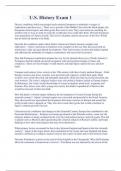
U.S. History Exam 1 Discuss conditions which encouraged early modern Europeans to undertake voyages of explorations and discovery: - There was a growth of the Middle Class after the black plague, the Europeans desired spices and other goods that were in Asia. They were intent on searching for another route to Asia in order to reach the wealth that Asia could offer them. Western Europeans were dependent on Chinese Goods. This led to Columbus and the discovery of the New World that he believed intently to be India. Describe the conditions under which Native American Cultures became complex and elaborative: - Native American civilizations were complex in the way they had successful art, architecture, trade and agricultural development. They had resource security that helped expand and elaborate the multitude of complex communities and successful economies. How did Portuguese exploration prepare the way for the Spanish discovery of North America? - Portuguese had developed advanced navigation with increased knowledge of charts and compasses. These new knowledge's would interest and help Spain explore the seas and new lands. Compare and contrast Aztec society in the 15th century with that of early modern Europe. - Both Europe societies and Aztec societies were powerful and expansive within their lands. Both societies were somewhat rural and prompted agriculture. Both also had successful merchant and craft workers. The Aztec's religious leaders were also political leaders similar to Europe leaders. In differences, the Aztecs lacked knowledge of ocean navigation, metal tools, weaponry and firearms. The Aztecs were still a young new society that hadn't expanded all of Mexico that would become part of their downfall. How did Spain's colonial empire influence the development of western Europe during the sixteenth century? - Spain's colonial empire was successful and powerful in the North America. They discovered new agricultural developments that many societies in Europe and around the world would come to depend on. They also discovered other goods that would contribute to Spain's continue growth of power. Characterize the conditions and changes in the Sixteenth Century Europe that contributed to the Protestant Reformation. - Religion was being questioned in the fifteenth century, some saw the religious leaders as being corrupted in the way they had political power, and rich goods. This led to people such as Martin Luther questioning the common religion of Roman Catholic and begin thinking of new ideas and religions that may favor themselves. What primary factors accounted for the rivalry between England and Spain in the late sixteenth century? - Some of the major factors that contributed to the rivalry between England and Spain includes a difference in religion, mutual want for the control of lands and rivalry between trade. Describe Powhatan's reaction to the arrival of the English in the Chesapeake. Why did Powhatan allow the settlement at Jamestown to survive? - Powhatan was not alarmed by the arrival of the English he had known of them and their weapons, but his people far out numbered them. He saw that they struggled in agricultural production and were failing to feed themselves. Powhatan allowed the English to survive because he believed them to have a use, especially in trade in their powerful weapons. What was the mercantilism? Why did the logic of mercantilist ideas encourage King James to grant a charter to the Virginia Company? - Mercantilism was a popular economic theory in Europe. It explained that wealth and trade were determined by a favorable balance of trade. This was powerful and made King James wish to expand to the "new world" and granted a charter to the Virginia Company to establish Jamestown. Discuss the causes of Bacon's Rebellion in Virginia. Compare and Contrast the causes and character of that rebellion with the causes and charter of Coode's Rebellion in Maryland. - Bacon's rebellion was caused by many factors, one which included the special privileges that were granted to those in power and with money. Bacon wanted permission to trade with local Indians but was denied. Bacon and other poor and minority frontiers joined forces against their governor. Starting in 1676, Bacon and his followers started to fight against the more powerful plantations, Bacon won the right to kill Indians. Bacon's rebellion against the government continued, but died out with his death. Coode's Rebellion, similar to Bacon's happened because of political disadvantages, including the Calvert Family and other successful leaders in Maryland. Smaller plantations wished to have a governor that was less expansive and power hungry and more representative of them. Another factor was religious differences between the Catholics and the Protestants. In 1689 Coode and discontented planters captured property from the governor and took their issues to England authority who in turn revoked the Calvert's charter until 1715.
Written for
- Institution
- U.S. History
- Course
- U.S. History
Document information
- Uploaded on
- May 28, 2023
- Number of pages
- 5
- Written in
- 2022/2023
- Type
- Exam (elaborations)
- Contains
- Questions & answers
Subjects
-
us history exam 1 rationale based questions and answers

Also available in package deal