
Social psychology
= scientific study of the way people’s thoughts and behaviors are influenced by the
real or imagined presence of other people
- Directly or indirectly
- Direct ex: salesman trying to sell u something
- Indirect ex: what your parents would think about quitting university to have
a kid influence your decision
Vs Philosophy
- Same questions, but studied scientifically
- Free will: psychology looks at when you feel or don’t feel free will
- Explains facilitated communication (technique used with autism, turns
out it doesn't help because the facilitator is actually communicating
their own ideas), ouija board beliefs
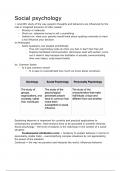
Vs. Common Sense
- Is it just common sense?
- It is easy to overestimate how much we know about ourselves;
Explaining behavior is important for curiosity and practical applications to
contemporary problems. Interventions have to be grounded in scientific theories.
Social psychology - the level of analysis is the individual in the context of a social
situation
Fundamental attribution error = tendency to explain behavior in terms of
personality, stable traits - oversimplifying complex situations by not appreciating
the power of the situation
Construal = the way we perceive and interpret the world; influences behavior
, - Roots in Gestalt psychology
Naive realism = the belief that our interpretation of the world is true
Relativism = (NO, BAD SCIENCE) that truth is relative to the person
Basic Human Motives influence construals
Social cognition motive
= trying to get an accurate understanding of the world
How people think about themselves and the social world, how they select,
interpret, remember and use social information to judge and decide
Expectations
- They shape our experiences
- Self-fulfilling prophecy (Rosenthal and Jacobson)
Self-esteem motive
= people’s evaluations of themselves and self-worth, the extent to which they
perceive themselves as good; people have a need to maintain high self-esteem (see
getting upset when receiving negative feedback); people sometimes distort their
own world view to accommodate their own self esteem
Hazing
Motives may conflict
Lecture 2
Social Cognition - how we think about the
social world
1. Automatic thinking
a. Low effort
b. Nonconscious, unintentional, involuntary
c. Understanding new situations by relating them to prior experiences
i. ⇒ schemas ; see archetypes; useful for establishing
connections, understanding
ii. Korsakov syndrome - no new memories, approaching every
situation as a completely foreign thing
iii. Accessibility = schemas and concepts that are at the forefront of
the mind are more likely to be used in judgements about the
social world; because schemas become accessible due
1. Priming - thoughts need to be both accessible and
applicable to become primers
, iv. Acting on schemas → Self-fulfilling prophecies: people’s
expectations influence their behavior toward a person, which
leads to their expectations coming true
d. Automatic Goal Pursuit - nonconscious mind picks goal to be pursued
based on which goal is recently activated and primed for
i. The connection is unconscious
e. Automatic Decision making - unconscious choices are sometimes
better and more “thought through” than conscious ones, especially for
integrating complex information; by contrast, following rules requires
consciousness
i. Ambiguous stimuli are unconsciously interpreted and activate as
metaphors that influence the way we judge unrelated topic or
person
f. Judgemental Heuristics - while sometimes causing unconscious
erroneous inferences, the shortcuts are useful and usually lead to good
decisions
i. When schemas fail
ii. Availability Heuristic = basing a judgement on the ease with
which something can be brought to mind
iii. Representativeness Heuristic = mental shortcut we use to
classify something according to how similar it is to a typical case
1. VS base rate information = the info about the relative
frequency of members of categories in a population
2. We often don’t use base rate information sufficiently,
rather leaning on individual characteristics
2. Controlled thinking
a. High effort
b. Conscious, intentional, voluntary, effortful
c. Turn on/off at will, full awareness
d. Free will?
i. Even though conscious through precedes action, there is a third
variable of unconscious intention
ii. People can often believe that they are more in control than they
really are, or can be more controlling than they realize
e. The extent to which people think they have free will impacts behavior:
regardless of how much free will human beings really have, it is in
society’s best interest for us all to believe that we have it.
f. Counterfactual thinking - mentally changing a memory of the past to
imagine what might have been
i. Emotional reactions - can cause more distress
ii. Paradoxical → rumination (depression) or can lead to
improvement if it gives heightened sense of control
, iii. Not necessarily intentional/voluntary, see unconscious intention
g. Self-serving attributions - see internal locus of control
i. Tendency to attribute positive outcomes to oneself and negative
outcomes to external factors (to preserve self esteem and
provide an explanation)
ii. A bias (technically)
h. Can be a system of checks and balances with Automatic thinking
i. Combatting overconfidence barrier (belief that we are correct
more often than we are); can lead to better construal and fewer
mistakes in judgement
ii. See improvement in judgement after learning statistics
- They work together, cooperating
- Improving human thinking
- Asking people to consider another pov
- Other ways to construe the world
- Teaching basic statistical principles also helps
Culture and Social Cognition
- Culture influences our schemas
- Unconscious thinking ways are used by all humans, but can be shaped by
culture
- Western: analytic thinking style = focusing on an object’s properties
without considering the context
- Eastern: Holistic thinking = people focus on the overall context, ways
in which objects relate to one another
- These differences influence how we perceive emotion in other people;
due to differences in philosophical tradition
Social Perception - Chapter 4
How do we figure out other people?
● How we form impressions of and make inferences about people
● Understanding and predicting the social world
Nonverbal communication: intentional or unintentional, without words
- Encoding (expressing) vs Decoding (interpreting, construal)
● Facial expressions (!!!) - can express quite a bit
○ Darwin: nonverbal communication is species (not culture)
specific (for anger, happiness, surprise, fear, disgust, sadness)
= scientific study of the way people’s thoughts and behaviors are influenced by the
real or imagined presence of other people
- Directly or indirectly
- Direct ex: salesman trying to sell u something
- Indirect ex: what your parents would think about quitting university to have
a kid influence your decision
Vs Philosophy
- Same questions, but studied scientifically
- Free will: psychology looks at when you feel or don’t feel free will
- Explains facilitated communication (technique used with autism, turns
out it doesn't help because the facilitator is actually communicating
their own ideas), ouija board beliefs
Vs. Common Sense
- Is it just common sense?
- It is easy to overestimate how much we know about ourselves;
Explaining behavior is important for curiosity and practical applications to
contemporary problems. Interventions have to be grounded in scientific theories.
Social psychology - the level of analysis is the individual in the context of a social
situation
Fundamental attribution error = tendency to explain behavior in terms of
personality, stable traits - oversimplifying complex situations by not appreciating
the power of the situation
Construal = the way we perceive and interpret the world; influences behavior
, - Roots in Gestalt psychology
Naive realism = the belief that our interpretation of the world is true
Relativism = (NO, BAD SCIENCE) that truth is relative to the person
Basic Human Motives influence construals
Social cognition motive
= trying to get an accurate understanding of the world
How people think about themselves and the social world, how they select,
interpret, remember and use social information to judge and decide
Expectations
- They shape our experiences
- Self-fulfilling prophecy (Rosenthal and Jacobson)
Self-esteem motive
= people’s evaluations of themselves and self-worth, the extent to which they
perceive themselves as good; people have a need to maintain high self-esteem (see
getting upset when receiving negative feedback); people sometimes distort their
own world view to accommodate their own self esteem
Hazing
Motives may conflict
Lecture 2
Social Cognition - how we think about the
social world
1. Automatic thinking
a. Low effort
b. Nonconscious, unintentional, involuntary
c. Understanding new situations by relating them to prior experiences
i. ⇒ schemas ; see archetypes; useful for establishing
connections, understanding
ii. Korsakov syndrome - no new memories, approaching every
situation as a completely foreign thing
iii. Accessibility = schemas and concepts that are at the forefront of
the mind are more likely to be used in judgements about the
social world; because schemas become accessible due
1. Priming - thoughts need to be both accessible and
applicable to become primers
, iv. Acting on schemas → Self-fulfilling prophecies: people’s
expectations influence their behavior toward a person, which
leads to their expectations coming true
d. Automatic Goal Pursuit - nonconscious mind picks goal to be pursued
based on which goal is recently activated and primed for
i. The connection is unconscious
e. Automatic Decision making - unconscious choices are sometimes
better and more “thought through” than conscious ones, especially for
integrating complex information; by contrast, following rules requires
consciousness
i. Ambiguous stimuli are unconsciously interpreted and activate as
metaphors that influence the way we judge unrelated topic or
person
f. Judgemental Heuristics - while sometimes causing unconscious
erroneous inferences, the shortcuts are useful and usually lead to good
decisions
i. When schemas fail
ii. Availability Heuristic = basing a judgement on the ease with
which something can be brought to mind
iii. Representativeness Heuristic = mental shortcut we use to
classify something according to how similar it is to a typical case
1. VS base rate information = the info about the relative
frequency of members of categories in a population
2. We often don’t use base rate information sufficiently,
rather leaning on individual characteristics
2. Controlled thinking
a. High effort
b. Conscious, intentional, voluntary, effortful
c. Turn on/off at will, full awareness
d. Free will?
i. Even though conscious through precedes action, there is a third
variable of unconscious intention
ii. People can often believe that they are more in control than they
really are, or can be more controlling than they realize
e. The extent to which people think they have free will impacts behavior:
regardless of how much free will human beings really have, it is in
society’s best interest for us all to believe that we have it.
f. Counterfactual thinking - mentally changing a memory of the past to
imagine what might have been
i. Emotional reactions - can cause more distress
ii. Paradoxical → rumination (depression) or can lead to
improvement if it gives heightened sense of control
, iii. Not necessarily intentional/voluntary, see unconscious intention
g. Self-serving attributions - see internal locus of control
i. Tendency to attribute positive outcomes to oneself and negative
outcomes to external factors (to preserve self esteem and
provide an explanation)
ii. A bias (technically)
h. Can be a system of checks and balances with Automatic thinking
i. Combatting overconfidence barrier (belief that we are correct
more often than we are); can lead to better construal and fewer
mistakes in judgement
ii. See improvement in judgement after learning statistics
- They work together, cooperating
- Improving human thinking
- Asking people to consider another pov
- Other ways to construe the world
- Teaching basic statistical principles also helps
Culture and Social Cognition
- Culture influences our schemas
- Unconscious thinking ways are used by all humans, but can be shaped by
culture
- Western: analytic thinking style = focusing on an object’s properties
without considering the context
- Eastern: Holistic thinking = people focus on the overall context, ways
in which objects relate to one another
- These differences influence how we perceive emotion in other people;
due to differences in philosophical tradition
Social Perception - Chapter 4
How do we figure out other people?
● How we form impressions of and make inferences about people
● Understanding and predicting the social world
Nonverbal communication: intentional or unintentional, without words
- Encoding (expressing) vs Decoding (interpreting, construal)
● Facial expressions (!!!) - can express quite a bit
○ Darwin: nonverbal communication is species (not culture)
specific (for anger, happiness, surprise, fear, disgust, sadness)


