
Samenvatting Management Accounting
Lecture 1
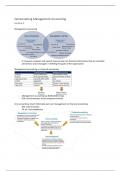
Management accounting
- It measures, analyses and reports financial and non-financial information that are intended
primarily to assist managers in fulfilling the goals of the organization
Management accounting vs. financial accounting
- Management accounting op BU/bedrijfsniveau
- ESG: environmental, social and governmental
Cost accounting: levert informatie aan voor management en financial accounting
- MA: interne kosten
- FA: bv. Voorraadkosten
,Management accounting
- Cost concepts and cost accounting systems
- Cost information for decision making
- Planning and budgeting systems
- Management control & performance issues
Cost-inflation: inflatie door stijgende kosten (corona, oorlog in Ukraine)
Strategic management accounting (SMA): a type of accounting that focuses not only on internal
factors of a company, but factors that are external. This includes industry-wide financials, averages
and upcoming trends
- Costs
- Market trends
- KPI’s
- How to achieve financials and non-financials
- Risk management
- Long-term perspective
The balanced scorecard
- Translates an organization’s mission and strategy into a
comprehensive set of performance measures
- The balanced scorecard does not focus solely on
achieving financial objectives
- It highlights the non-financial objectives that an
organization must achieve in order to meet its financial
objectives
- The scorecard measures an organization’s performance
from four key perspectives
o Financial
o Customer
o Internal business processes
o Learning and growth
Lecture 2
Costs
- “Resource sacrificed to achieve a given objective”
- Usually expressed in monetary terms
- Goal: find out the true costs → crucial for decision making
- Terminology
o Part of cost: giving up an alternative = opportunity cost (als je het ene doet, kan je
het andere niet doen)
o Actual versus budgeted costs
,Responsibility accounting
- If decentralized organization structure → responsibility centers
- Different types of responsibility centers
o Cost center: accountable for costs
o Revenue center: accountable for revenues
o Profit center: accountable for revenues and costs
o Investment center: accountable for revenues, costs and investments
- Choice of responsibility centers is based on the controllability principle: keep
managers/employees accountable for the items they can control
- Who has the best information/knowledge to explain deviations from targets?
o Not: who can we blame for deviations from targets?
Sort costs
- Direct materials
- Direct labor
- Manufacturing overhead
o Management
o Support staff
o Energy and rent
o Depreciation
o R&D
Cost object: ‘thing’ for which cost information is needed
o Products or product lines
o Departments or business unit
o Projects or programs
o Service
o Activity or process
o Customers
- It depends on individual situation or interest
- Cost = sum of monetary values of all resources needed to achieve the cost object
- Cost accumulation → stage 1 → bookkeeping
- Cost assignment → stage 2 → tracing and allocating
- Assigning to departments (cost object) is already difficult, to the product level even more
complex
, Direct vs. indirect costs
- It depends on cost object
o Wage production manager is direct, if cost object is production department
o Wage production manager is indirect, when cost object is product
- Variable vs. fixed is not the same as direct vs. indirect
- Cost driver: a factor that causally affects total costs over a given time span
o Labor hours, units, distance to customer
o Change in level cost driver → change in total cost of cost object
Variable vs. fixed costs
- Time span
o Classification depends on the time horizon
o Costs can be classified as fixed in short run, but variable in the long run
- Relevant range
o Costs can be variable in a certain range, but require additional fixed costs when
range is exceeded
Product cost versus period cost
Product cost will be stated on BS, period costs are
expensed to P&L
Lecture 1
Management accounting
- It measures, analyses and reports financial and non-financial information that are intended
primarily to assist managers in fulfilling the goals of the organization
Management accounting vs. financial accounting
- Management accounting op BU/bedrijfsniveau
- ESG: environmental, social and governmental
Cost accounting: levert informatie aan voor management en financial accounting
- MA: interne kosten
- FA: bv. Voorraadkosten
,Management accounting
- Cost concepts and cost accounting systems
- Cost information for decision making
- Planning and budgeting systems
- Management control & performance issues
Cost-inflation: inflatie door stijgende kosten (corona, oorlog in Ukraine)
Strategic management accounting (SMA): a type of accounting that focuses not only on internal
factors of a company, but factors that are external. This includes industry-wide financials, averages
and upcoming trends
- Costs
- Market trends
- KPI’s
- How to achieve financials and non-financials
- Risk management
- Long-term perspective
The balanced scorecard
- Translates an organization’s mission and strategy into a
comprehensive set of performance measures
- The balanced scorecard does not focus solely on
achieving financial objectives
- It highlights the non-financial objectives that an
organization must achieve in order to meet its financial
objectives
- The scorecard measures an organization’s performance
from four key perspectives
o Financial
o Customer
o Internal business processes
o Learning and growth
Lecture 2
Costs
- “Resource sacrificed to achieve a given objective”
- Usually expressed in monetary terms
- Goal: find out the true costs → crucial for decision making
- Terminology
o Part of cost: giving up an alternative = opportunity cost (als je het ene doet, kan je
het andere niet doen)
o Actual versus budgeted costs
,Responsibility accounting
- If decentralized organization structure → responsibility centers
- Different types of responsibility centers
o Cost center: accountable for costs
o Revenue center: accountable for revenues
o Profit center: accountable for revenues and costs
o Investment center: accountable for revenues, costs and investments
- Choice of responsibility centers is based on the controllability principle: keep
managers/employees accountable for the items they can control
- Who has the best information/knowledge to explain deviations from targets?
o Not: who can we blame for deviations from targets?
Sort costs
- Direct materials
- Direct labor
- Manufacturing overhead
o Management
o Support staff
o Energy and rent
o Depreciation
o R&D
Cost object: ‘thing’ for which cost information is needed
o Products or product lines
o Departments or business unit
o Projects or programs
o Service
o Activity or process
o Customers
- It depends on individual situation or interest
- Cost = sum of monetary values of all resources needed to achieve the cost object
- Cost accumulation → stage 1 → bookkeeping
- Cost assignment → stage 2 → tracing and allocating
- Assigning to departments (cost object) is already difficult, to the product level even more
complex
, Direct vs. indirect costs
- It depends on cost object
o Wage production manager is direct, if cost object is production department
o Wage production manager is indirect, when cost object is product
- Variable vs. fixed is not the same as direct vs. indirect
- Cost driver: a factor that causally affects total costs over a given time span
o Labor hours, units, distance to customer
o Change in level cost driver → change in total cost of cost object
Variable vs. fixed costs
- Time span
o Classification depends on the time horizon
o Costs can be classified as fixed in short run, but variable in the long run
- Relevant range
o Costs can be variable in a certain range, but require additional fixed costs when
range is exceeded
Product cost versus period cost
Product cost will be stated on BS, period costs are
expensed to P&L

