Certified Nurse Dialysis questions with
correct answers
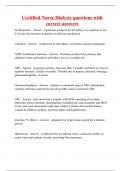
Erythropoetin - Answer a hormone produced by the kidney as a response to low 02 levels; this hormone stimulates erythrocyte production.
Calcitriol - Answer synthesized by the kidney, accelerates calcium production.
ADH/ Antidiuretic hormone - Answer Hormone produced by pituitary that enhances water reabsorption and kidney acts as a receptor for.
ARF - Answer progresses quickly, lasts less than 3 months, and there is a loss of nephron function. Usually reversible. Possibly due to trauma, infection, blockage, glomerulonephritis, or toxins.
Glomerulonephritis - Answer intrinsic or intrarenal type of ARF; dehydration, systemic infection, and trauma are all possible causes of prerenal ARF
CRF - Answer lasts more that 3 months, with GFR remaining at less than 60ml/min, blood chemistry abnormalities including elevated creatinine and BUN levels, and renal ultrasound results that exhibit a smaller than normal kidney. Caused by diabetes mellitus, systemic lupus, and hypertension.
less than 7% HbA1c - Answer optimal level of glycemic control for a diabetic patient
aldosterone - Answer synthesized by the adrenal cortex, causes the kidney to retain water and sodium, thereby increasing blood pressure. parathyroid hormone - Answer increases calcium: phosphate ratio and enhances the calcium level in the blood
estrogen, progesterone, and testosterone - Answer not synthesized by nor received
by the kidney
erythropoietin, calcitriol, and renin - Answer all hormones synthesized by the kidney
bowman capsule - Answer cup-like structure with thin double membrane that surrounds the glomerulus of each nephron.
proteinuria - Answer main sign of glomerulosclerosis, scarring of the glomeruli allows protein to spill into urine; blurred vision, confusion, and restlessness
diabetic nephropathy - Answer albuminuria, periorbital edema, and headaches linked to...
mycobacterium tuberculosis - Answer caseation, sterile pyuria, and hematuria
nephrosclerosis - Answer caused by uncontrolled hypertension, causes narrowing of the arteries and arterioles
symptoms of malignant nephrosclerosis - Answer nausea, vomiting, headache, confusion, blurred vision, and restlessness
symptoms of bladder infection - Answer suprapubic pain, fever, elevated white count, and chilling
correct answers
Erythropoetin - Answer a hormone produced by the kidney as a response to low 02 levels; this hormone stimulates erythrocyte production.
Calcitriol - Answer synthesized by the kidney, accelerates calcium production.
ADH/ Antidiuretic hormone - Answer Hormone produced by pituitary that enhances water reabsorption and kidney acts as a receptor for.
ARF - Answer progresses quickly, lasts less than 3 months, and there is a loss of nephron function. Usually reversible. Possibly due to trauma, infection, blockage, glomerulonephritis, or toxins.
Glomerulonephritis - Answer intrinsic or intrarenal type of ARF; dehydration, systemic infection, and trauma are all possible causes of prerenal ARF
CRF - Answer lasts more that 3 months, with GFR remaining at less than 60ml/min, blood chemistry abnormalities including elevated creatinine and BUN levels, and renal ultrasound results that exhibit a smaller than normal kidney. Caused by diabetes mellitus, systemic lupus, and hypertension.
less than 7% HbA1c - Answer optimal level of glycemic control for a diabetic patient
aldosterone - Answer synthesized by the adrenal cortex, causes the kidney to retain water and sodium, thereby increasing blood pressure. parathyroid hormone - Answer increases calcium: phosphate ratio and enhances the calcium level in the blood
estrogen, progesterone, and testosterone - Answer not synthesized by nor received
by the kidney
erythropoietin, calcitriol, and renin - Answer all hormones synthesized by the kidney
bowman capsule - Answer cup-like structure with thin double membrane that surrounds the glomerulus of each nephron.
proteinuria - Answer main sign of glomerulosclerosis, scarring of the glomeruli allows protein to spill into urine; blurred vision, confusion, and restlessness
diabetic nephropathy - Answer albuminuria, periorbital edema, and headaches linked to...
mycobacterium tuberculosis - Answer caseation, sterile pyuria, and hematuria
nephrosclerosis - Answer caused by uncontrolled hypertension, causes narrowing of the arteries and arterioles
symptoms of malignant nephrosclerosis - Answer nausea, vomiting, headache, confusion, blurred vision, and restlessness
symptoms of bladder infection - Answer suprapubic pain, fever, elevated white count, and chilling